
Ultimate Guide to Labor Management Systems for E-commerce
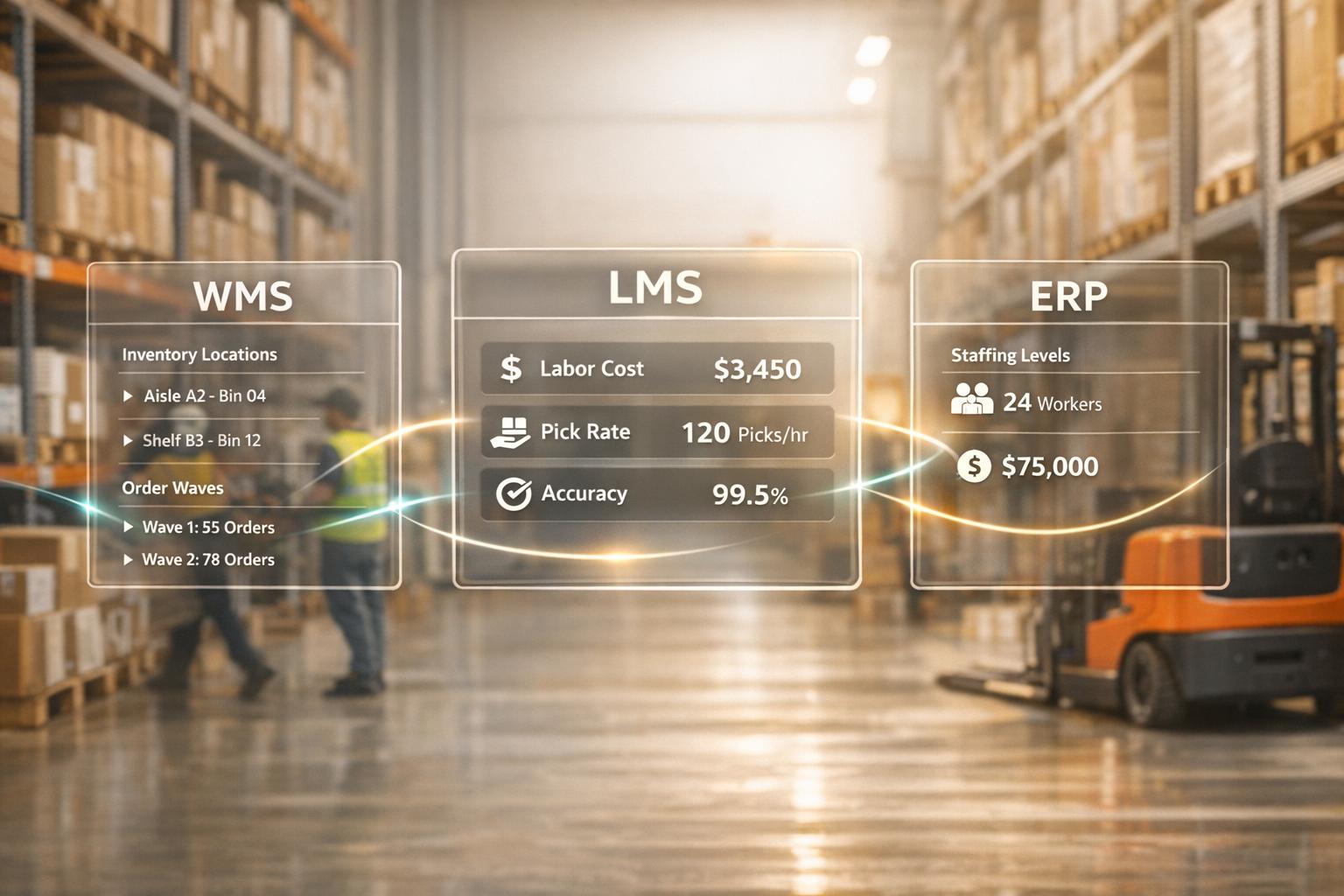
E-commerce businesses face a major challenge: labor costs often account for over 50% of total fulfillment expenses. A Labor Management System (LMS) offers a solution by improving workforce efficiency, reducing costs, and speeding up order fulfillment. This guide breaks down how LMS works, its key features, and the benefits it provides for high-growth e-commerce operations.
Key Takeaways:
- What LMS Does: Tracks employee productivity, assigns tasks dynamically, and integrates with systems like Warehouse Management Systems (WMS) to optimize labor use.
- Cost Savings: LMS can cut labor expenses by up to 15% and deliver a return on investment in 3–6 months.
- Productivity Boost: Features like real-time task assignment, performance tracking, and predictive scheduling help businesses process orders faster and more accurately.
- Scalability: LMS supports businesses during peak demand periods, ensuring efficient labor allocation without increasing workforce size.
- Integration Benefits: When paired with tools like WMS and ERP systems, LMS eliminates inefficiencies and enhances data-driven decision-making.
Whether you're looking to cut labor costs, improve fulfillment speed, or scale your operations, an LMS can transform your workforce into a more efficient and cost-effective resource.

Labor Management System ROI and Cost Savings for E-commerce
How Labor Management Impacts 3PLs & E-Commerce Sellers - Valentine Trent iJility
sbb-itb-eafa320
Core Features of E-commerce LMS
Every feature of a Learning Management System (LMS) in e-commerce - whether it's task assignment or performance tracking - works together to create a streamlined and adaptive operation. These modern systems not only automate processes like scheduling but also provide detailed performance insights that help uncover new efficiencies. Here's a closer look at what makes these systems stand out.
Real-Time Task Assignment and Workforce Optimization
Top-tier LMS platforms assign tasks dynamically, considering factors like worker skills, location, and task priority. Instead of relying on manual decisions, the system directs urgent orders to the nearest qualified worker, cutting down on travel time and reducing idle moments.
A great example of this in action is Spikeball. In 2023, Adam LaGesse, Spikeball's Global Warehousing Director, utilized ShipBob's WMS/LMS features to overhaul their fulfillment process. By automating tasks like carrier selection and managing weight and dimensions, the company went from needing 3–4 people packing all day to just one manager handling all direct-to-consumer orders between 7:00 a.m. and noon.
This kind of real-time task routing lays the foundation for automated scheduling that keeps workloads balanced throughout the day.
Automated Scheduling and Workload Balancing
Modern LMS platforms use historical data on order volumes and productivity to predict hourly staffing needs. This allows managers to adjust staffing levels in real-time to address sudden demand spikes or fill scheduling gaps. Research from Deloitte shows that businesses implementing workforce management solutions strategically can see a 20% boost in productivity and cut labor costs by up to 15%. Even a modest 5% reduction in overtime can translate into significant annual savings.
Once a system ensures efficient scheduling, the next step is monitoring performance through precise tracking tools.
Performance Tracking and Reporting
An LMS tracks key productivity metrics like Units Per Hour (UPH), lines per hour, and deviations from standards at the individual, team, or shift level. With real-time dashboards, managers can quickly identify performance trends, while automated alerts highlight underperforming associates, enabling immediate coaching based on data. For example, Accuristix saved approximately 9% on annual labor costs within six months of adopting the Rebus Labor Management System. Ryan Donoghue, their Director of Operations, noted that the platform was instrumental in pinpointing performance gaps.
"After a little over six months on Rebus LMS, our annualized savings was approximately 9% off labor spending."
- Ryan Donoghue, Director of Operations & Continuous Improvement, Accuristix
Some LMS platforms take engagement to the next level with gamification and pay-for-performance models. Walmart, for instance, doubled its productivity by using the Easy Metrics LMS to implement a pay-for-performance system. According to CEO Dean Dorcas, this approach not only cut costs but also rewarded top-performing employees, leveraging performance data to drive productivity gains.
Benefits of LMS for High-Growth E-commerce Businesses
Labor Management Systems (LMS) offer powerful tools to transform workforce operations, especially for e-commerce businesses experiencing rapid growth. Managing labor effectively becomes a critical challenge as order volumes surge. With the right LMS in place, businesses can turn labor into a flexible and efficient resource, adapting to demand shifts while keeping costs in check.
Cost Reduction and Productivity Gains
Labor accounts for a hefty 30–40% of total fulfillment costs, making it the largest controllable expense in warehouse operations. An LMS tackles this issue by delivering real-time insights into employee attendance, break times, and task activities. This visibility helps managers pinpoint inefficiencies and prevent unnecessary labor expenses. By proactively assigning tasks during shifts, the system minimizes downtime, which can eat away at profit margins. Automation also plays a big role - streamlining workflows and cutting the time spent on manual tasks by as much as 40%. These improvements ensure that every minute of labor counts, driving both cost savings and operational efficiency.
The result? Leaner operations and a foundation for quicker, more precise order fulfillment.
Faster Fulfillment and Higher Accuracy
Efficiency improvements do more than just save money - they directly enhance the customer experience. In e-commerce, speed and accuracy are essential, particularly during peak shopping periods like Black Friday or the holiday season. An LMS ensures real-time task optimization, assigning employees to tasks based on their skills and availability, which helps avoid delays. Automated alerts notify managers about bottlenecks or disruptions, allowing them to act quickly and maintain smooth workflows.
The system also optimizes travel paths within the warehouse, improving picking efficiency. When paired with a Warehouse Management System (WMS), an LMS reduces errors in picking, packing, and labeling by minimizing manual data entry. This integration ensures orders are processed accurately and on time. Additionally, cross-training employees with data-driven insights allows businesses to reallocate labor during high-demand periods. Advanced systems have even achieved productivity rates of up to 400 picks per hour, showcasing how streamlined labor management can meet growing customer expectations.
Scalability to Support Business Growth
As order volumes grow, scalability becomes essential. A modern LMS uses dynamic task assignment and predictive scheduling to meet increasing demand without proportionally increasing labor costs. By analyzing historical data, predictive staffing ensures businesses are prepared for spikes in demand before they occur. Dynamic labor allocation further optimizes staff assignments, maximizing efficiency.
For high-growth e-commerce brands, partnering with a tech-enabled 3PL like JIT Transportation can take scalability to another level. Outsourcing fulfillment to a 3PL reduces per-order costs by 10–25%, while services such as pick & pack, kitting, and nationwide distribution eliminate the need for significant in-house investments. JIT Transportation integrates seamlessly with LMS platforms, providing the infrastructure and technology needed to manage rapid growth without the overhead of expanding warehouse operations. This combination allows businesses to scale efficiently while keeping costs under control.
How to Implement an LMS
Rolling out a Labor Management System (LMS) requires thoughtful planning to ensure minimal disruption and maximum benefits. The process can be broken down into three main steps: understanding your current operations, connecting your technology systems, and preparing your workforce for the transition.
Assessing Your Current Operations
Start by reviewing your existing labor processes, such as scheduling, time tracking, overtime management, and compliance monitoring. Look for manual tasks that slow things down - like managers manually combining reports - since these can often be automated. Travis Hinkle from Rebus highlights this issue as a common pain point for managers working with disconnected systems.
Gather baseline data by analyzing metrics like overtime hours, absentee rates, and scheduling errors over the past 6–12 months. Calculate your labor utilization rate using the formula: (Productive Time / Total Available Time) x 100. Ideally, this number should fall between 75% and 90%. Knowing where you stand helps you measure progress after implementing the LMS.
Involve key stakeholders early in the process - like operations managers, HR, IT, and finance teams - to pinpoint challenges and confirm technical requirements. Also, assess your current hardware, such as time clocks and mobile devices, to ensure they’re ready for real-time data synchronization. This detailed analysis creates a solid foundation for integrating your LMS with other systems.
Integrating LMS with WMS and Other Systems
An LMS works best when it’s seamlessly connected to other platforms, like your Warehouse Management System (WMS) and Enterprise Resource Planning (ERP) system. Each system plays a specific role: the WMS manages tasks like receiving, picking, and shipping, the LMS tracks how efficiently those tasks are performed, and the ERP oversees financials and order lifecycles. For smooth data exchange, use APIs for newer systems and middleware for older ones. Map out data flows to ensure critical details - like bin locations and item dimensions - transfer accurately.
Before fully launching, confirm that your bin location mapping is at least 95% accurate and that your item master includes complete weights and dimensions. Run a phased pilot by testing a single workflow, such as picking or receiving, to validate data accuracy and timing before scaling up. Once live, monitor the system closely to catch and resolve any discrepancies quickly, which helps maintain trust among your team.
Starting with a pilot phase ensures that integration issues are resolved before a full rollout.
Testing and Training for a Smooth Rollout
Even the best technology only succeeds if people use it effectively. After setting up and integrating your LMS, focus on thorough testing and employee training to ensure a smooth transition. Begin with a pilot program involving a cross-functional team to conduct user acceptance testing (UAT), identify any bugs, and gather feedback. Employees should test routine tasks - like checking schedules or completing assignments - to confirm the system is intuitive. Verify that integrations support real-time data updates.
Tailor training sessions to specific roles to demonstrate how the LMS simplifies their work, saves time, and improves accuracy. Provide clear support options, such as help desks, FAQs, and video tutorials, to address questions quickly. Highlight early successes, like reducing overtime admin time by 40%, to build confidence and enthusiasm for the new system. Consider using microlearning modules, which can improve training completion rates from 15% to 90%, making it easier for employees to learn while on the job.
Choosing the Right LMS for Your E-commerce Needs
What to Consider When Selecting an E-commerce LMS
Picking the right Labor Management System (LMS) starts with understanding your operational scale and future growth plans. If you're managing multiple warehouse facilities, multi-location support is crucial. Your LMS should offer a centralized dashboard to avoid data silos and ensure smooth operations across locations. For businesses that experience seasonal spikes - like Black Friday or the holiday season - look for a cloud-native system. This allows for flexible scaling and ensures updates happen without downtime, keeping your operations running smoothly as demand grows.
Rather than being swayed by flashy features, focus on integration capabilities. Your LMS should work seamlessly with your existing systems, such as your Warehouse Management System (WMS) and Enterprise Resource Planning (ERP) software, using APIs or middleware if necessary. Before committing, request a live demo using your actual data. This hands-on approach, combined with a "Day in the Life" (DITL) test simulating peak operations, helps uncover potential bottlenecks and ensures the system aligns with your needs.
Required LMS Features for E-commerce Success
To succeed in e-commerce, your LMS must provide real-time visibility. Features like AI-driven predictive staffing can help forecast labor needs based on order volume trends. Additionally, "dynamic slotting" can optimize warehouse layouts by reorganizing based on SKU velocity and seasonal demand.
Performance tracking is another must-have. Dashboards should monitor key metrics like units processed per hour, order accuracy, and labor utilization rates. Ideally, labor utilization should stay between 75% and 90% for optimal efficiency. Support for mobile apps, RFID devices, and barcode scanning can further streamline operations by reducing manual errors and automating task assignments, minimizing idle time and balancing workloads across shifts. Gamification tools, such as leaderboards and achievement badges, can also boost worker engagement and retention.
Modern LMS systems can significantly enhance efficiency. For example, they can increase picking rates from 50–70 to 100–150 picks per hour and improve inventory accuracy from 85–90% to over 99%. These advancements lead to faster fulfillment times and lower per-order costs, while also setting the stage for partnerships that further enhance your operations.
How JIT Transportation's 3PL Services Complement LMS
Once you’ve identified the LMS features you need, partnering with a specialized third-party logistics (3PL) provider like JIT Transportation can amplify your efficiency. For e-commerce businesses that want to enjoy LMS benefits without managing the infrastructure themselves, this partnership offers a strategic edge. JIT Transportation combines advanced technology with scalable infrastructure, enabling you to tap into enterprise-level labor management without the upfront investment.
JIT Transportation offers value-added services such as pick & pack, kitting & assembly, testing, and white-glove handling. These services operate within optimized labor workflows that mirror the efficiency gains of an LMS, making them a natural extension of your labor management strategy. Their ERP integration capabilities ensure seamless data exchange between your order management system and their fulfillment operations, providing the same level of visibility you’d expect from an in-house LMS.
With strategically located warehouses across the country, JIT Transportation provides the scalability and multi-location support that growing e-commerce businesses require. They also offer vendor-managed inventory (VMI) and returns management (RMA) services to simplify labor management across multiple facilities. By leveraging shared infrastructure and better carrier rates, JIT Transportation can reduce per-order costs by 10–25% compared to in-house fulfillment. At the same time, their solutions maintain the speed, accuracy, and performance tracking that today’s e-commerce landscape demands.
Measuring Success and Optimizing LMS Performance
Key Performance Indicators (KPIs) to Track
Evaluating the success of your LMS begins with identifying the right metrics. With labor accounting for over 50% of a warehouse's total operating costs, it’s essential to focus on a handful of critical KPIs - ideally 5 to 7 - rather than overwhelming your team with excessive data. Among the most important is units per labor hour (UPH), which measures workforce productivity by comparing output to time invested. Another key metric is the order accuracy rate, which should aim for 99.8% or higher to minimize costly returns and rework.
The labor utilization rate - the percentage of productive hours compared to total available hours - should ideally fall between 75% and 90%. Additional metrics worth monitoring include:
- Cost per order
- Labor cost per unit handled, factoring in wages, benefits, and overtime
- Cycle time metrics, such as order cycle time (from pick assignment to staging) and receiving cycle time (dock-to-stock)
- Incident rates, to ensure productivity gains do not compromise worker safety
These KPIs not only measure efficiency but also lay the groundwork for ongoing operational improvements. For instance, a 2021 Forrester Total Economic Impact study revealed that a composite multi-billion-dollar organization with 10,000 employees saved $14 million over three years by implementing Legion’s Workforce Management software, achieving a 13x ROI. Establishing baseline metrics before rolling out an LMS is crucial for accurately calculating similar returns.
Continuous Improvement Through Feedback Loops
Once you’ve established baseline KPIs, continuous feedback loops can help refine operations further. A modern LMS generates actionable data, enabling managers to identify inefficiencies like "missing time" - the gap between paid hours and productive hours, which can exceed 60–90 minutes per employee daily. By integrating data from time clocks, ERP systems, and WMS platforms, these systems provide full operational visibility, compared to the roughly 40% visibility offered by standalone WMS tools. This detailed view often uncovers that 25–40% of total time is spent on indirect activities like meetings or maintenance, highlighting areas for optimization.
When performance falls short of expectations, reason codes can help pinpoint the cause - whether it’s due to training gaps, slotting inefficiencies, or congestion - enabling managers to provide targeted coaching. Sharing real-time metrics via dashboards fosters transparency and shows employees how their roles contribute to broader goals.
One compelling example comes from a May 2025 case study by Logiwa, which demonstrated how their AI Job Optimization tool helped a fulfillment operation cut labor hours by 39.8% (from 1,500 to 902 hours) over an 8-day period, while boosting items picked per hour from 56 to 93. Machine learning-powered feedback loops also refine forecasting and resource allocation as new data is collected. By recalculating ROI annually, you can track performance trends and uncover additional efficiency opportunities, feeding these insights back into your KPI monitoring for a continuous cycle of improvement.
Conclusion
Implementing a Labor Management System (LMS) effectively can transform fulfillment costs into a competitive advantage. With labor expenses making up 30–40% of total fulfillment costs and fulfillment and logistics accounting for 10–15% of total e-commerce revenue, even small improvements can significantly impact profitability. An LMS provides real-time insights into workforce performance, optimizes task distribution, and supports data-driven staffing decisions. This means businesses can handle increasing order volumes without needing to proportionally expand their workforce - an essential factor for companies experiencing rapid growth.
Integration plays a critical role in maximizing the benefits of an LMS. When connected with Warehouse Management Systems (WMS), ERP platforms, and payroll systems, it eliminates data silos. This seamless connection allows businesses to track vital metrics like units per labor hour, order accuracy rates, and cost per order, leading to more informed decision-making.
For businesses looking to further enhance their operations, partnering with a third-party logistics (3PL) provider that uses advanced labor management tools can yield immediate results. JIT Transportation, for example, combines state-of-the-art LMS capabilities with robust 3PL services, including distribution and fulfillment, pick and pack, kitting and assembly, and ERP integration. Their approach enables clients to achieve optimized cost-per-order benchmarks of $3.50–$5.00 - well below the $5.00–$8.00 average seen in standard setups.
FAQs
Do I need an LMS or just a WMS?
A Warehouse Management System (WMS) and a Labor Management System (LMS) serve different purposes, so the choice depends on what you need most. A WMS helps with tasks like inventory management, order processing, and overall warehouse operations. On the other hand, an LMS is designed to improve workforce efficiency, manage labor costs, and boost employee performance.
If your main goal is to streamline labor productivity, an LMS is the way to go. But for a more all-encompassing solution, combining both systems can deliver the best results by addressing both operational and workforce challenges.
What data do I need before implementing an LMS?
Before rolling out a Labor Management System (LMS), it's essential to collect some critical data. Start with your current labor utilization rate - this measures productive time against total available time. Next, review key warehouse performance metrics like picking accuracy, order fill rates, and labor costs per unit. Don't overlook employee engagement levels, as they can impact productivity and morale.
This data serves as a foundation to pinpoint inefficiencies, establish benchmarks, and customize the LMS to better streamline your operations.
How long does it take to see ROI from an LMS?
The timeline for seeing a return on investment (ROI) from a Labor Management System (LMS) largely depends on the specifics of your operations and the system's scope. Many companies start noticing improvements in labor efficiency within 3 to 6 months after full deployment. More substantial ROI - like lowered labor costs and improved performance management - typically becomes evident within 6 to 12 months, as the system fine-tunes workflows, scheduling, and coaching processes.
Related Blog Posts
Related Articles

8 Ways 3PLs Handle Seasonal Workforce Swings

Marketplace API vs EDI for Fulfillment
