
Container Unloading and Storage Near Los Angeles Port

The Port of Los Angeles, processing 40% of U.S. containerized imports, plays a major role in supply chains for goods like electronics and apparel. However, businesses face challenges like terminal congestion, tight storage space, and costly delays from demurrage and detention fees. Here's how you can streamline operations:
- Plan Ahead: File customs documents early and secure terminal appointments to avoid delays.
- Drayage Optimization: Use strategies like dual transactions to cut costs and reduce inefficiencies.
- Fast Unloading: Aim for same-day unloading to minimize detention fees and accelerate inventory flow.
- Choose the Right Storage: Port-proximate warehouses enable faster turns, while Inland Empire facilities offer lower costs for slower-moving goods.
- Integrated Solutions: Work with 3PL providers offering combined drayage, transloading, and value-added services for smoother operations.
Key Considerations:
- Drayage costs range from $350 to $800 per container.
- Demurrage fees start at $75/day and escalate after six days.
- Warehouses near the port cost $1.40–$2.00 per sq. ft. monthly, while inland options are cheaper but increase drayage expenses.
Pro Tip: Consolidate logistics under one provider to reduce errors and improve efficiency. Facilities like JIT Transportation, located 29 miles from the port, offer on-site container yards and integrated technology for real-time tracking, ensuring faster and more accurate operations.
Port of Los Angeles Port of LA, Port of Long Beach Container Ships, Shipping Containers 2020 to 2021

sbb-itb-eafa320
Key Steps in Container Unloading Near the Los Angeles Port
Moving containers from the terminal to the warehouse involves a series of steps that need to flow smoothly to avoid delays and extra costs. Here's how the process works:
Pre-Arrival Planning and Scheduling
Preparation begins long before the ship reaches port. Importers are required to file the Importer Security Filing (ISF) at least 24 hours before the vessel is loaded at its origin. Missing this deadline can lead to customs holds, delaying your shipment once it arrives.
After submitting the manifest, it’s a smart move to pre-clear customs as early as possible. Filing the entry summary (CBP Form 7501), along with the Bill of Lading, Commercial Invoice, and Packing List, while the ship is still at sea gives U.S. Customs and Border Protection (CBP) time to address any potential issues.
Additionally, securing a terminal appointment is crucial. Most terminals in Los Angeles and Long Beach require pre-scheduled pickup times, and these slots fill up fast during busy periods. Using tools like the Port of Los Angeles "Signal" platform, which provides real-time vessel tracking and volume forecasts, can help you plan when containers will be available. Proper scheduling ensures that drivers arrive at the terminal when the container is ready and at the warehouse during its receiving window, avoiding unnecessary costs and delays.
Drayage and Inbound Transportation
Once customs clearance and terminal appointments are set, the focus shifts to drayage, which involves short-haul trucking from the terminal to the warehouse. In the Los Angeles/Long Beach area, drayage costs typically range from $350 to $800 per container, depending on factors like distance, weight, and terminal fees.
To cut costs and improve efficiency, many companies use the "dual transaction" model. Here, a driver drops off an empty container and picks up a loaded one in the same trip, reducing wasted mileage and keeping equipment in motion. For dense cargo, the Overweight Container Corridor allows trucks to carry up to 95,000 lbs with proper permits, minimizing the number of trips required.
"Speed comes from total cycle time, not just miles." - SHIPIT Logistics
Scheduling morning gate appointments can also save time. Afternoon congestion at the LA/Long Beach terminals often adds 3 to 4 hours of wait time per truck. This not only inconveniences drivers but also eats into your Last Free Day (LFD) and increases the risk of detention fees.
Unloading and Dock Operations
Even after the container reaches the warehouse, efficiency remains key. Aim for same-day stripping - unloading the container on the day it arrives. This reduces detention fees, which can range from $75 to $150 per day, and gets your inventory into circulation faster.
Warehouse setup plays a big role in how quickly containers can be processed. Facilities near the port should have enough dock doors and staging areas to handle sorting, palletizing, or preparing outbound shipments without delays. A well-run warehouse can typically unload and process a standard 40-foot container within 24 to 48 hours. Slower processing times can disrupt your ability to meet customer demands.
Labor flexibility is another critical factor. Floor-loaded containers, which are common with imports from Asia, require more manual effort than palletized freight. Having a staffing plan that adjusts to your inbound schedule can prevent backlogs when multiple containers arrive at once. Tracking metrics like your same-day strip rate and live unload turnaround time helps identify where processes are efficient and where improvements are needed.
Storage Options Near the Los Angeles Port
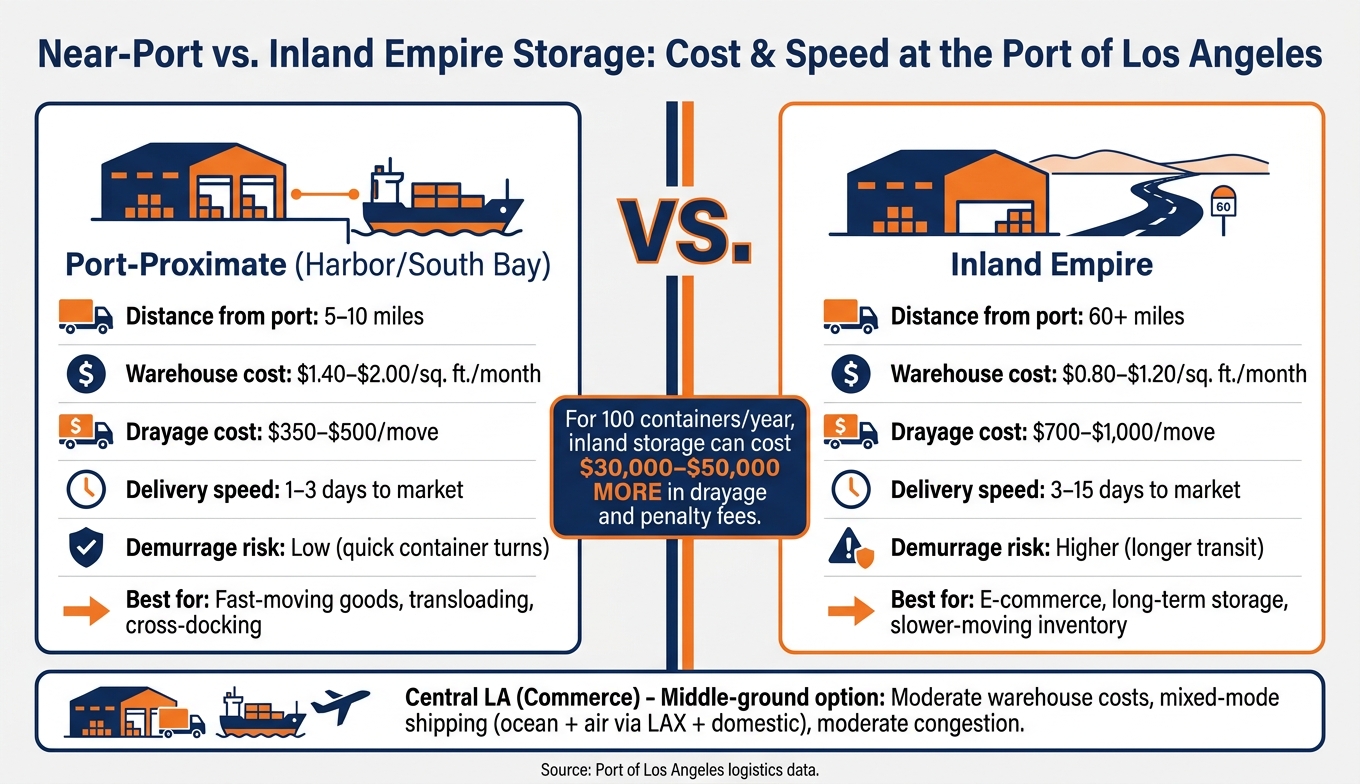
Near-Port vs. Inland Empire Warehousing: Cost & Speed Comparison Near LA Port
After unloading your containers, the next step is deciding where to store your freight. This choice directly affects costs, delivery speed, and operational risks.
Types of Storage Facilities
There are three primary storage options near the Los Angeles port, each catering to specific needs. Port-proximate warehouses in the Harbor and South Bay areas are located just 5–10 miles from terminals. These facilities are ideal for quick container turns, transloading, and cross-docking, which help reduce dwell time and avoid costly demurrage fees - typically $100–$200 per container per day. Regional distribution centers in the Commerce and Central LA areas offer a middle-ground solution. They provide access to ocean freight, air cargo via LAX, and local delivery routes. Lastly, Inland Empire facilities, further east, are known for their spacious yards and lower costs. These are best suited for e-commerce operations and managing slower-moving inventory.
"Near-port warehousing is rarely just a real estate decision. It is a decision about drayage execution, transloading speed, labor cutoffs, customs readiness, and how many handoffs you are willing to manage." - SHIPIT Logistics
The best option depends on your cargo's turnover rate. Fast-moving goods perform well in port-proximate locations, while slower-moving stock is better suited for inland storage.
- Port-Proximate Facilities (Harbor/South Bay): Best suited for rapid container turns and transloading operations; the tradeoff is higher operating costs and limited yard space
- Central LA (Commerce): Ideal for mixed-mode shipping that combines ocean, air, and domestic transportation; however, facilities in this area often face moderate congestion challenges
- Inland Empire Facilities: Well-suited for e-commerce fulfillment, long-term inventory storage, and scalable operations; tradeoffs include higher drayage costs and longer transit times to and from the ports
For specialized cargo, there are facilities offering temperature-controlled areas, food-grade certifications (GMP/SQF), and HAZMAT storage. Always confirm that a warehouse holds the necessary certifications if you're handling regulated goods. Choosing the right facility can streamline your inventory processes and reduce delays.
Inventory Management for High-Growth Businesses
Once you've selected a storage facility, efficient inventory management becomes the next priority. Near-port storage should integrate seamlessly with your fulfillment process, not just act as a holding area. Techniques like cross-docking, where freight moves directly from inbound containers to outbound trailers, can cut delivery times to 1–3 days compared to the 3–15 days often required by inland warehousing.
To optimize operations, position fast-moving SKUs near dock doors for quicker picking and packing. Partnering with scalable 3PL services and using a warehouse management system (WMS) that integrates via API or EDI provides real-time inventory tracking. Additionally, aligning warehouse receiving hours with port schedules can help avoid detention fees and next-day unload delays.
Risk Management for Stored Goods
Protecting your goods during storage is just as important as efficient handling. Look for facilities with strong physical security measures, such as CCTV, keycard access, and visitor ID systems. For fire safety, ensure the warehouse is equipped with ESFR (Early Suppression Fast Response) sprinklers, particularly if you're storing high-density items.
If your inventory includes regulated or sensitive goods, verify that the facility has the proper certifications. SQF certification is necessary for food-grade storage, while EPA and DOT permits are required for HAZMAT materials. For bonded freight or duty deferral, consider facilities within Foreign-Trade Zone (FTZ) 202, managed by the Port of Los Angeles. This zone covers over 5,400 acres and includes 35 general-purpose sites across Los Angeles, Orange, and Riverside counties. Scalable 3PL services can assist with compliance across various facility types, ensuring smooth operations.
How 3PLs Support Port-Centric Operations
Handling container unloading and storage near the Port of Los Angeles is no small task. It involves coordinating drayage schedules, warehouse receiving windows, customs clearance, and outbound distribution. When these responsibilities are spread across multiple vendors, even a single misstep - like a missed terminal appointment - can lead to costly demurrage fees and delayed fulfillment. This highlights the importance of a streamlined, integrated approach to container processing.
"The LA gateway punishes fragmented responsibility. When ocean or air freight, drayage, transloading, warehousing, and outbound trucking are all handled by different parties, the gaps show up as missed cutoffs and finger-pointing." - SHIPIT Logistics
3PL Services for Port Operations
A well-equipped third-party logistics provider (3PL) simplifies operations by combining drayage and warehousing under one roof. JIT Transportation, for example, operates a facility strategically located to reduce congestion and streamline these processes. Without proper staging, containers can pile up at the gate, causing drayage drivers to miss return windows and leading to per-diem fees.
Short-haul drayage, when coordinated effectively, can cut costs by as much as 50%, significantly lowering the risk of missed empty container returns. By aligning drayage schedules with warehouse receiving times, delays are minimized. This synchronized approach not only avoids bottlenecks but also lays the groundwork for efficiency-driven services and better digital oversight.
Value-Added Services
JIT Transportation takes this coordination a step further by offering on-site value-added services. These include kitting and assembly, pick and pack, testing and revision upgrades, and white-glove handling. With these services, inventory can become retail-ready immediately after unloading, eliminating the need to ship components to a separate facility for pre-assembly.
This setup speeds up the supply chain significantly. Near-port transloading - where goods move directly from import containers into domestic trailers - can get products to market 2 to 12 days faster compared to traditional inland warehousing models. Additionally, same-day container stripping helps return empty containers to the terminal faster, reducing detention and per-diem fees, which can range from $100 to $200 per container per day.
Technology Integration for Real-Time Visibility
Technology ties everything together, creating an end-to-end solution for seamless port operations. Speed and precision depend on real-time data, and JIT Transportation achieves this by integrating its Warehouse Management System (WMS) and Transportation Management System (TMS) with client ERP systems via APIs and EDI connections. This enables real-time tracking at the order, pallet, and part levels. Automated alerts ensure quick responses to any issues that arise.
For businesses managing omni-channel fulfillment, JIT provides pre-built integrations with platforms like Shopify, Amazon FBA, WooCommerce, and Magento. This connects port-level operations directly to customer-facing order management, ensuring a smooth flow from the dock to the doorstep.
Cost, Performance, and Risk in Near-Port Operations
For businesses moving containers through the Port of Los Angeles, understanding what drives costs and eats into margins is crucial. Decisions about warehouse location, drayage partners, and unloading methods can significantly impact your bottom line.
Cost Drivers and Ways to Reduce Expenses
Location is a major factor. Warehouses near the port typically cost $1.40–$2.00 per square foot per month, compared to $0.80–$1.20 in the Inland Empire. However, inland storage comes with higher drayage costs - $700–$1,000 per move versus $350–$500 for local moves. For a business handling 100 containers annually, this can mean an extra $30,000–$50,000 in drayage and penalty fees.
Avoiding terminal penalties is another way to cut costs. Same-day stripping not only prevents these fees but also frees up chassis for the next move.
"If your inventory is stuck in a container 60 miles away, you can't sell it. Every day your product spends in transit is a day it isn't generating revenue." - Fulfillment Express
These cost considerations highlight the importance of tracking performance metrics to optimize operations.
Performance Metrics to Track Success
To ensure smooth operations, monitor these key performance indicators:
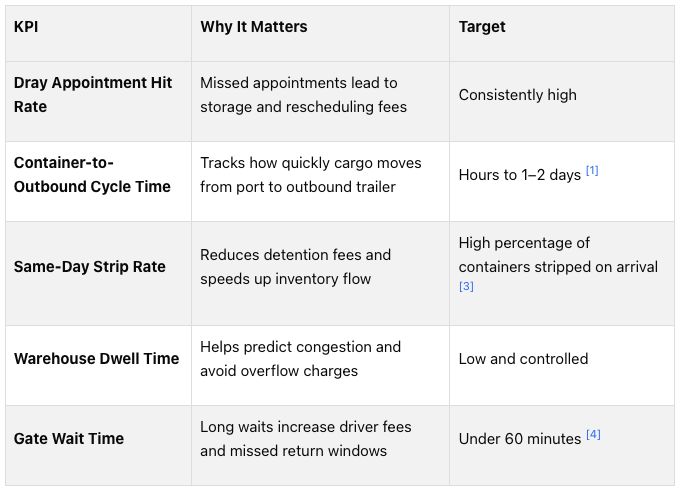 Among these, container-to-outbound cycle time is especially critical. Near-port transloading can move products to market in 1 to 3 days, compared to the 3 to 15 days typical of inland warehousing. For e-commerce businesses, this speed can be a game-changer when meeting tight delivery windows.
Managing Risks in Port-Proximate Logistics
Operational efficiency is only part of the equation - managing risks is just as important. Near the Port of Los Angeles, fragmented vendor management is a common issue. For example, a missed terminal appointment can lead to demurrage charges, while delayed unloading results in chassis per-diem fees. Consolidating these functions under a single provider ensures accountability at every step.
Chassis availability is another critical factor. Roughly 85% of chassis at the LA port complex come from three main pools, and shortages are common during peak seasons. Partnering with an asset-based drayage provider that owns its own chassis can significantly reduce this risk. Additionally, ensuring your warehouse has enough yard depth and dock capacity to handle large vessel discharges - sometimes 30 to 40 containers at once - helps avoid bottlenecks that could lead to detention fees.
For businesses handling high-value or high-volume goods, a Foreign Trade Zone (FTZ) near the port offers financial advantages. FTZs allow importers to defer, reduce, or even eliminate duties until the goods are officially entered into U.S. commerce.
Conclusion: Building Efficient Container Operations Near Los Angeles Port
Managing container movement at the Port of Los Angeles is no small feat. With challenges like tight terminal schedules, chassis shortages, demurrage fees, and fragmented vendor coordination, maintaining profitability can become a real struggle. The key to overcoming these hurdles lies in creating a streamlined, well-integrated logistics system. This is where near-port solutions shine.
When it comes to efficiency, proximity and integration consistently outperform isolated fixes. A near-port facility equipped with robust yard management, real-time tracking via an integrated Warehouse Management System (WMS), and an on-site container yard offers clear advantages over traditional inland setups. By reducing total landed costs, near-port transloading enables quicker deliveries and more competitive pricing, as previously highlighted.
A great example of this approach is JIT Transportation's facility near Los Angeles. Just 29 miles from the Port of Long Beach, it boasts 26 dock doors, a 32-foot clear height, and an on-site container yard. These features are paired with API-connected WMS and live dashboards, ensuring immediate access to inventory data.
"Speed matters. Accuracy matters more." - JIT Transportation
FAQs
How do I avoid demurrage and detention at the Port of Los Angeles?
To steer clear of demurrage and detention fees at the Port of Los Angeles, teaming up with a 3PL close to the port can make a big difference. This proximity helps cut down transit delays and allows for greater flexibility. Choose a provider who prioritizes early terminal appointments, works closely with drayage carriers to ensure timely pickups, and extends receiving hours to accommodate your schedule. Warehouses equipped with real-time tracking systems and on-site container yards can also streamline unloading and speed up the return of empty containers, reducing detention costs.
Should I store freight near the port or in the Inland Empire?
The decision comes down to your business model and inventory priorities. Port-proximate storage works best for companies that frequently import, need quick turnaround times, and want to cut drayage costs. This option also helps reduce port dwell times and avoid per-diem fees. On the other hand, Inland Empire storage is a better fit for businesses aiming to save on costs for large, long-term inventory or those focusing on inland B2B markets rather than fast delivery.
What KPIs should I track to improve container cycle time?
To make container cycle times more efficient at the Port of Los Angeles, focus on tracking a few important metrics. Start with port dwell time and drayage cycle time to ensure containers keep moving without unnecessary delays. Keep an eye on gate turn times and chassis availability to identify and resolve potential bottlenecks before they slow things down.
Additionally, evaluate your warehouse's transload velocity by measuring how quickly containers are processed from arrival to outbound loading. At the same time, prioritize inventory accuracy to avoid delays and extra costs that could disrupt operations.
Related Blog Posts
Related Articles
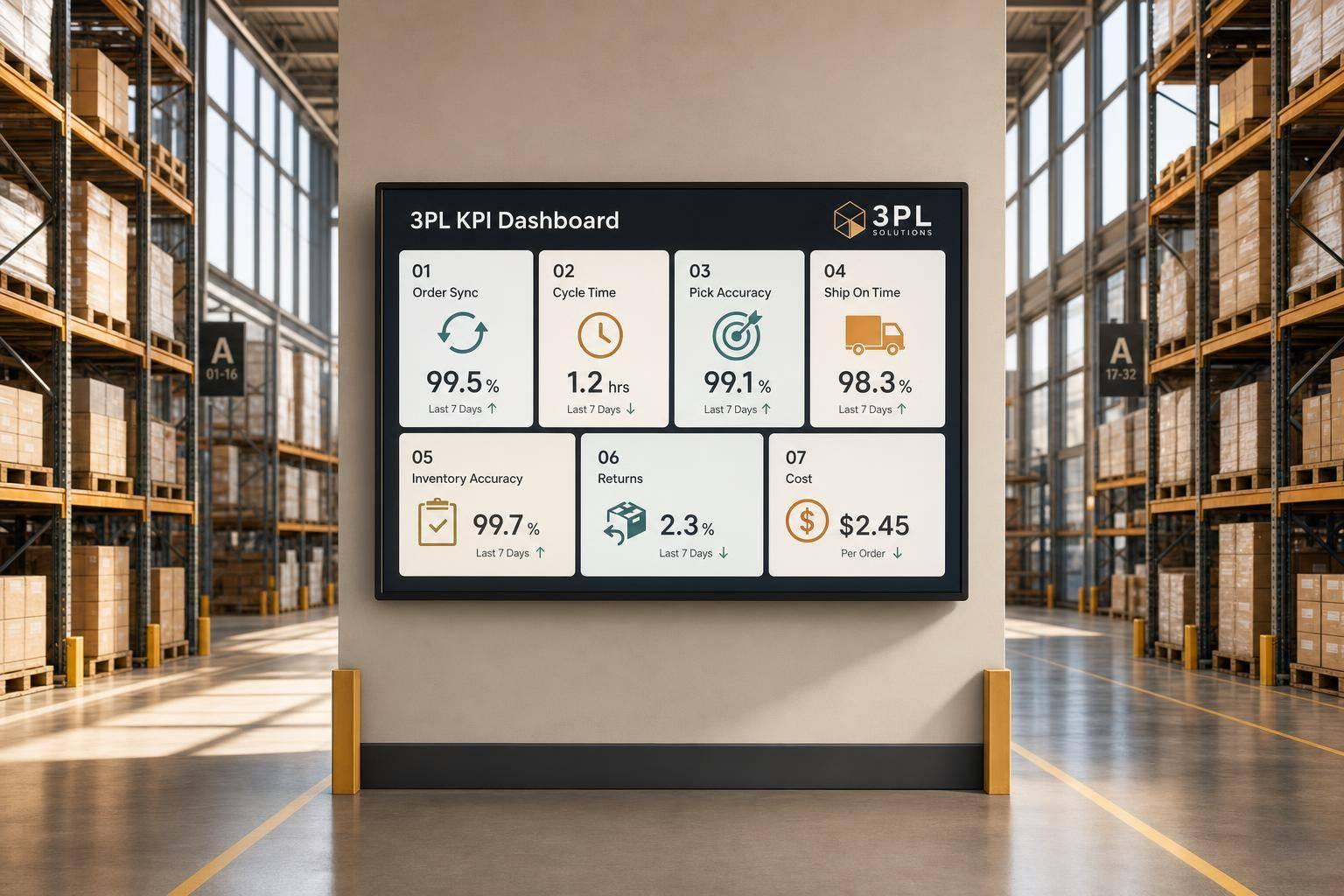
7 WooCommerce 3PL KPIs Teams Track

Centralized vs Decentralized Replenishment
