How Demand Pricing Cuts Peak Season 3PL Costs

Peak season 3PL costs don’t jump by accident - they jump when volume, timing, labor, and carrier choices fall outside plan. If I want to keep margin from getting squeezed in Q4, I need to do four things early: map my base costs, set demand bands, price late or unplanned work, and match carrier and labor decisions to those rules.
Here’s the short version:
- Build a clean baseline from 2–3 years of invoices from October 1 to January 31
- Split base fees from peak add-ons, like storage uplifts, overtime, rush handling, and carrier surcharges
- Set demand bands such as:
- Baseline: 0%–110%
- Elevated: 110%–150%
- Surge: 150%–200%
- Extreme surge: 200%+
- Use pricing to move work earlier, including promotions, inbound receipts, and project work
- Set firm order cutoffs to avoid rush handling that can run 50% to 200% above standard rates
- Charge more for unplanned inbound and urgent projects, often at 1.5x to 2.0x
- Route orders by landed cost, not habit, since carrier peak fees can add 10%–15%
- Tie labor to demand bands, with flex shifts and weekend coverage only when volume crosses set thresholds
- Lock the playbook 8–10 weeks before peak and review results after the season ends
A few numbers make the problem plain. Many 3PLs add 10%–30% peak surcharges. Residential and fuel fees can tack on 10%–15% more to parcel cost. And logistics often sits at 8%–12% of e-commerce revenue even before peak pressure hits.
If I sum it up in one line: demand pricing works when I use it to shape order flow before the warehouse gets tight and fees stack up.
| Area | What I focus on | Why it matters |
|---|---|---|
| Cost baseline | Base fees vs. peak surcharges | Shows where margin leaks start |
| Demand bands | Baseline, elevated, surge, extreme surge | Sets the trigger points |
| Cutoffs | Same-day and expedited order deadlines | Cuts rush handling charges |
| Inbound rules | Planned vs. unplanned arrivals | Lowers overtime and dock disruption |
| Carrier mix | Ground, air, regional, zone-skip | Keeps shipping cost in check |
| Labor timing | Core shifts, flex shifts, weekend work | Lines staffing up with volume |
| Review | Cost per order, on-time ship rate, surcharge spend | Shows what to keep or change |
That’s the core play: plan the cost bands, set the rules early, and make each late decision carry a clear price.
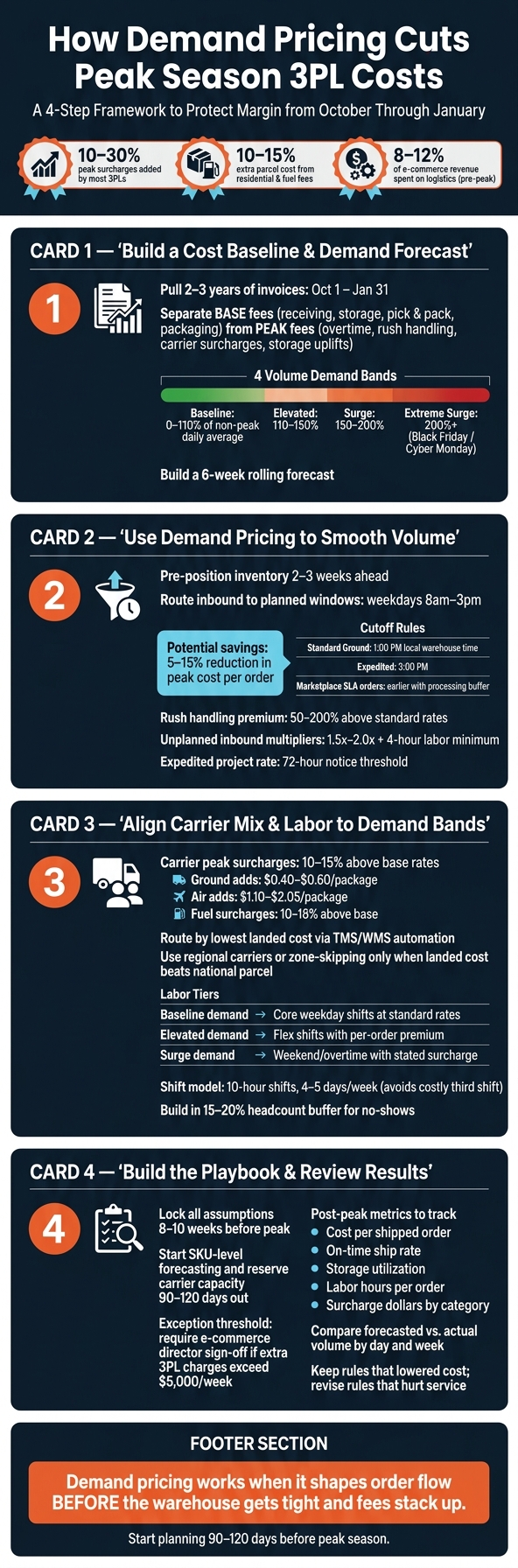
Peak Season 3PL Demand Pricing Playbook: 4-Step Cost Control Framework
Pallet Side Chat: A 10-Point Carrier Strategy for Peak Season
sbb-itb-eafa320
Step 1: Build a Peak Season Cost Baseline and Demand Forecast
Start with your invoice data and sort every charge into the right bucket. That gives you a clean cost baseline. And you’ll use that baseline to set pricing triggers in Step 2.
Separate Base 3PL Fees from Peak Surcharges
Pull two to three years of invoices covering October 1 through January 31. Then tag each line item as either base or peak.
Your base bucket should include:
- Receiving fees
- Monthly pallet, bin, or cubic-foot storage
- Standard pick and pack labor
- Packaging materials
Your peak bucket should hold the extra charges that show up when volume jumps. That includes priority receiving fees, same-day putaway, storage rate uplifts, overtime labor charges, accessorials like rework or relabeling, and carrier peak surcharges such as residential peak, large package, additional handling, and fuel surcharges.
Once you’ve sorted everything, calculate peak cost per order by service level, weight, and SKU. This is where the picture gets clearer. If you skip this step, your demand pricing triggers can miss the costs that hurt margin the most. A solid cost map shows where pricing changes should land first.
Map Order Volume by Day, Week, SKU, and Service Level
Next, pull order-level data from your e-commerce platform, OMS, and WMS for at least one full peak season. Join that data with carrier billing so each order shows its full cost stack, including billed weight, dimensional weight, service used, and line-item surcharges.
Build views that show daily volume by service level. Then flag the days when expedited, heavy, or oversize orders jump. Break orders into segments by service level, such as standard ground, 2-day, and next-day. Also group them by weight and size bands using pounds and inches.
That makes it much easier to spot which SKUs cost the most during peak. In many cases, the problem isn’t the product itself. It’s that the item is heavy, bulky, or often ships expedited. Once you can see that pattern, you can set higher rates or tighter rules for those costly orders.
Then use that view to decide which orders need higher rates or earlier cutoffs.
Set Volume Bands for Baseline, Elevated, and Surge Demand
With your historical data in place, define three to four volume thresholds based on your actual daily order averages:
- Baseline: 0–110% of your non-peak average daily volume (February through September)
- Elevated: 110–150% of non-peak average, common on mid-peak days
- Surge: 150–200% of non-peak average, covering your top 10% of historical peak days
- Extreme surge: above 200%, held for events like Black Friday and Cyber Monday
Then pressure-test those thresholds against your sales and marketing calendar. If you’re launching a new product in November or planning a bigger holiday promotion than last year, your surge band should reflect that. Build a 6-week rolling forecast around baseline, elevated, and surge demand.
These bands will later trigger pricing changes, labor shifts, and cutoff rules in the next step.
Step 2: Use Demand Pricing to Smooth Volume Before Costs Climb
With the baseline and demand bands from Step 1 in place, demand pricing turns your forecast into clear rate triggers. The goal is simple: push orders and inbound work into planned windows before surcharge-heavy weeks arrive. When pricing is set up well, brands have a direct financial reason to keep volume inside those bands from Step 1. That usually means fewer fire drills, less overtime, and less dock congestion when peak weeks hit.
Tie Lower Pricing to Forecasted Order and Inbound Volume
The target here is to keep daily volume inside a planned range. If your 3PL can staff around a known band, it doesn't have to lean on temp labor. That predictability is what makes lower per-unit pricing possible.
A few moves help make that happen:
- Spread promotions across several days
- Pre-position inventory 2 to 3 weeks ahead
- Route inbound shipments into planned receiving windows, such as weekdays between 8:00 a.m. and 3:00 p.m.
That gives your 3PL enough notice to staff the floor the right way and helps you avoid weekend or after-hours fees. It can also cut peak season cost per order by 5% to 15%. Some 3PLs also offer better rates when weekly volume stays within ±10% of the submitted forecast.
Once volume is spread across the week, cutoff timing becomes the next pressure point. A few late-day orders can push work into premium handling fast.
Set Cutoff Rules That Reduce Rush Handling Charges
A cutoff rule should spell out exactly when an order needs to be inside the 3PL's WMS to qualify for same-day processing at standard rates. Orders that miss that window turn into premium exceptions. And those exceptions add up. Expedited processing premiums for true rush orders can run 50% to 200% above standard handling rates.
One workable setup looks like this:
- Standard ground shipping cutoff: 1:00 p.m. local warehouse time
- Expedited shipping cutoff: 3:00 p.m.
- Marketplace orders with strict SLAs: even earlier, so there's a processing buffer
During the heaviest peak weeks, moving cutoffs back by one hour can cut rush-fee exposure in a meaningful way. On the front end, site countdown timers should match the 3PL's real cutoffs. That nudges late-day shoppers toward next-day shipping instead of promising same-day service that triggers exception handling behind the scenes.
Those pricing rules don't just shape order flow. They also affect carrier choice and labor planning.
Price Unplanned Inbound and Urgent Requests Explicitly
Cutoff rules help on the outbound side. Explicit inbound pricing does the same job for receiving and project work. Late containers, unscheduled truck arrivals, and last-minute special projects are some of the easiest peak-season costs to prevent. If a container shows up on a Saturday evening with no dock appointment, the 3PL may have to pull people off outbound picking or pay overtime to deal with it. One bad arrival can throw off the whole week.
A well-built rate card separates standard receiving windows from non-standard ones. For after-hours or weekend arrivals, premium multipliers of 1.5x to 2.0x are common, along with minimum labor charges like a 4-hour minimum per worker for unscheduled work. Unscheduled truck arrivals may also come with a per-event surcharge.
The same logic applies to value-added services like kitting, relabeling, and promo bundling. Set one rate for standard project work scheduled 1 to 2 weeks in advance, and a higher expedited project rate for anything requested during peak weeks with less than 72 hours' notice. Put those fees directly into the contract by scenario. When the cost of a late decision is plain to see, people tend to change behavior fast.
These same volume rules should shape carrier mix and labor timing in Step 3.
Step 3: Align Carrier Mix and Labor Timing to Demand-Based Rates
Step 2 set the pricing triggers. Step 3 puts those triggers to work in day-to-day carrier and staffing choices that protect margin during peak. Once the pricing rules are in place, carrier and labor plans need to follow them.
Adjust Carrier and Service Mix Based on Surcharge Exposure
Not every order needs the fastest shipping option. During peak season, paying for speed you don't need is one of the easiest ways to let costs creep up.
Major parcel carriers can push shipping rates up by 10%–15% during peak. Some ground services add $0.40–$0.60 per package, while air shipments can add $1.10–$2.05 on top of base rates. Fuel surcharges may also add about 10%–18% above base carrier pricing.
The goal is simple: route each order to the lowest-cost service that still hits the delivery promise. Keep express service for paid upgrades or for ground shipments that can't arrive on time. Your demand bands should also guide when to move from standard parcel to regional carriers or zone-skipped routing. Use regional carriers or zone skipping only when landed cost comes in below national parcel pricing.
This should not be a manual exercise. Run routing rules through your TMS or WMS so each order is assigned based on landed cost and promised transit time.
Once routing is lined up, staffing should track that same demand pattern.
Match Labor Schedules to Your Demand Volume Bands
Static labor schedules are a bad fit for peak. They leave you paying for labor when volume is light, then scrambling when volume jumps.
A better setup is to size core shifts around baseline demand and turn on added labor only when forecasted or live volume moves into elevated or surge bands. In practice, that usually means core weekday shifts cover normal volume. Flex shifts start only after demand crosses the elevated threshold. Weekend windows stay reserved for true surge periods, like Black Friday weekend and the final shipping days before major holidays.
One staffing model recommends stretching shifts to 10 hours, four or five days per week, during peak instead of adding a third shift, since third-shift fixed costs often come in higher than overtime premiums.
Earlier cutoffs and peak surcharges should trigger flex shifts, overtime, or weekend coverage. It also helps to build in a 15%–20% headcount buffer for no-shows and productivity dips tied to order complexity.
Each labor tier should connect directly to a rate in your demand pricing agreement:
- Baseline labor at standard rates
- Flex shifts with a defined per-order premium
- Weekend or overtime work with a stated surcharge
That kind of clarity matters. It makes the cost of a flash sale or a tighter cutoff plain before you commit to it.
Where JIT Transportation Fits Into a Peak Season Plan
JIT Transportation can support demand-based routing, flex staffing, and coordinated pickups through integrated transportation, distribution, fulfillment, and value-added services such as pick & pack, kitting & assembly, testing, and white glove handling. Because transportation and fulfillment sit together, JIT can line up cutoff planning, carrier pickups, and processing schedules in one plan. That gives brands a single cost view instead of scattered decisions that quietly push peak spend higher.
JIT recommends starting demand forecasting at the SKU level, reserving carrier capacity, and setting staffing tiers 90–120 days before peak.
These rules should feed straight into your peak-season playbook.
Step 4: Build a Peak Season Demand Pricing Playbook and Review Results
Carrier and labor rules don’t help much if they live in someone’s head or get buried in old emails. You need one playbook your team and your 3PL can use every peak season without rebuilding the process from scratch.
Document Pricing Triggers, Operating Rules, and Escalation Points
Once your bands, cutoffs, and labor rules are set, put them into one peak-season playbook. This gives your team a single source of truth for the decisions made in Steps 1–3, plus the calls that need to be made before peak begins.
Write down your approved bands, cutoffs, and surcharge triggers in one place. Include the surge multipliers that kick in when volume jumps, when a flash sale gets added within 72 hours, or when inbound volume comes in more than 20% above the locked forecast.
Lock these assumptions 8–10 weeks before peak so your 3PL has time to plan labor and capacity around them. For each trigger, name the data source that confirms it, such as:
- WMS order timestamps
- Carrier scan data
- Your forecast file
Just as important, assign an owner for each trigger so there’s no confusion about who confirms when a band or multiplier is live.
Exception rules matter too. Be clear about what counts as an exception, how much extra cost you’re willing to accept, and who has approval authority. If an exception is likely to add more than $5,000 in extra 3PL charges in a week, require sign-off from your e-commerce director.
Track the Metrics That Show Whether Demand Pricing Worked
After peak ends, compare the playbook to what actually happened on the floor and on the P&L. The goal is simple: see which rules cut cost without hurting service.
Track cost per shipped order, on-time ship rate, storage utilization, labor hours per order, and surcharge dollars by category. Break those numbers out by band and by week so you can see what worked and where things went sideways.
Then compare forecasted vs. actual volume by day and week. Tie each demand pricing decision to an outcome you can measure. For example, note which cutoff changes reduced rush charges without hurting on-time delivery. And if a carrier shift saved $0.50 per order but pushed late deliveries past your threshold, flag it and adjust the routing rule.
Conclusion: Control Peak Season Costs Without Cutting Service
The last step is straightforward: keep the rules that lowered cost and change the ones that didn’t.
FAQs
How do I set the right demand bands?
Analyze 12–24 months of past order data by SKU, channel, and destination region. Start with last year’s weekly unit sales as your baseline, then layer in year-over-year growth to build three demand scenarios: conservative, base, and aggressive.
Then turn those demand scenarios into three labor tiers: baseline, elevated, and surge. Each tier should have clear trigger points, so your team and your 3PL know when staffing needs to shift.
You’ll also want to share SKU-level data and promo calendars with your 3PL 90–120 days before peak. That lead time gives them room to plan labor, space, and outbound volume before things get busy.
When should peak season pricing rules be finalized?
Finalize peak season pricing rules 90 to 120 days before the peak period starts.
Then hold a pre-season meeting 4 to 8 weeks before peak to confirm promotions, labor plans, inventory timing, and service targets.
Start carrier coordination and capacity planning 60 to 90 days in advance. Waiting until Q4 is too late and can lead to capacity issues and rate spikes.
What metrics best show if demand pricing worked?
Track whether service levels stayed steady while costs and order volume were kept in check.
Key metrics to watch include:
- Same-day ship rate above 95% for orders placed before cutoff
- Order accuracy at 99.5% or higher
- Receiving turnaround under 24 hours for peak-critical SKUs
- Inventory accuracy of 98%–99% for top SKUs
It also helps to keep an eye on pick rates per labor hour, dock-to-stock cycle times, total cost per shipment, and overtime spend. Those numbers show whether volume is being spread out more evenly and whether margins are holding up.
Related Blog Posts
Related Articles

Last-Mile Cost Reduction With 3PLs

3PL Warehouse Automation: Guide for Fast Growth