Last-Mile Cost Reduction With 3PLs

Last-mile delivery now eats up about half of parcel logistics cost, so I’d focus on four levers first: inventory placement, carrier mix, order routing, and service level. If I want to cut shipping spend, I’d work on shorter zones, fewer surcharge hits, better node selection, and fewer unneeded expedited shipments.
Here’s the short version:
- Put inventory closer to demand so more orders ship via ground and cross fewer zones
- Use a 3PL’s carrier mix to compare national and regional options on each order
- Route orders from the right node to avoid split shipments and bad service choices
- Match shipping speed to the promise instead of paying extra by default
- Watch total landed cost, not just the base transportation rate
A few numbers show why this matters:
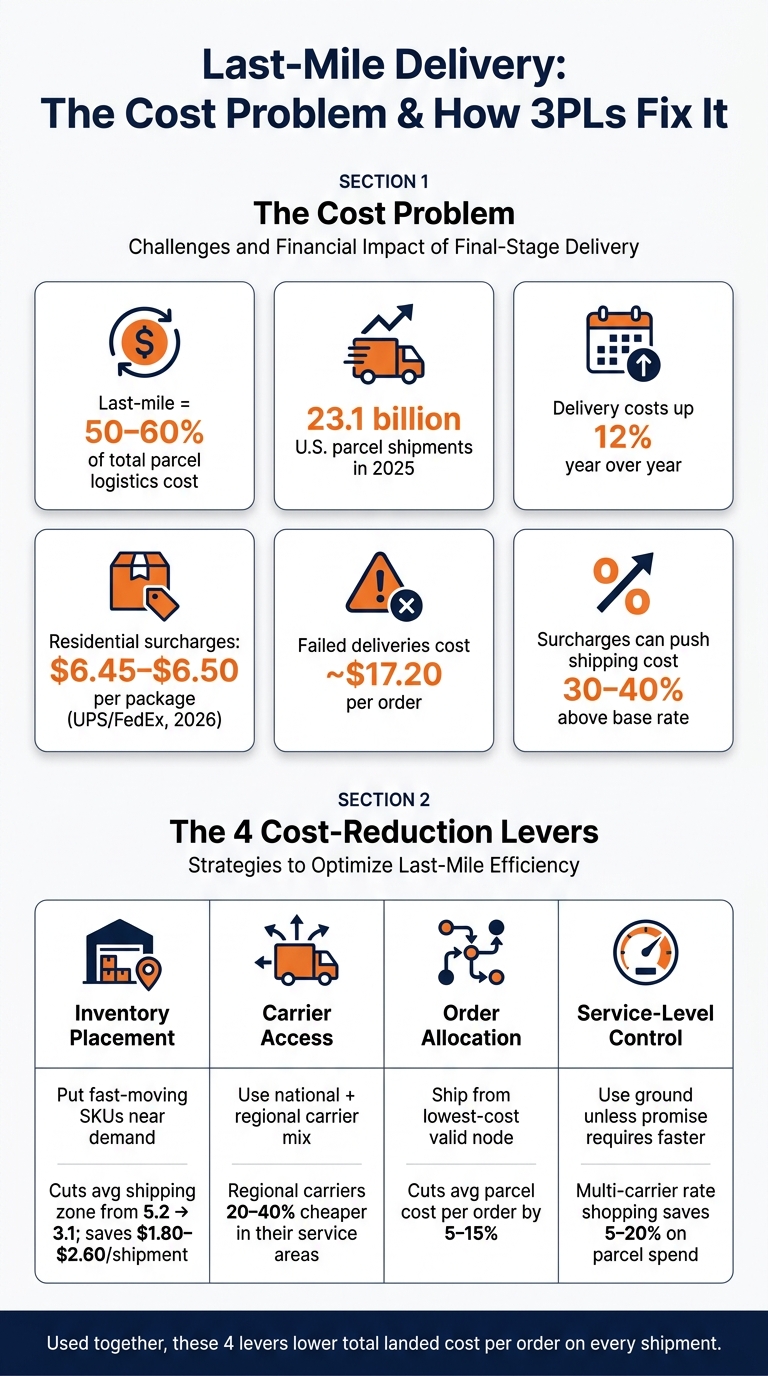
- Last-mile cost is often 50% to 60% of total parcel logistics cost
- U.S. parcel volume reached 23.1 billion shipments in 2025
- Delivery costs climbed 12% year over year
- UPS and FedEx residential surcharges are about $6.45 to $6.50 per package in 2026
- Failed deliveries can cost about $17.20 per order
- Surcharges and exceptions can push shipping cost 30% to 40% above the base rate
- Multi-carrier rate shopping can trim parcel spend by 5% to 20%
| Lever | How I’d use it | Main cost impact |
|---|---|---|
| Inventory placement | Put fast-moving SKUs near demand | Lower zones and more ground coverage |
| Carrier access | Compare national and regional carriers | Lower total parcel cost and fewer surcharge hits |
| Order allocation | Ship from the lowest-cost valid node | Fewer bad routing choices and fewer upgrades |
| Service-level control | Use express only when the promise needs it | Lower premium shipping spend |
In other words: if I want lower last-mile cost, I wouldn’t look at rates alone. I’d use a 3PL to make the lowest-cost shipping choice the default on every order.
Last-Mile Delivery Cost: Key Stats & 3PL Savings Levers
How Does 3PL Pricing Work? | 3PL Cost Breakdown Explained
sbb-itb-eafa320
Use Multi-Node Fulfillment to Cut Distance, Zones, and Transit Cost
Shorter shipping lanes cut parcel spend. When inventory sits closer to the customer, carriers bill fewer zones, and ground shipping works for more orders. From there, the key move is deciding which SKUs should live in each node.
How Regional Inventory Placement Lowers Parcel Spend
Start with your order data. Map orders by ZIP Code to spot repeat demand clusters. If you sell B2B, look at account clusters and commercial delivery lanes too, not just consumer ZIP Code demand. High-velocity SKUs usually make the most sense for regional placement because they move fast enough to support split inventory across multiple nodes. Slow movers are often better kept in one central location so you don't tie up cash in scattered stock.
A move from one fulfillment center to a two-node network can cut average shipping zone (ASZ) from 5.2 to 3.1. That can mean about $1.80 to $2.60 in savings per shipment. Shorter distances also push more orders into standard ground delivery, which helps reduce the need for pricier two-day or air service.
When More Nodes Help and When They Add Cost
More nodes don't always mean lower cost. They help only when parcel savings beat the extra inventory and operating cost. Every added location brings more safety stock, more replenishment work, and more overhead. Split demand across two warehouses, and safety stock can go up by about 42% versus one centralized location at the same service level.
Split shipments can also eat into savings. In some multi-node setups, 10% to 40% of multi-item orders ship from more than one location. That drives up both shipping and handling cost per order. So the right way to judge the network is by total landed cost per order, not parcel rates alone. Once the network is set, carrier access and order allocation become the next place to cut spend.
How a 3PL Network Makes Multi-Node Expansion Practical
Building your own warehouse network for regional fulfillment takes time and a lot of money. A 3PL gives you a faster path. You get access to existing warehouse locations without the long lead time and fixed cost of building your own footprint. That lets brands place inventory in multiple regions and scale capacity up or down as demand shifts.
JIT Transportation's nationwide network lets brands place inventory in multiple regions without building their own warehouse footprint. A 3PL makes this model practical by giving brands regional footprint without fixed warehouse expansion.
Lower Parcel Spend With Carrier Access, Rate Shopping, and Order Allocation
Once inventory is in the right place, the next place to cut parcel spend is routing and carrier choice. This is where carrier access, rate shopping, and allocation rules start doing the heavy lifting. The savings come from the small decisions made on every order: where it ships from, which carrier gets it, and what service level it uses.
Why 3PL Carrier Access Matters Beyond Base Rates
A lot of brands zero in on base rates. That makes sense. But in practice, the bigger hit often comes from surcharges.
Residential delivery fees, delivery area surcharges (DAS), fuel schedules, dimensional weight fees, and additional handling charges can pile up fast. In many cases, they matter more than the base-rate gap between carriers. A 3PL pools volume across many shippers, which gives it more leverage to work out better surcharge terms, not just lower base rates, with national carriers such as UPS and FedEx and regional carriers like OnTrac, GLS US, and Spee-Dee.
That access to regional carriers is a big deal for DTC brands. Regional carriers often come in 20–40% lower than FedEx and UPS inside their service areas. They also often bring lower DAS exposure for residential deliveries. Of course, there's a catch: coverage. Regionals tend to be strong in some parts of the country and weaker in others.
That’s where a 3PL’s multi-carrier network helps. It lets brands lean on regional carriers where they shine, then switch to national carriers where regional coverage drops off. In plain English, you’re not stuck forcing one carrier to do every job.
How Rate Shopping Reduces Total Cost Per Shipment
Rate shopping looks at live cost and transit choices across multiple carriers for each order. The 3PL’s rating engine pulls in shipment weight, dimensions, origin and destination ZIP codes, delivery date, and handling rules. Then it compares each carrier’s total landed parcel cost.
So instead of defaulting to UPS Ground or FedEx Ground, the system may route the order to a regional carrier if that option still meets the delivery promise for less. Used the right way, multi-carrier rate shopping often cuts parcel spend by 5–20%. The main point is automation. If this happens at order release, the savings show up again and again instead of depending on someone making the right call by hand.
Dimensional weight is another spot where rate shopping can make a clear difference. A 4 lb DTC shipment in a large box might bill at 18 lb under one carrier’s DIM rules and 16 lb under another’s. That gap can completely change which carrier is the best fit. And before rate shopping even starts, a 3PL can help trim DIM charges by using better carton sizing.
The next piece is service level. The lowest rate on paper doesn’t always protect margin if it creates a missed promise or an avoidable upgrade.
Order Allocation Rules That Prevent Unnecessary Shipping Cost
Carrier choice can only do so much if the order gets sent to the wrong node from the start. Allocation logic across the OMS, WMS, and TMS decides which fulfillment location handles the order before a carrier is picked. The target is simple: choose the lowest-cost valid node that has inventory, can hit the cutoff, and still meets the customer’s delivery promise.
For DTC brands, that usually means rules such as:
- Nearest-node routing
- SLA-aware routing
- Profile-based routing
These rules can steer orders to the node with the lowest zone to the destination ZIP, stop upgrades to two-day or next-day when ground can still hit the promise, and route lightweight parcels to USPS or regional carriers while sending heavier, DIM-sensitive parcels to national integrators with better oversize terms.
When teams apply those rules in a steady way, DTC brands can cut average parcel cost per order by 5–15%. For B2B, the same logic can push replenishment into fewer LTL or pool moves.
Manage Service-Level Tradeoffs to Protect Margin
Once a 3PL has placed inventory and routed the order, service level becomes the next big cost lever. Carrier access can cut the shipping rate. Service-level control helps you keep those savings instead of giving them back on the last mile.
Where Faster Shipping Stops Paying for Itself
Premium shipping can cost 30% to 70% more than standard service, while most customers are willing to wait two to three days if it helps them avoid shipping fees. So when a brand defaults to expedited shipping on every order, it often pays extra for speed the customer didn’t ask for.
A simple rule works well here: use ground shipping whenever it still arrives inside the promised delivery window. Save air or expedited service for orders that are actually time-sensitive or high-value.
For DTC, that usually means ground is the right fit. For B2B, faster shipping tends to make sense only when appointments or OTIF rules make it non-negotiable.
How Value-Added Services Affect Final-Mile Cost
White glove delivery, kitting, pre-shipment testing, and special handling all come with a price tag. Kitting and assembly fees often run from $0.50 to $8.00+ per kit, depending on how much work is involved.
That added cost can make sense. For high-value, bulky, or install-dependent products, premium handling may cut damage, returns, and support costs. In those cases, paying more upfront can prevent a bigger hit later.
But this only works when the order supports it. DTC brands usually use these services sparingly. B2B brands use them for shipments tied to installation needs or delivery appointments, where the product and margin can absorb the spend. Put those same services on routine orders, and you’re just adding cost without adding revenue.
Using a 3PL to Build Tiered Delivery Options
Instead of using one expensive default for every shipment, brands can set up a tiered delivery structure:
- Standard ground for routine, lower-risk orders
- Priority for orders that need a tighter delivery window
- Express for urgent, high-value, or appointment-driven shipments
Each tier can map to a clear order profile based on order value, product type, and customer expectation. That means the right service level can be applied automatically, without someone stepping in by hand.
A 3PL makes this much easier to run. JIT Transportation, for example, offers pick & pack, kitting & assembly, testing, white glove handling, returns management, and transportation support under one roof. That lets a brand send a standard DTC order through ground shipping with basic pick & pack, while sending a high-value B2B order through white glove handling with testing, all through the same 3PL partner.
That kind of setup keeps most shipments in the lowest-cost band that still works, while saving premium handling for the orders that actually need it. The goal is simple: match the service tier to order value, product type, and the delivery promise.
Conclusion: The 3PL Levers That Reduce Last-Mile Cost
Last-mile delivery now accounts for roughly 53% of total shipping cost, up from 41% in 2018. That shift puts real pressure on margin. And it shows why brands need one operating model built around four levers: inventory placement, carrier access, order allocation, and service-level control.
Used together, these four levers lower total landed cost per order. They do that by cutting zone distance, opening the door to better carrier terms, stopping avoidable routing choices, and keeping brands from paying for speed an order doesn’t need.
But those savings don’t happen by accident. Routing, carrier selection, and service decisions need to pull from the same data at the same time. When that real-time integration is missing, teams fall back on manual calls, and the cost gains shrink.
As volume grows, that model also needs a 3PL that can run it across both DTC and B2B shipments. JIT Transportation brings together the nationwide network and fulfillment infrastructure that DTC and B2B brands need to run this model without rebuilding their operations every time volume grows or the channel mix shifts.
The goal is simple: make the lowest-cost option that still meets the delivery promise the default on every order.
FAQs
How do I know if multi-node fulfillment will actually save money?
Check your shipping data for fewer high-cost zones. A strong sign is a lower Weighted Average Zone (WAZ), often down by 1.0 to 1.5 zones. You’ll also want to see fewer than 40% of shipments going to Zone 5 or higher.
A few other signs can show up at the same time:
- Shipping costs drop below 12% of revenue
- Monthly expedited air upgrade spend goes down
- Total shipping savings land in the 15% to 30% range
This is the kind of shift that shows your network is getting tighter. Fewer far-out shipments usually means less money leaking into high-zone deliveries.
What data does a 3PL need to improve order routing and rate shopping?
A 3PL needs accurate, real-time data synced across your storefront, OMS, and WMS. That includes:
- SKU, UPC/GTIN, quantity, and unit of measure
- Weight, dimensions, destination ZIP Code
- Required service levels
Historical orders, customer ZIP Codes, demand forecasts, package details, and carrier API access also help the 3PL make smarter calls on inventory placement, routing, and real-time rate shopping.
When should I use expedited shipping instead of ground?
Use expedited shipping for time-sensitive, high-margin products when ground shipping can’t meet delivery commitments.
Ground should be your default because it costs less and can reach up to 96% of U.S. households within two days when inventory is placed in the right locations. Use expedited service as a smart exception for urgent customer needs or stockout recovery.
Related Blog Posts
Related Articles
How Demand Pricing Cuts Peak Season 3PL Costs
3PL Warehouse Automation: Guide for Fast Growth