
EOQ Applications in Stock Replenishment
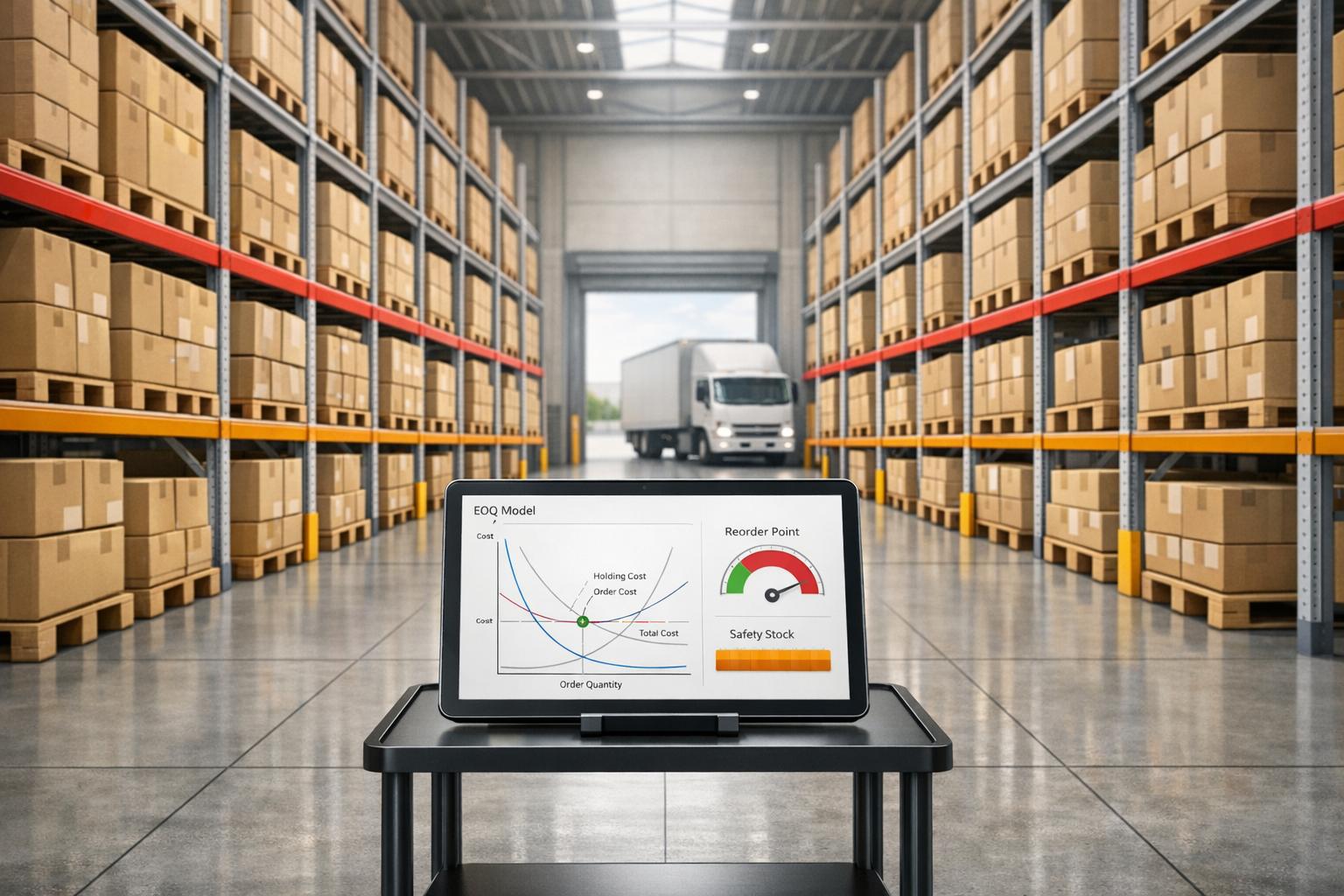
EOQ (Economic Order Quantity) is a formula that helps businesses determine the ideal order size to minimize inventory costs. It balances ordering costs (like shipping and admin fees) with holding costs (such as storage and insurance). For e-commerce businesses, EOQ is a powerful tool to reduce expenses, avoid stockouts, and improve cash flow.
Key Takeaways:
- Formula: EOQ = √(2DS / H), where:
- D = Annual demand in units
- S = Fixed cost per order
- H = Holding cost per unit per year
- Benefits: Cuts inventory costs, reduces order frequency, and frees up working capital.
- Challenges: Assumes constant demand and fixed costs, which may not align with seasonal fluctuations or supplier constraints.
- Practical Use: Combine EOQ with reorder points and safety stock for a resilient inventory system.
For example, a business selling 10,000 units annually with a $500 ordering cost and $0.75 holding cost would find an EOQ of approximately 3,652 units per order. This reduces total inventory costs by optimizing order size and frequency.
The EOQ Formula and How to Use It
Understanding the EOQ Formula Components
The EOQ formula is EOQ = √(2DS / H). To use it effectively, you need to understand each variable and how it influences your inventory decisions.
- D (Annual Demand): This is the total number of units sold in a year, based on your sales data. When demand increases, you’ll need to place larger orders to keep up with the pace of sales.
- S (Ordering Cost): These are the fixed costs associated with placing an order. Think of expenses like shipping, packaging, administrative tasks, and any fees from your third-party logistics provider. Higher ordering costs push the EOQ up, encouraging larger but less frequent orders.
- H (Holding Cost): This is the cost of storing one unit for a year. It includes expenses like warehouse rent, insurance, depreciation, and the opportunity cost of tied-up capital. When holding costs rise, EOQ decreases, favoring smaller and more frequent orders to minimize storage costs.
"If your inventory manager is constantly reacting to shortages by ordering small batches of inventory, you may be paying too much in setup costs. On the other hand, if you are placing large orders that will be stored for long periods of time, you may be paying too much in holding costs." - ShipMonk
The purpose of EOQ is to find the balance where ordering and holding costs are minimized, resulting in the lowest possible total cost. Now that the variables are clear, let’s move on to a practical example.
EOQ Calculation Example
Here’s how the EOQ formula works in a real-world scenario. Imagine you sell vanilla-scented candles, and your numbers look like this:
- Annual Demand (D): 10,000 units
- Ordering Cost (S): $500 per order
- Holding Cost (H): $0.75 per unit per year
Plugging these values into the formula gives:
√[(2 × 10,000 × 500) / 0.75] ≈ 3,652 units per order
This means you’d place about three orders a year (10,000 ÷ 3,652).
For most e-commerce businesses, holding costs typically range between 20% and 30% of the total inventory value annually. While the EOQ formula provides a starting point, real-world factors often require adjustments.
Adapting EOQ to Business Constraints
Although the EOQ formula gives a mathematically optimal order size, logistical realities often demand flexibility. Suppliers might have minimum order quantities (MOQs), or your products might ship in fixed case sizes. For example:
- If your calculated EOQ is 3,652 but your supplier’s MOQ is 4,000, you’ll need to order 4,000 units, even if it increases holding costs.
- If your products ship in cases of 48, round your order to the nearest multiple of 48 for easier handling.
Storage space is another key factor. If your warehouse can only hold 2,500 units, you’ll need to order smaller amounts more frequently, even if this drives up costs.
For products with seasonal demand, like those that sell primarily during holidays, it’s better to calculate EOQ separately for peak and off-peak seasons rather than relying on a single annual average. This ensures your inventory aligns with sales patterns, keeping costs under control.
sbb-itb-eafa320
Economic Order Quantity (EOQ) Explained - Optimize Inventory Costs
Combining EOQ with Reorder Points and Safety Stock

EOQ Formula Components and Integrated Inventory Management System
Setting Reorder Points
EOQ tells you how much to order, but Reorder Points (ROP) determine when to place that order. The ROP acts as a trigger, signaling it's time to restock when inventory hits a specific level.
Here’s the formula:
ROP = (Average Daily Sales × Lead Time in Days) + Safety Stock.
Let’s break it down with an example. If your business sells 50 units daily, your supplier needs 14 days to deliver, and your safety stock is 875 units, the ROP is:
(50 × 14) + 875 = 1,575 units.
When your inventory drops to 1,575, it’s time to reorder.
Keep in mind, lead time includes every step in your supply chain. If delays occur at any stage, the risk of stockouts increases, making safety stock even more critical.
Using Safety Stock with EOQ
Safety stock acts as a backup for unexpected demand surges or supply chain hiccups. While EOQ assumes stable demand and lead times, real-world e-commerce rarely follows such predictable patterns. Demand spikes, shipping delays, and supplier issues can all disrupt your inventory flow. Without safety stock, you’re more likely to run out of stock when these disruptions happen.
Here’s the formula for safety stock:
Safety Stock = (Max Daily Sales × Max Lead Time) - (Average Daily Sales × Average Lead Time).
For example, if daily sales typically hover around 50 units but can jump to 75, and lead time ranges from 14 to 21 days, safety stock would be:
(75 × 21) - (50 × 14) = 875 units.
This buffer ensures you can handle simultaneous demand spikes and delays.
"The determination of level of safety stock involves a basic trade-off between the risk of stockout, resulting in possible customer dissatisfaction and lost sales, and the increased costs associated with carrying additional inventory." - Wikipedia
By combining safety stock with EOQ, you can create a more resilient inventory system.
How EOQ, Reorder Points, and Safety Stock Work Together
When you integrate EOQ with ROP and safety stock, you create a system that balances cost efficiency with reliability. Each component plays a specific role:
| Component | Description | Example |
|---|---|---|
| EOQ | Order size that minimizes costs | 3,652 units |
| Lead Time Demand | Stock needed during delivery lead time | 700 units (50/day × 14 days) |
| Safety Stock | Extra inventory for variability | 875 units |
| Reorder Point | Inventory level to trigger reordering | 1,575 units (700 + 875) |
Here’s how it works in practice: When inventory dips to 1,575 units, you place an order for 3,652 units (your EOQ). The 700 units of lead time demand cover typical needs during the 14-day delivery period, while the 875-unit safety stock protects against unexpected disruptions.
Take Ample Foods as an example. They implemented this strategy by splitting inventory across multiple fulfillment centers and automating reorder points based on SKU velocity. The result? A 13% cost reduction and no stockouts.
"Correctly paired EOQ and ROP settings ensure each order is economically sized and precisely timed - cutting total cost while protecting promised service levels." - Umbrex Inventory Management Playbook
For fast-growing e-commerce businesses, regular updates to these parameters are crucial. Reassess at least every quarter for high-demand items, or sooner if sales velocity changes by more than 10%. Additionally, multi-location inventory optimization can cut total inventory by 10% to 30%, all while maintaining or improving fill rates.
EOQ Limitations and When to Modify the Model
While EOQ (Economic Order Quantity) offers a structured approach to inventory control, its assumptions often clash with the unpredictable nature of e-commerce.
EOQ Assumptions and Their Shortcomings
The EOQ formula may seem like a perfect fit on paper, but it operates under assumptions that rarely hold up in fast-paced, real-world scenarios. For instance, it assumes constant demand throughout the year, ignoring seasonal peaks and promotional bursts that are common in e-commerce. Another major assumption is instant replenishment, which doesn't account for fluctuating lead times or supply chain delays. The formula also relies on fixed costs for ordering and holding inventory, overlooks bulk discounts, and treats each SKU as a standalone unit.
In reality, freight costs can vary, suppliers often offer tiered pricing for bulk orders, and combining shipments for multiple SKUs can lead to cost efficiencies. Moreover, the model assumes that stockouts are nonexistent, but the numbers tell a different story: retailers lose approximately $1 trillion annually to out-of-stock situations, and only 37% of shoppers return after encountering one.
"The EOQ model is perfect theoretically, but not very suitable from the practical perspective of [many firms]." – Guga and Musa
Seasonality poses another challenge. The EOQ model struggles to adapt to sharp demand fluctuations, and modern omnichannel operations - where inventory serves physical stores, online platforms, and direct-to-consumer sales - further complicate the model’s single-location assumption. These gaps highlight why businesses often need to tweak EOQ calculations to align with real-world complexities.
When to Adjust EOQ Calculations
Given these limitations, businesses should modify EOQ calculations under specific conditions. For example, seasonal demand spikes require recalculating EOQ more frequently - quarterly rather than annually - to better reflect changing demand patterns . In cases of rapid growth, demand may follow an exponential trend instead of remaining steady. A study on Amazon.com during a high-growth period revealed that while the classical EOQ suggested ordering 250 units, an adjusted model accounting for exponential growth recommended 294 units - a difference of 17.6%.
Supplier constraints can also force adjustments. The standard EOQ formula doesn't factor in bulk discounts, so businesses should compare the total landed cost at the EOQ against costs at various discount tiers. In some cases, ordering more than the "optimal" quantity can actually lower overall expenses.
"The classical EOQ formula is rarely applicable in practice. For example, suppliers may enforce a minimum order quantity (MOQ) that is much larger than the EOQ." – MDPI Sustainability Journal
Product lifecycle is another key factor. For goods with short life cycles - like fashion items or consumer electronics - the risk of obsolescence can outweigh the cost benefits predicted by the EOQ model. Using real-time point-of-sale data to track when a product enters its decline phase can help businesses manually adjust order quantities and avoid overstocking.
Supply chain disruptions also call for adjustments. During the COVID-19 pandemic, simulations suggested increasing EOQ by 20–30% to mitigate stockouts caused by supplier constraints. Additionally, any significant changes in carrying or ordering costs - roughly 10% or more - should prompt an immediate recalibration of EOQ parameters.
Using 3PL Partners and Technology for EOQ Implementation
How 3PL Services Support EOQ
Third-party logistics (3PL) providers play a key role in making EOQ (Economic Order Quantity) implementation smoother and more effective. They offer the infrastructure and detailed cost data businesses need. For example, they provide precise numbers for ordering costs - like packaging, labor, shipping, and receiving - and holding costs such as warehousing, insurance, and staffing expenses. Many 3PLs also use advanced warehouse management systems that automatically trigger purchase orders when inventory hits the reorder point, reducing the chances of human error. For fast-growing companies, this scalability is a game-changer. Take Rainbow OPTX, a sunglasses brand with highly seasonal demand. Partnering with a 3PL allowed its CEO, Noel Churchill, to scale operations without the burden of fixed costs tied to managing their own warehouse.
Beyond the basics, 3PLs often provide additional services like kitting, assembly, and vendor-managed inventory (VMI), which further enhance EOQ strategies. A great example is JIT Transportation, which combines traditional warehousing with specialized services. Their nationwide network and ERP integration capabilities help businesses bundle components into single SKUs, cutting down setup costs per unit. They also strategically distribute inventory across multiple locations to minimize transit times and holding costs.
By streamlining these operations, 3PLs make it easier to integrate advanced technology into inventory management processes.
Technology Tools for EOQ Management
Modern technology takes EOQ from being a simple calculation to a dynamic system for replenishing stock. Inventory management systems, for instance, track stock levels in real time across all sales channels and automatically trigger reorders based on EOQ thresholds. Meanwhile, warehouse management systems provide detailed data on inventory levels, labor availability, and storage utilization, helping businesses refine their holding cost estimates. ERP platforms take it a step further by integrating 3PL data with item records and purchase histories, ensuring EOQ calculations stay aligned with current operational needs.
Demand forecasting tools powered by AI and machine learning analyze historical trends and predict lead-time variability. This makes EOQ inputs much more accurate, helping businesses make smarter replenishment decisions. Order management systems also come into play, using "Available-to-Promise" logic to ensure that restocking aligns with actual customer demand. Analytics tools further enhance EOQ management by tracking landed costs - the total expense of getting a product to its destination - which is crucial for determining the true "order cost" variable in EOQ.
One company improved its forecast accuracy by 22% over two years by combining quantitative methods with qualitative insights.
"Quantitative methods are the baseline, but qualitative insights from our sales and customer service teams help fine-tune the predictions".
While these tools handle the heavy lifting of calculations, human expertise remains an essential element for fine-tuning stock replenishment strategies.
Additional Logistics Services for E-Commerce
Specialized logistics services add another layer of efficiency to EOQ strategies by addressing hidden costs and improving product quality. Services like white glove handling, testing, and assembly help reduce damage rates and ensure products meet quality standards before shipping. For example, white glove services are ideal for fragile or high-value items, lowering the risk of returns and replacement costs. Testing and revision upgrades further help businesses avoid costly customer service issues.
Mithu Kuna, Co-Founder and CEO of Baby Doppler, uses real-time dashboards to track SKU performance by warehouse location.
"I can literally go into my ShipBob dashboard and see exactly what I want to see with a few clicks. I love that it's a quick snapshot of everything that's going on".
This level of visibility allows for precise inventory allocation, making EOQ calculations more actionable and effective for restocking.
JIT Transportation offers a suite of services - like pick & pack, kitting & assembly, and returns management (RMA) - that integrate seamlessly with EOQ-based replenishment strategies. By consolidating these functions under one provider, businesses reduce coordination challenges. This flexibility allows businesses to adapt order quantities as market conditions change, all while maintaining service quality and speed.
Conclusion
EOQ takes the guesswork out of stock replenishment, transforming it into a precise, data-driven strategy. By balancing ordering and holding costs, it allows high-growth e-commerce businesses to free up working capital that might otherwise be tied up in excess inventory. This freed-up capital can then be redirected toward key areas like marketing campaigns or product development. And the stakes couldn’t be higher - retailers lose an estimated $1 trillion annually due to stockouts [16,37]. Consistent inventory replenishment not only avoids these disruptions but also helps maintain customer trust.
The benefits don’t stop there. Incorporating 3PL expertise into EOQ strategies takes inventory management to another level. 3PL providers deliver exact cost data and automate reordering, replacing manual spreadsheets with streamlined, automated systems [11,16]. This kind of integration boosts efficiency and simplifies operations.
A great example of this is JIT Transportation. With its nationwide network, ERP integration capabilities, and specialized services like kitting, assembly, and white-glove handling, JIT optimizes EOQ implementation. By strategically distributing inventory across multiple locations, they help businesses reduce both transit times and holding costs.
To keep these benefits flowing, it’s crucial to treat EOQ as a flexible tool. Market conditions, demand, and supplier lead times are always changing. Businesses that regularly update their EOQ calculations - whether monthly or quarterly - can stay ahead of these shifts [4,37]. Pairing EOQ with safety stock buffers and automated reorder points creates a scalable inventory management system. This approach ensures efficient operations and supports growth, all while avoiding the burden of excessive warehouse overhead [8,16].
FAQs
How do I estimate holding cost per unit?
To calculate the holding cost per unit, you need to add up all related expenses - such as warehousing, insurance, depreciation, and opportunity costs. Once you have the total, divide it by the number of units held during a specific time frame. Typically, this cost is shown as an annual percentage of the unit's value, making it easier to factor into Economic Order Quantity (EOQ) calculations. For precise results, it's important to account for all inventory-related expenses and average inventory levels.
When should I recalculate my EOQ numbers?
To keep your inventory management effective, it's crucial to revisit your EOQ calculations whenever key factors change. These could include shifts in demand patterns, seasonal trends, updated supplier pricing, or changes in carrying costs. Regularly recalculating ensures your stock replenishment stays aligned with your business's evolving needs.
How do MOQs and case packs change EOQ?
When dealing with Minimum Order Quantities (MOQs) and case packs, these supplier-imposed constraints can significantly impact the Economic Order Quantity (EOQ). MOQs set a baseline for the smallest order size, while case packs require purchasing in fixed multiples. Both factors can force you to order in quantities that differ from what the EOQ model recommends.
This misalignment can lead to ordering either more or less frequently than planned, which may disrupt inventory levels and cost efficiency. To address this, it's crucial to adjust EOQ calculations to reflect these constraints. By doing so, you can better balance supplier requirements with your goal of minimizing overall costs.
Related Blog Posts
Related Articles
7 WooCommerce 3PL KPIs Teams Track

Centralized vs Decentralized Replenishment
