EV Last-Mile Delivery Trends: 2026 Summary
EV last-mile delivery moved from test runs to fleet rollouts in 2026 - and the main reason was cost.
If I had to sum up the article in a few lines, it would be this:
- Last-mile delivery is expensive, taking up as much as 53% of total logistics costs
- EV adoption picked up most in Asia-Pacific, while North America and Europe kept growing under policy and city access rules
- Electric vans still lead, but cargo bikes, two-wheelers, and three-wheelers are gaining ground on short urban routes
- Depot charging, route planning, and grid access now shape where EV fleets work best
- For brands, this is now a network choice, not just a vehicle choice
Here’s the short version: EVs now make the most sense on dense, repeatable city routes with overnight charging. Mixed fleets can cut cost to serve by 8% to 15%, micro-fulfillment sites can cut delivery distance by 64%, and battery costs have dropped hard enough to put EV total cost in line with diesel on many urban routes.
If you’re growing into new cities, the main question is no longer “Are carriers trying EVs?” It’s “Which carriers can still deliver where I need them to go, at the right cost?”
This Is Amazon’s Future Delivery Van 2026 | Rivian Electric Power
sbb-itb-eafa320
Quick comparison
| Area | What the article shows |
|---|---|
| Main 2026 shift | EVs moved past pilot use into day-to-day delivery fleets |
| Cost driver | Urban EV total cost reached diesel parity on high-use routes |
| Fastest-growth region | Asia-Pacific |
| Best-fit routes | Short, repeatable city routes with depot charging |
| Vehicle mix | Vans lead; bikes and small EVs grow on sub-3.1-mile routes |
| Main bottlenecks | Charging access, grid capacity, equipment delays, technician shortages |
| Brand takeaway | Review carrier mix, site choice, and city access before 2027 |
What follows is a plain-English recap of the data, the fleet moves, and what I think brands should pay attention to next.
Where EV last-mile adoption grew fastest in 2026
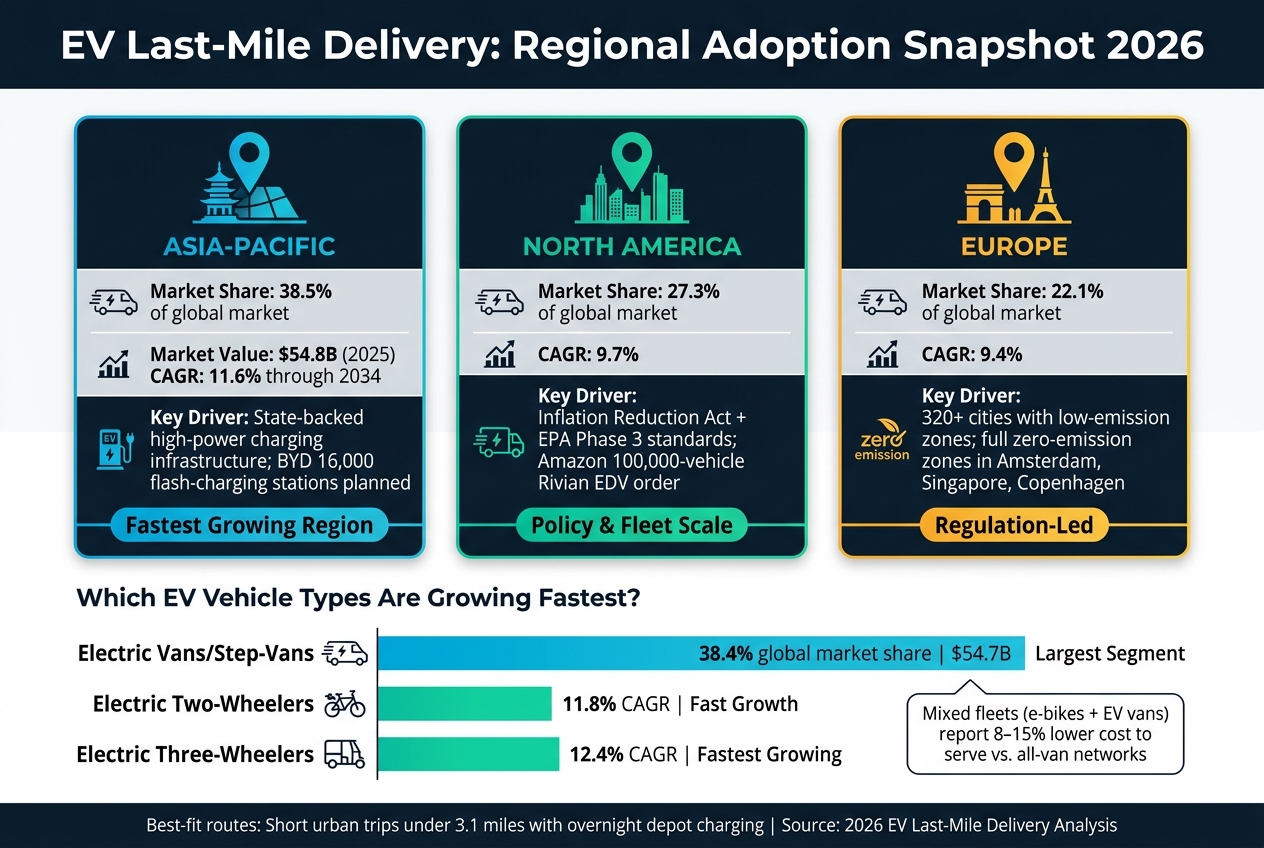
EV Last-Mile Delivery by Region: Market Share, Growth & Key Drivers (2026)
Regions moved at different speeds in 2026, and the reasons were pretty different from one market to the next. Policy mattered. Charging access mattered. Fleet economics mattered too.
Asia-Pacific, Europe, and North America compared
Asia-Pacific led adoption, with 38.5% of the global last-mile delivery vehicle market at $54.8 billion in 2025, and the region is forecast to grow at an 11.6% CAGR through 2034. China pushed much of that growth by treating high-power charging like state-backed infrastructure. You can see that pace in moves like BYD's March 2026 Blade Battery 2.0 launch and its plan for 16,000 flash-charging stations.
North America held 27.3% market share and is growing at a 9.7% CAGR. In the U.S., federal policy is a big part of the push, especially the Inflation Reduction Act and EPA Phase 3 greenhouse gas standards. Fleet buyers are also moving at scale. Amazon's 100,000-vehicle Rivian EDV order is a good example of how large carriers are placing bets on electrification. That kind of volume tends to matter most in dense delivery networks, where charging access and route density heavily shape fleet decisions.
Europe made up 22.1% of the market and is forecast to grow at a 9.4% CAGR. Here, regulation is doing much of the heavy lifting, including low-emission zones in more than 320 cities worldwide.
Those differences didn't just affect adoption rates on paper. They shaped what carriers put on the road next. In many cases, regional conditions influenced whether operators leaned toward vans, cargo bikes, or a blended urban fleet.
Electric vans, cargo bikes, and mixed urban fleets
Electric vans and step-vans still sit at the center of suburban and urban parcel routes. In 2025, they held the largest global market share at 38.4%, or $54.7 billion.
But in dense city cores, the vehicle mix is starting to change. As micro-fulfillment centers cut delivery distances to less than 3.1 miles, cargo bikes and electric two-wheelers start to make more sense than full-size vans. It’s a simple route-design issue: when the trip gets shorter and streets get tighter, smaller vehicles can do the job with less friction.
That shift shows up in growth rates too:
- The two-wheeler segment is growing at an 11.8% CAGR globally
- Three-wheelers are growing at 12.4%, which is faster than the four-wheeler category
Mixed fleets are also starting to look attractive on cost. Operators using combinations of e-bikes and EV vans report 8% to 15% lower cost to serve than all-van networks. For growth-stage brands trying to offer same-day delivery in dense metro areas, that’s a number worth watching as carrier networks keep changing.
How carriers and urban operators used EVs in real delivery networks
Parcel carrier and retailer fleet moves
In 2026, carriers stopped treating EVs like a future target and started putting them into daily delivery work. The shift wasn't just about buying electric vans. It tied vehicle choice to route design, depot setup, and how the whole network ran.
UPS is a clear example. The company used electrification as one part of a broader network redesign, not as a separate sustainability project. UPS announced a $2 billion investment to modernize its network with robotics and AI-based route optimization, and it also ordered 10,000 electric vehicles from Arrival to support zero-emission urban delivery. When carriers place orders at that scale, it shows EVs are now built into network planning from the start, not added later.
That approach worked best on routes that were short, dense, and easy to predict.
Use cases that worked best in cities
The strongest fit for EVs was short, predictable urban routes with overnight depot charging. City routes often handled 40 to 50 stops per day, usually at lower speeds and over known distances, which made them a good match for electric vans and smaller delivery vehicles.
Food and grocery delivery in dense urban areas showed another strong use case. Electric two-wheelers and three-wheelers worked well there because they were easier to maneuver and cost less to run. In tight city streets, that matters a lot.
Micro-fulfillment centers also helped. By placing inventory closer to customers, operators shortened delivery distances enough to make cargo bikes and compact EVs practical on routes under 3.1 miles. That's a big shift. Once the route gets that short, a smaller vehicle stops looking like a compromise and starts looking like the smart option.
The sticking point was routes without depot charging. That was where planning made or broke fleet performance. AI-powered route optimization cut missed delivery windows by 35% and reduced fuel use by up to 20%. DHL's "Greenplan" algorithm delivered 20-minute precision ETAs while cutting fuel consumption by 15% to 18% through dynamic route adjustments. In plain terms, route planning often decided whether an EV fleet stayed busy or sat underused.
That operating model still leaned on depot charging and tight route planning, which the next section addresses.
Charging, total cost, and policy changes that shaped 2026 decisions
Depot charging build-out and infrastructure gaps
In 2026, operators building EV fleets put private depot charging ahead of public charging build-outs. That setup worked best for carriers running dedicated contract lanes and other predictable urban routes. When trucks could charge overnight at a controlled site, scheduling felt a lot less risky.
New logistics hubs were built mostly at greenfield sites in Southeast manufacturing corridors. That wasn't random. EV and battery manufacturing clusters in those areas created direct demand for electrified delivery infrastructure.
Even so, rollout slowed in a few stubborn places. The biggest pain points were:
- Too few technicians trained for diagnostics and maintenance
- Procurement delays for EV charging equipment
Those gaps hit suburban and secondary markets hardest. In many of those areas, operators kept hybrid fleets on the road as a bridge option.
Warehouse location choices started to shift too. Being close to substations with 5 MW-plus capacity became a practical need for scaling charging infrastructure, especially since a 1.5 MW charger puts a heavy load on the grid. That changed the screening process. Depot access and grid capacity became the main filters for EV scale, and adoption moved fastest where carriers controlled routes, depots, and energy use.
Total cost trends in U.S. dollars
Once charging access was handled, the next issue was cost. On high-use urban routes, EV total cost of ownership reached parity with diesel.
A big part of that came from battery pricing. Pack prices fell by more than 85% over the past decade, and the shift toward Lithium Iron Phosphate (LFP) chemistry pushed costs lower still. LFP came in at about $81 per kWh, compared with $128 per kWh for NMC alternatives.
That chemistry shift mattered for more than sticker price. LFP also offers a cycle life of 3,000+ cycles, versus 1,000–2,000 for NMC. For fleet vehicles, that can support better long-term resale value.
Charging downtime still carried cost risk, which kept fast-charging tech high on the list. AI route planning helped too, giving carriers a way to schedule charging with less wasted time.
U.S. and global policy shifts
Policy in 2026 had a direct effect on when and where carriers moved on EV fleets. California's Advanced Clean Trucks (ACT) regulation kept spreading past state borders, with Oregon, Washington, and New York adopting similar rules. For carriers working across those states, zero-emission conversion turned into a regional compliance issue.
At the federal level, the EPA's Phase 3 greenhouse gas standards for heavy-duty vehicles shortened fleet replacement timelines and pushed carriers to factor alternative-fuel vehicles into procurement planning earlier. The Inflation Reduction Act (IRA) commercial clean vehicle tax credits also stayed in place to support electric delivery vehicle purchases.
Outside the U.S., the pressure was even more direct. More than 320 cities worldwide had urban vehicle emission restrictions in place as of 2025, and that figure was expected to pass 500 by 2030. Amsterdam, Singapore, and Copenhagen went furthest, setting up full zero-emission last-mile delivery zones.
For growth-stage brands, that changed the planning conversation. The issue wasn't just whether EV rules were coming. It was where those rules would start reshaping network design, inventory placement, and carrier selection.
What the 2026 findings mean for growth-stage brands
Network decisions for brands scaling beyond one warehouse
For growth-stage brands, EV adoption is now a network design call. It’s not just about picking a vehicle. It’s about choosing the right sites and building the right carrier mix.
Route length is now a major factor in deciding which EVs make sense. Micro-fulfillment centers in the 50,000–100,000 sq. ft. range, placed in dense urban areas, can cut average delivery distances by 64% and reduce operating costs by 31%. That makes them a strong fit for e-commerce, beauty, wellness, medical devices, technology, and manufacturing brands that rely on fast delivery.
Real estate choices are shifting too. Grid capacity should be treated as a lease requirement, not something to deal with later. For temperature-sensitive freight, new LFP packs can fast-charge from 20% to 97% in under 12 minutes at -4°F (-20°C), which expands EV use on northern routes.
In plain terms, fleet readiness now belongs in the planning stage. It’s not something to patch in later.
Key takeaways
These operating shifts lead to three practical decisions for brands.
- Treat EV last-mile delivery as a network-planning issue. In 2026, it moved beyond the pilot stage and became a workable option for brands operating in dense cities and other markets with low-emission zone rules.
- Choose carrier partners based on where they can operate. As brands move into cities with access limits, carrier pressure is rising. A carrier that can’t run in those zones can become a bottleneck fast.
- Audit your network before 2027. The brands in the best spot for 2027 will already have reviewed carrier mix, site locations, and network flexibility.
The big shift here is simple: carrier mix, site location, and operating-zone fit now sit much closer to the center of growth planning.
FAQs
Which delivery routes are the best fit for EV fleets?
EV fleets work best on predictable local routes, usually in the 0 to 300-mile range. That makes them a strong fit for dense urban and semi-urban areas, where drivers handle short- to medium-range routes and return to the depot for overnight charging.
The sweet spot is pairing the right vehicle with the right job. Electric two-wheelers, cargo bikes, and compact vans tend to do best in high-frequency, short-range urban delivery zones.
How should brands evaluate carriers for EV-ready city delivery?
Pick carriers that already have the right tech, charging setup, and proven compliance in place. That means looking for AI-powered route optimization, shipment-level carbon reporting, and integrated telematics tied to cloud-native management systems.
You’ll also want to confirm that the carrier has scalable depot charging, high-voltage safety protocols, and a phased electrification plan that uses BEVs for local routes. Put together, these capabilities help support delivery density, uptime, visibility, and audit-ready Scope 3 emissions reporting.
What infrastructure matters most before scaling EV last-mile delivery?
Before scaling EV last-mile delivery, the top priorities are charging infrastructure and grid capacity.
That’s the part a lot of teams run into first. A depot might look ready on paper, but if it doesn’t have enough power for charging, rollout plans can stall fast. And grid upgrades don’t happen overnight. In many cases, they take 12 to 24 months to permit and complete.
There are other site needs, too. Operators may need:
- Locations near high-voltage substations
- Battery energy storage to manage peak loads
- Facility upgrades
- Technician certifications for high-voltage safety
This means EV rollout isn’t just about buying vehicles. It also depends on whether the site, power supply, and staff are ready to support them.
Related Blog Posts
Related Articles
Carbon-Neutral Shipping Tools: 9 Options for 3PLs

3PL Custom Packaging for E-commerce Orders