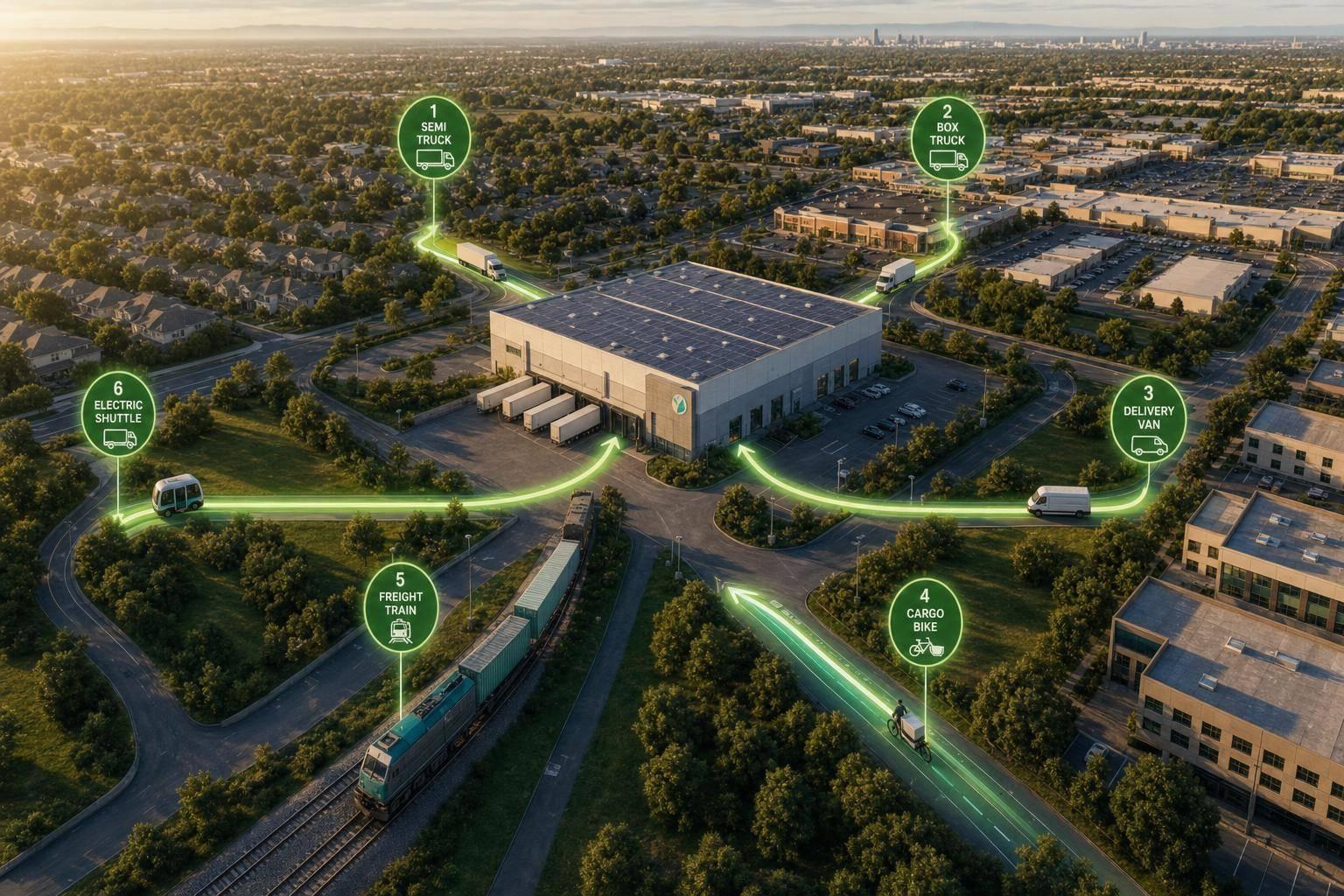
Green Reverse Logistics: 6 Ways 3PLs Reduce Miles
Returns can cost $17 to $30 per item, and bad routing can add up to 30% more CO₂ than outbound shipping. My takeaway is simple: the fastest way to cut return cost and miles is to stop sending every item through one long, messy path.
If I had to sum up the article in one line, it would be this: 3PLs cut return miles by routing items to the nearest node, grouping shipments, picking the right mode, timing moves better, placing restocked goods near demand, and sending unsellable items straight to the right resale outlet.
Here’s the full picture in plain English:
- Zone-based routing cuts the first long trip by sending returns to the nearest approved site.
- Local consolidation groups nearby returns before linehaul, so fewer small shipments hit the road.
- Carrier and mode selection trims wasted miles by matching each lane to the right carrier and truck type.
- Batch transfers replace one-off moves with planned runs built around volume and timing.
- Smart restock placement puts sellable returns at the closest node that can process and resell them.
- Resale channel routing sends damaged or non-stock items straight to the best next destination instead of through an extra DC loop.
Why this matters: fewer miles usually means lower freight spend, lower fuel use, faster inspections, faster refunds, and less delay before resale.
How Does Reverse Logistics Make Supply Chains Green? - Smart Logistics Network
sbb-itb-eafa320
Quick Comparison
 In short, I’d read this article as a guide to cutting waste out of reverse logistics at each step, not just lowering parcel spend on a return label.
Why Return Miles Add Up in U.S. Supply Chains
Most return networks didn’t start as clean, purpose-built systems. They grew over time, piece by piece, on top of existing forward logistics. And that kind of patchwork setup adds miles almost everywhere.
Centralized returns processing is a big reason why. A return shipped from Miami to a Los Angeles DC can travel 2,700+ miles, even though a Southeast hub could handle that same item in 400 to 600 miles. Parcel routing creates its own detours too. A return from Ohio might pass through several carrier hubs before it reaches a Texas returns center, adding 500 to 1,000 miles that a regional LTL consolidation model could skip.
The biggest drain often comes from multi-touch handling. A returned home appliance may go from a store to a regional DC, then to a central DC, and then to a refurbisher. That can mean 1,500+ miles for one item. A 3PL-run first-touch hub closer to the customer could inspect, grade, and route that item in under 300 miles. That’s why routing strategy matters so much. It’s not just about how fast you process returns. It’s about where the item goes first.
This starts to matter even more at scale. In a Yusen Logistics case study, a big-box retailer with six returns centers was shipping returned freight coast to coast back to manufacturers through LTL or poorly loaded trailers. Yusen set up a nearby warehouse close to those return centers, moved freight there, grouped it by manufacturer, and built truckload volumes to cut transportation cost and lower damage risk.
The cost adds up fast. A 500-mile extra leg on a typical LTL return move can add $100 to $250 in linehaul and fuel costs. Spread that across a large network, and those extra miles turn into avoidable yearly spend and avoidable emissions.
Each of the next six tactics goes after one of these mile-heavy weak spots.
1. Zone-Based Routing
With zone-based routing, a 3PL sends each return to the nearest approved processing node by region. That could be a regional returns center, a cross-dock, or a refurbishment hub. In practice, companies usually set this up with ZIP clusters, regional service areas, or carrier zones like the Northeast, Southeast, Midwest, South Central, Mountain, and Pacific. The big win is simple: you remove that first long haul before returns start stacking up in one central network.
The distance savings can be huge. If a retailer sends West Coast returns to a national center in the Midwest, those items may travel 1,800 to 2,200 miles round trip. Add a West Coast returns node, apply zone-based routing, and that same item may travel only 300 to 600 miles. At scale, that adds up fast. Across large parcel networks, regional zonal processing can cut average miles per return by 20% to 40%.
There’s also a truck-fill upside. When returns are grouped by zone, it gets much easier to build full truckloads from nearby stores or drop-off points. That can push trailer utilization from 60% to 70% up to 85% to 95%, which means more returns moved per mile and lower fuel cost per unit. ASDA is a good example here: its 10 local hubs increased vehicle fill 26.5%, cut annual distance traveled 19.9%, and saved more than 7 million road miles over five years.
Zone-based routing also speeds up inspection and next-step routing. If a returned item reaches a nearby regional node instead of a far-off central DC, teams can triage it days sooner. That matters a lot for seasonal or promo items, where every delay chips away at recovery value.
To make this work, the tech stack has to do the heavy lifting. A TMS needs zone-routing rules and multi-stop planning. A WMS or RMS should automatically map each origin ZIP to the right zone and facility. If that setup isn’t in place, teams end up routing returns by hand, which is slower and much harder to scale.
JIT Transportation can support zonal returns hubs with distributed transportation, distribution, testing, and returns handling. Once returns land in the right zone, the next mile cut comes from pooling them locally.
2. Local Consolidation of Returns
Local consolidation groups nearby returns before sending them on a longer trip. If zone-based routing decides where a return should go, consolidation decides when it should move.
Here’s the basic idea: instead of shipping each return straight from a store or customer address to a central DC that may be hundreds of miles away, retailers hold those returns at a nearby node until there’s enough volume for one outbound shipment. Zone routing picks the right region. Consolidation picks the right moment to send the load.
The mileage math is pretty simple. A retailer sending individual e-commerce returns from Los Angeles to a national DC in Tennessee is asking each item to travel 2,000+ miles. Add a West Coast consolidation point, and the picture changes. Each item only moves a short local leg first. Then the long trip happens once, with a full consolidated load instead of a stream of separate parcels.
That shift has a big effect on trailer space too. U.S. 3PLs usually aim for 85%–95% cube utilization on planned consolidated return moves, compared with the 30%–50% utilization often seen with individual parcel returns. Put plainly, that means the same return volume can move in roughly half the linehaul miles.
After returns are pooled, the next step is fixed pickup timing. This is where the plan gets more disciplined:
- Fast-moving items like seasonal apparel and electronics usually consolidate on daily pickups
- General merchandise often consolidates twice a week or less
That schedule helps keep partial trips off the road. Fewer partial trips means fewer empty miles before returns head to the next node. JIT Transportation can support regional processing with transportation, distribution, and returns handling.
3. Carrier and Mode Selection for Mile Efficiency
Once returns are consolidated, the next call is carrier and mode selection. And this part matters more than many teams think.
The goal isn't just to find the lowest rate. It's to choose the carrier network that moves returns in the fewest miles possible. If the carrier's network doesn't line up with your return lanes and final processing sites, those shipments can end up taking a costly detour.
Choose the mode based on lane length, volume, density, and urgency. A simple way to think about it:
- Use LTL for short hauls
- Use partial truckload (PTL) for mid-distance lanes
- Use FTL or dedicated capacity for long-haul returns
Speed should also match item value and urgency. If a return is high-value or time-sensitive, faster service to disposition can make sense even if that mode adds a few extra miles.
Route optimization helps trim miles by cutting out detours and improving lane fit. Sometimes the waste isn't in the shipment itself. It's in the path it takes.
Backhauls can also make a big dent in wasted miles. Instead of sending a truck back empty, use the return leg to pick up returns. That cuts empty, or deadhead, miles and makes better use of truck capacity. U.S. carriers average about 20.6 deadhead miles per trip, which shows how much room there is to reduce non-revenue miles with better carrier and mode choices, plus backhaul planning.
JIT Transportation's nationwide network and technology help match return flows to the right carrier and mode.
When the remaining lane is still inefficient, batch transfers and scheduled return runs usually cut more miles.
4. Batch Transfers and Scheduled Return Runs
Once you've picked the carrier, the next place to cut miles is simple: stop shipping every return the moment it shows up.
That reactive model is expensive. When each store or customer sends back a box on its own, reverse logistics turns into a stream of small, low-density shipments. In plain English, that often means half-empty trucks burning fuel and piling on miles that never had to happen.
Batch transfers solve that problem by grouping returns into scheduled, higher-volume runs instead of treating each return like a one-off event.
Here's how it works: returns build up at regional nodes until they hit a dispatch threshold, then move together on one trailer. The usual best-practice setup uses two triggers - a quantity trigger and a time trigger - so freight keeps moving without letting items sit too long. The result is pretty direct: fuller trailers, fewer empty miles, and lower freight spend.
The cost impact can be meaningful. One documented reverse-logistics optimization initiative reported 12.4% freight savings, and shipments were 1.2 days faster on average after the team focused on routing and consolidation.
Speed still matters, though. In many returns operations, the clock doesn't stop just because freight is being grouped. A common standard is 48 hours from receipt at the processing center to final disposition. That means batch transfers need to be planned around that window so items don't sit at a node or in transit any longer than needed.
Some items also can't wait for the next grouped move. Products with short resale windows or other priority limits may need to skip the batch and go out on a faster, dedicated run.
At scale, this takes more than good intent. You need:
- Regional nodes with staging space set up by lane and departure time
- WMS/TMS integration that batches returns by geography and disposition type
- Tight dock scheduling so inbound and outbound flows don't crash into each other
Once those batch moves are in place, the next savings usually come from putting returned inventory closer to demand.
5. Smart Restock Placement
Once batches are built, smart restock placement sends each return to the nearest fulfillment node that can actually handle it, instead of shipping it back to a far-off central hub. In many older setups, returns go to the original ship-from site or one main returns center. That adds miles that simply don’t need to happen.
With smart restock placement, each returned item goes to the closest node that can inspect it, restock it, refurbish it, or dispose of it. So an item returned in Ohio might belong in a Chicago-area node, not a West Coast warehouse. That one routing choice can remove 200–800 miles from a single return. And with e-commerce return rates averaging about 20.8%, even a modest drop per return can trim total network miles in a meaningful way. It can also shrink the time from return receipt to back in stock from 10–14 days to 4–7 days.
Distance isn’t the only thing that matters. The best node is also the one closest to the demand most likely to move that item next. If a SKU sells faster in the Southeast than in the Midwest, a return from Tennessee may make more sense at an Atlanta-area node, even if another site is a bit nearer on the map. That move cuts the return leg and the next outbound leg, which stacks the mileage savings across the network.
To pull this off at scale, a 3PL needs OMS, TMS, and WMS platforms that share real-time data, plus routing rules built around SKU, item condition, capacity, and demand signals. A nationwide 3PL like JIT Transportation can use a multi-node return network, distribution, testing, and white-glove handling to place returns at the closest capable facility. And when an item can’t go back into stock, it should move straight to the best resale channel instead of getting stuck in a longer return loop.
6. Resale Channel Routing
When a returned item can't go back into sellable stock, sending it to a central DC before anyone decides what to do with it just adds miles for no good reason. The smarter move is to make that call at first touch and send the item straight to the resale path that matches its condition.
The process is simple in theory: grade the item when it arrives, then route it based on that grade. But that only happens if the first scan fires the right disposition code.
Here’s what that can look like:
- A like-new return goes to an outlet or resale partner.
- A functional unit with cosmetic damage goes to a regional liquidator.
- A broken item goes to recycling or disposal.
Timing matters. Returned products can lose value fast. Seasonal apparel, electronics, and promotional goods may lose resale value in just a few days.
For slower-moving categories, milk runs can help cut waste. Instead of moving small volumes one by one, returns from several local nodes can be picked up and combined into one dense linehaul to the same disposition center.
A WMS records item condition and triggers a disposition code. A TMS then turns that code into a routing instruction by assigning the carrier, lane, and consolidation window. EDI or API links with liquidators, refurbishers, and outlet chains make pre-approved manifests possible, so loads move with very little dwell time.
A nationwide 3PL like JIT Transportation can connect graded returns to the right downstream partner through its nationwide network, testing capabilities, and carrier coverage. At scale, those routing rules hold up only when item condition, demand, and carrier data update together.
What Makes All Six Tactics Work at Scale
These six tactics only work at scale when they sit on the same base: a multi-node network, connected systems, and clear routing rules. Those three pieces shape how much each tactic can cut miles in day-to-day operations.
A distributed network keeps returns moving to the closest usable facility instead of sending everything back to one national DC. That matters because return volume tends to cluster by ZIP code, region, and product category. With ZIP-level visibility, that pattern stops being guesswork and becomes a planning input. Teams can use it to decide where consolidation points should go and when batch pickups or return runs make the most sense.
System integration ties the physical network to the decision layer. A WMS shows what sits in each facility and whether an item should be restocked, quarantined, or forwarded. A TMS helps pick the carrier, lane, and service level. When those systems share data, a single return scan can kick off the next move on its own. At scale, that scan should set off the facility, transport, and refund steps automatically.
Carrier scorecards tighten the transportation side of the process. Track cost per mile, on-time pickup, damage rate, and scan compliance by lane. That data helps teams make better routing-guide choices and gives the 3PL a clear reason to shift volume, adjust rates, or drop a weak lane option when needed. JIT Transportation supports this model with a nationwide network, advanced technology, and multi-node returns handling.
The next step is to compare how each tactic reduces miles on its own.
How Each Strategy Cuts Miles: A Side-by-Side Look
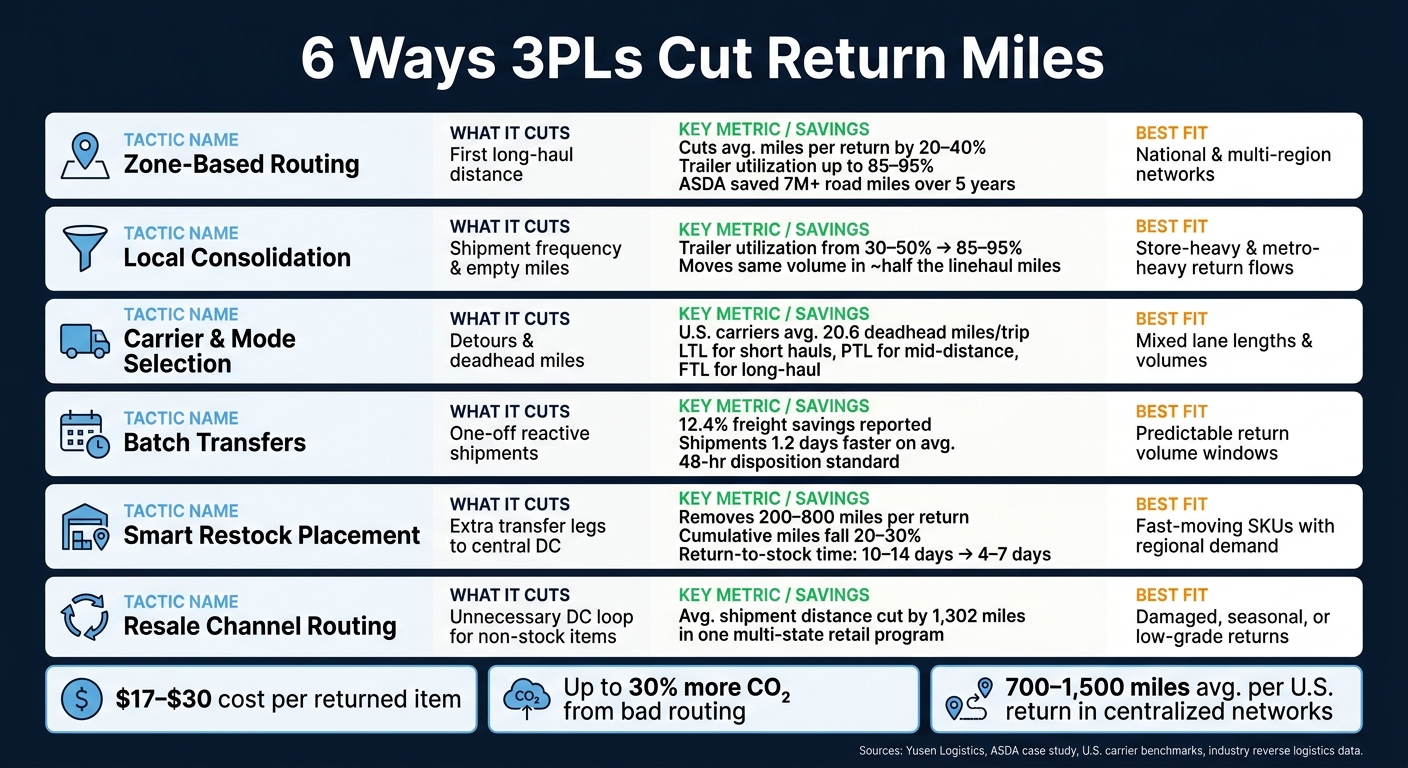
6 Ways 3PLs Cut Return Miles: Tactics, Savings & Best Fit
In centralized returns networks, many U.S. return shipments travel 700 to 1,500 miles before disposition. So it helps to separate what each tactic actually does. Some cut distance. Some improve load density. Others remove extra handoff legs.
Resale routing can cut miles fast. In one multi-state retail program, average shipment distance fell by 1,302 miles when returns were sent straight to nearby nonprofits.
Local consolidation and batch transfers are often the strongest levers for trailer fill. Retailers have reported improving trailer utilization from 50–60% to 80–90% by consolidating store returns through scheduled pickups instead of sending ad hoc parcels. The tradeoff is dwell time. Because of that, many operations cap holds at 24–72 hours for time-sensitive goods.
Carrier and mode selection usually doesn't shorten the lane itself. What it can do is lower miles per item by improving stop density and using more direct line-haul paths. Moving non-urgent returns from air or express to optimized ground LTL can trim cost per unit while still lining service levels up with the urgency of the return.
Smart restock placement may not change the first leg of the trip, but it can remove a second long transfer leg. If returned inventory is placed at the closest viable node for future demand, cumulative miles per return, including reallocation, can fall by 20–30%.
Here’s the quick breakdown:
- Zone-based routing: nearest eligible facility
- Local consolidation: store-heavy or metro-heavy networks
- Carrier and mode selection: lane-based volume with service-level tradeoffs
- Batch transfers: predictable return windows
- Smart restock placement: strong regional demand patterns
- Resale channel routing: distressed inventory that can move straight to secondary channels
The biggest gains usually come from matching the tactic to the lane, the item’s value, and the amount of return volume. Each one cuts miles at a different point in the return flow.
Conclusion
These tactics do more than cut miles. Reverse logistics miles drop fastest when 3PLs use zone routing, local consolidation, better carrier selection, scheduled transfers, smart restock placement, and direct resale routing together.
That approach works only when the return network is built as one connected system. Routing, consolidation, carrier selection, and disposition should all follow the same return-origin and demand data.
In the U.S., centralized return networks can add hundreds of extra miles per item. At e-commerce scale, that distance adds up fast. A nationwide 3PL can connect decisions across pickup, processing, and final disposition, making sure all six tactics work together so one leg doesn’t wipe out gains made somewhere else.
Green reverse logistics works when every return travels the shortest workable distance to its next best use.
FAQs
Which tactic should I implement first?
Start with RMA standardization. When every return follows one documented path, your team gets the consistency it needs for tracking, visibility, and warehouse planning before items even arrive.
That setup also makes tactics like consolidation and smart routing much easier to use well. They depend on clean data and disciplined workflows, so without that base, things can get messy fast.
How do 3PLs decide the best node for a return?
3PLs use data-driven network design and routing rules to send each return to the nearest best processing site based on product needs, return condition or grade, and timing requirements.
They also weigh shipment-level CO2e, consolidation options, and total landed cost - including outbound freight, handling, and inventory carrying costs. If fill rate or performance slips, they adjust routing.
What technology is needed to cut return miles?
To cut return miles, 3PLs lean on integrated platforms that connect WMS, TMS, and ERP systems.
The main tools here include AI-powered route optimization, network design software, nearest-node routing, and predictive analytics. Working together, these tools use real-time traffic, weather, carrier, and return-volume data to map more efficient return paths, spot backhaul opportunities, and allocate staff and resources with less guesswork.
Related Blog Posts
Related Articles
Demand-Driven Replenishment for Multi-Node 3PL

3PL Models Compared for Reverse Logistics Carbon