Profit Margin Calculator
Understand Your Pricing More Clearly
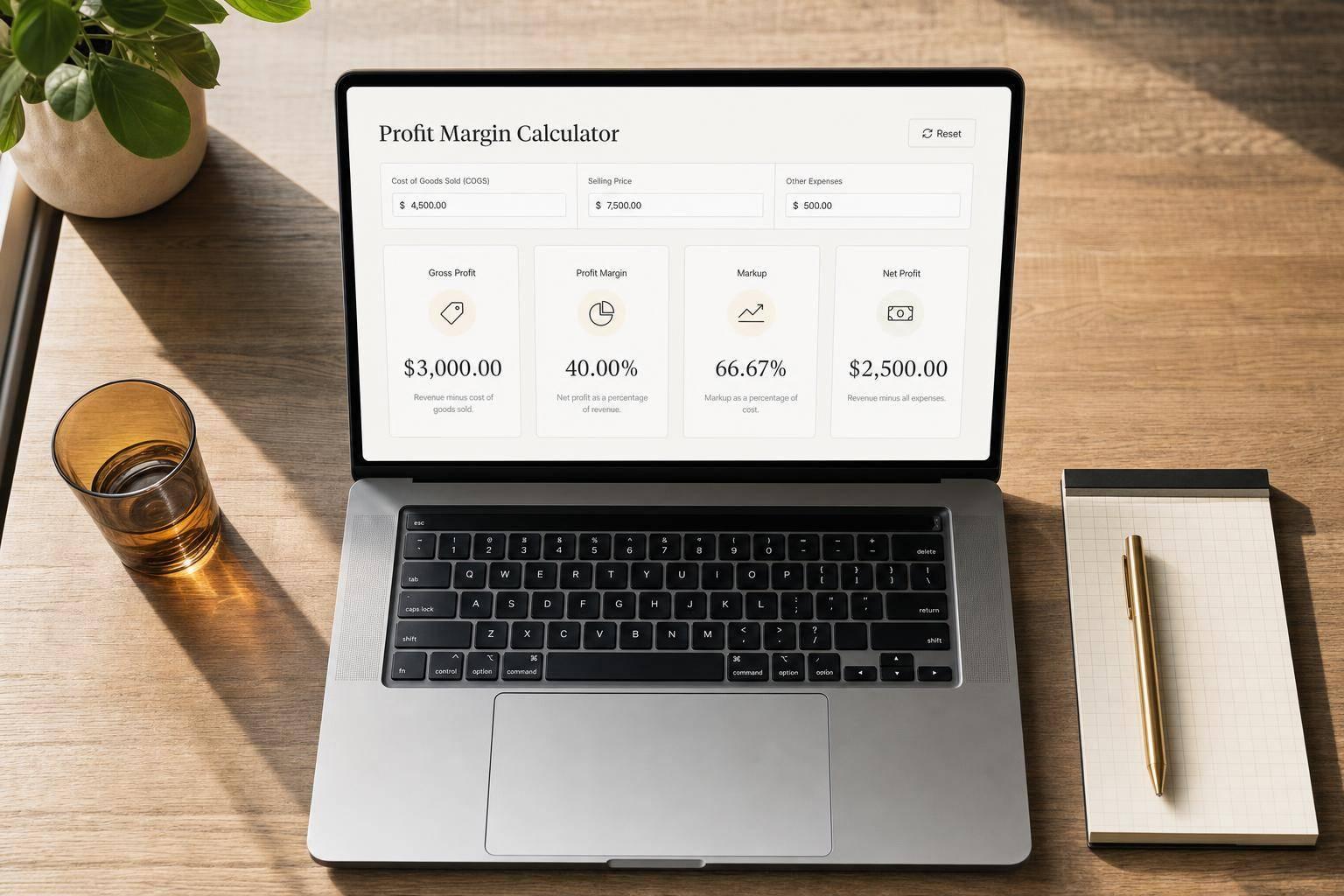
A Profit Margin Calculator helps you move beyond guesswork when setting prices or reviewing sales performance. If you know your revenue and cost, you can quickly see gross profit, gross margin, and markup percentage without working through formulas by hand. That’s useful whether you run a small business, manage product pricing, or simply want a faster way to compare different sales scenarios.
Why These Numbers Matter
Gross profit tells you how much money is left after cost, while profit margin shows how much of each sale you actually keep. Markup gives a different perspective by showing how far your selling price sits above cost. Looking at all three together makes it easier to price confidently and protect profitability.
Go Beyond Basic Profit
If you also have extra expenses such as shipping, fees, or packaging, this tool can help estimate net profit and net profit margin too. That extra layer is often what turns a rough estimate into a more useful business decision. A reliable Profit Margin Calculator can save time, reduce errors, and make day-to-day pricing choices feel much more straightforward.
FAQs
What’s the difference between profit margin and markup?
Profit margin shows the percentage of revenue you keep as profit after covering cost. Markup, on the other hand, shows how much you added to your cost to reach the selling price. They’re related, but they are not interchangeable. A product with a 50% markup does not automatically have a 50% profit margin, which is why it’s helpful to see both numbers side by side.
Why can’t the calculator show margin if revenue is 0?
Margin is calculated by dividing profit by revenue, so a revenue value of 0 would cause a division-by-zero problem. Instead of showing a misleading result, the tool prompts you to enter a value above 0. This keeps the calculation accurate and makes it easier to spot input issues right away.
When should I include optional expenses?
Use optional expenses when you want a clearer view of net profit beyond the direct cost of the product or service. This can include things like shipping, transaction fees, packaging, labor, or overhead tied to the sale. Adding those costs helps you move from a basic gross profit view to a more realistic picture of what you actually earn.
Related Articles

Demand-Driven Replenishment for Multi-Node 3PL

3PL Models Compared for Reverse Logistics Carbon