Ultimate Guide to Packaging Waste Diversion
Most warehouse packaging waste can stay out of landfill if you sort it at the point where it shows up, set packaging rules before freight arrives, and track a few core numbers. In this guide, I break packaging waste diversion into the parts that matter most for ecommerce brands and 3PLs shipping 3,000+ orders per month: floor setup, supplier packaging rules, recycler setup, returns handling, and KPI tracking.
Here’s the short version:
- I define packaging waste diversion as moving corrugate, plastic film, pallets, dunnage, and returns packaging into reuse, recycling, or recovery streams.
- I show why warehouse waste is different from home recycling: it shows up in predictable places like receiving, pack stations, outbound staging, and returns.
- I focus on source sorting because corrugated cardboard is recycled at over 90% in the U.S., while plastic film is near 5% and needs its own flow.
- I explain how to set up station-level sorting with:
- OCC bins
- film-only containers
- pallet zones
- color-coded signs
- clear area ownership
- I cover upstream packaging rules, like:
- using mono-material packaging where possible
- limiting empty space in boxes to 10%–15%
- requiring suppliers to share resin codes and material specs
- I outline how to check recycling partners by stream, contamination limits, bale specs, pickup terms, and weight-ticket records.
- I show how to sort returns packaging into:
- Grade A for direct reuse
- Grade B for internal reuse
- Grade C for recycling
- I narrow measurement to three main KPIs:
- diversion rate
- contamination rate
- net cost per ton
- I end with a rollout path: waste audit, 4–8 week pilot, SOP updates, then network rollout over 8–16 weeks.
If you want lower trash costs, cleaner docks, and numbers you can use in ESG reporting and RFPs, this article gives you the process in plain terms.
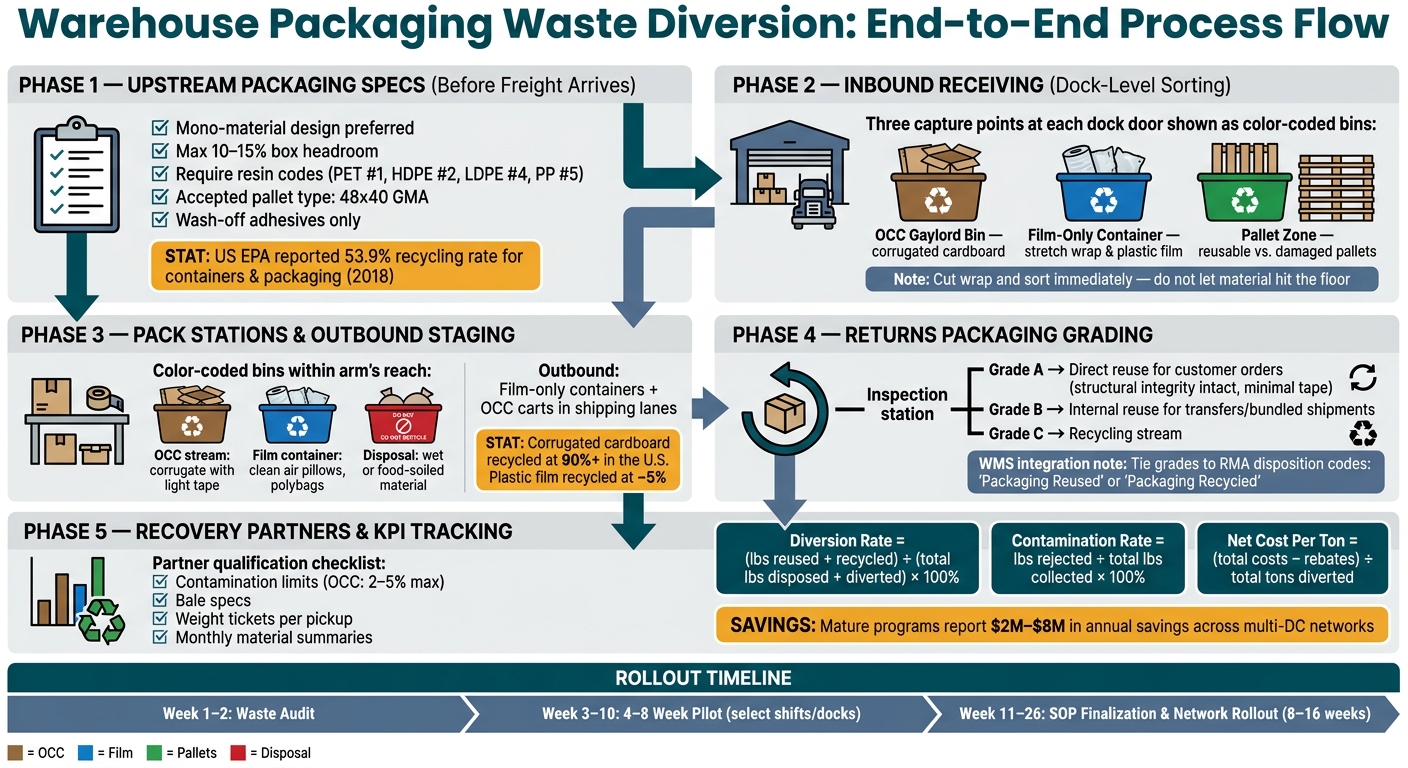
Warehouse Packaging Waste Diversion: End-to-End Process Flow
How Amazon is working to minimize packaging waste
sbb-itb-eafa320
How to Design Warehouse Processes That Capture Materials Correctly
The best way to handle packaging waste is simple: collect it where it shows up. That means building separation into receiving, pack-out, staging, and outbound loading so corrugate, film, pallets, and returns packaging are sorted during the job itself, not piled up for someone to fix later.
When teams have the right capture points in place, sorting becomes part of the workflow. Then the focus shifts to keeping each material stream clean with clear station rules.
Build Separation Points Into Inbound, Pack-Out, and Outbound Flow
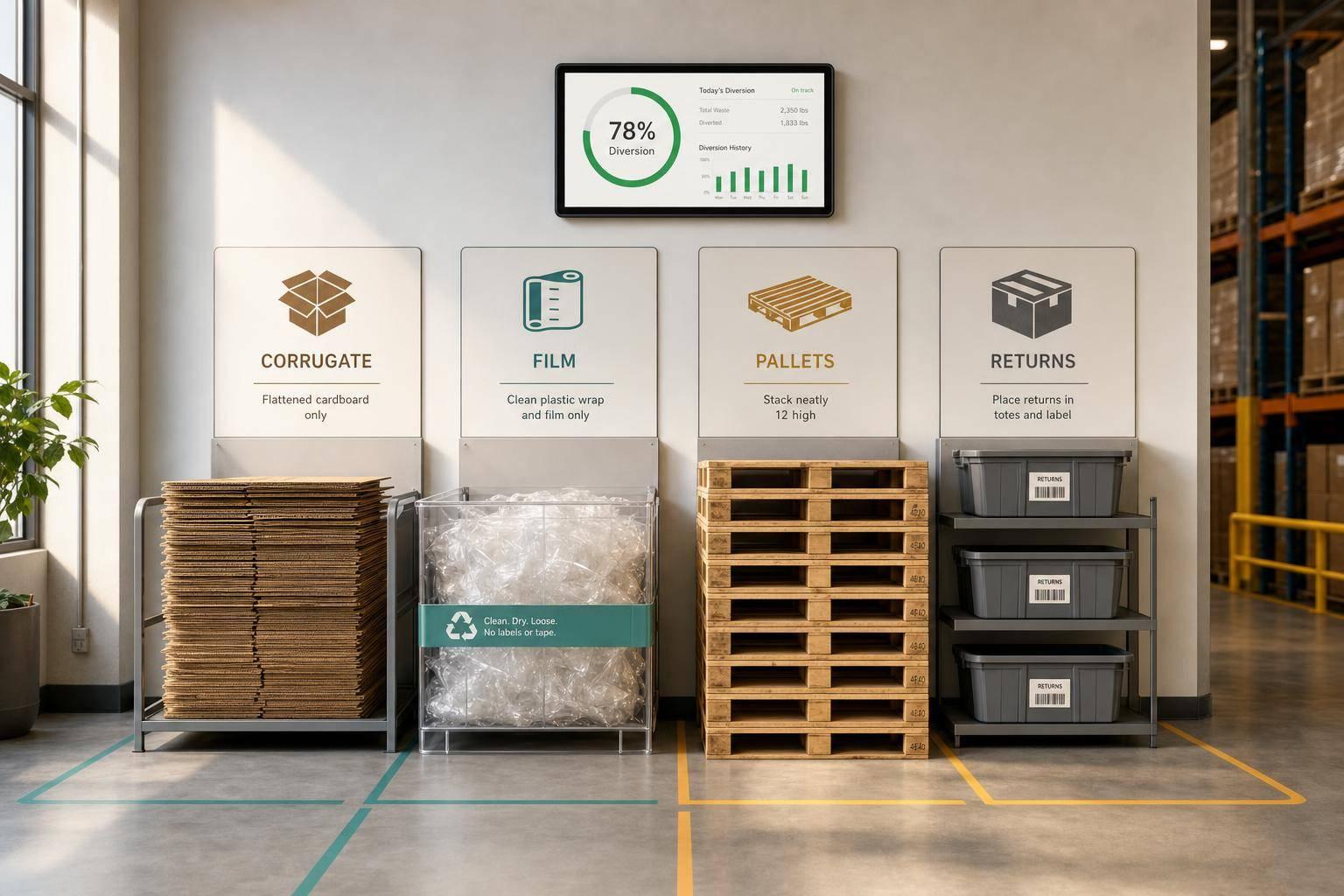
At each dock door, set up three capture points within easy reach:
- an OCC gaylord bin
- a film-only container for stretch wrap
- a marked pallet zone that separates reusable pallets from damaged ones
Receiving teams should cut wrap and place film and corrugate into the right containers right away. If material hits the floor or lands in mixed trash first, you've already made the job harder.
At pack stations, color-coded and labeled bins mounted within arm’s reach help keep operators on task. Corrugate with light tape goes into the OCC stream. Clean air pillows and polybags go into the film container. Wet or food-soiled material goes to disposal.
Outbound staging needs the same level of discipline. Film-only containers and OCC carts in the shipping lanes help collect shrink wrap used on outbound pallets before it ends up in mixed waste.
Prevent Contamination With Clear Ownership and Station Controls
Contamination usually starts with a weak process. If bins aren’t labeled, sit too far away, or get shared across streams, people will make the easy move instead of the right one.
That’s why station controls matter. Color-coded bins paired with large photo signage showing acceptable and unacceptable items at each station can cut down mistakes before they spread.
Ownership matters too. Each area should have one named role in charge. The dock supervisor should own film quality and pallet zone organization. The pack-area lead should own OCC quality at pack benches.
If contamination shows up, don’t let it drift through the system. Isolate it, send it to disposal, and log where it came from so the team can fix the source.
Set Up Consolidation and Pickup-Ready Handling Areas
Once material is collected at the station level, it needs a clean route to consolidation. Balers compact OCC and LDPE film into easier-to-handle bales. Gaylords and roll-offs handle bulk volume near the docks. The consolidation area should also have clear aisles, stack limits, and regular housekeeping.
Baled LDPE film should stay indoors and dry. Moisture, paper labels, and food residue are common reasons recycling loads get downgraded or rejected. In plain English: one sloppy bale can create a headache fast.
During peak season, step up housekeeping so overflow doesn’t lead to missed standards or rejected pickups. This kind of process control gets even better when upstream packaging specs cut down mixed materials before they reach the dock.
Set Packaging Specs and Supplier Rules Before Materials Reach the Warehouse
Packaging waste diversion starts before a shipment shows up at the dock. If materials come in as mixed laminates, composite mailers, or film that can't be recycled, the warehouse is stuck from the start. At that point, even strong floor controls can only do so much. The job is to set packaging specs early so materials can move into the right recovery stream later.
Write Packaging Standards That Improve Recovery and Reduce Mixed Waste
The simplest rule is often the one that works best: mono-material design. When one component stays within one material family, recovery gets much easier. A corrugated box with paper cushioning and paper tape can usually stay in the OCC stream with far less sorting. Add a plastic window or metallic laminate, and recovery becomes a lot tougher. That matters when the US EPA reported a 53.9% recycling rate for containers and packaging in 2018. Packaging that lines up with what US recovery facilities already take - like OCC corrugated, HDPE, PET, and LDPE film - has a better shot at being diverted.
Right-sizing is just as important. A solid target is no more than 10–15% headroom around the product, which cuts down on void fill and extra corrugate. Labels and adhesives matter too. Ask for wash-off adhesives that separate cleanly during pulping, and limit high-coverage labels made from materials that don't match the base substrate.
Require Supplier and Packaging Vendor Inputs During Onboarding
If a supplier can't tell you what resin an inner bag uses, you've got a sorting issue the minute that bag hits the warehouse. During onboarding, require a material composition breakdown for every packaging part - cartons, mailers, void fill, tape, banding, and stretch film. That should include plastic resin codes such as PET #1, HDPE #2, LDPE #4, and PP #5, along with fiber grades for paper and corrugate. Also ask which recovery path fits each item: curbside, commercial, or specialty streams.
Onboarding should also cover case-pack and pallet rules. Spell out accepted pallet types, such as 48x40 GMA, along with build quality and repair limits so pallets can move across sites for reuse instead of getting scrapped. For slip sheets, recyclable fiberboard is the better pick over non-recyclable plastic when load stability allows. Put all of this into one shared packaging database so inbound teams have a clear reference for each supplier. Then they can tell right away whether a carton belongs in a reuse area or a mailer belongs in the residual bin.
Align Packaging Decisions With Fulfillment and Value-Added Workflows
Kitting, assembly, and relabeling all add more material to the waste stream - inner bags, instruction sheets, branded wraps, compliance stickers. Those items may seem small, but they add up fast. And if they aren't chosen with diversion in mind, they create messy, hard-to-sort streams that chip away at overall performance.
Map each value-added workflow and set material rules for every added component. That can include:
- paper-based fillers for kitting trays
- mono-material polybags
- recyclable label stocks that don't contaminate the OCC stream
Then use floor data to adjust box sizes, swap out materials, and tighten supplier rules. After specs are set, check that recovery partners accept those same materials.
Manage Recovery Partners, Returns Packaging, and Performance Data
Once materials are sorted the right way, the next job is simple in theory and messy in practice: prove there’s a real end market for them.
Qualify Recycling Partners and Document Material Acceptance
Start by mapping each material stream. Then line up one primary outlet and one backup outlet for each stream.
For every partner, document exactly what they’ll take. That includes contamination limits and bale specs. OCC buyers often cap contamination at 2–5% by weight. Go over that limit, and the load can be downgraded or rejected. You’ll also want pickup cadence, rebates or fees, contamination charges, and fuel surcharges spelled out in writing, whether service is weekly or on-call.
Chain-of-custody records are NOT optional. Ask for weight tickets for every pickup, monthly material summaries by weight and grade, and periodic processing attestations that confirm where the material was processed. Keep all of it in a Recycling Partner Specification Sheet tied to your master service agreement.
Then use those same acceptance rules at the station to grade returns packaging. That keeps decisions consistent instead of turning them into judgment calls.
Build a Reuse and Recycling Path for Returns Packaging
Once outbound outlets are approved, returns packaging should follow the same material rules.
Add a packaging inspection step at the returns station. Associates should check cartons for structural integrity, moisture damage, heavy tape buildup, and label coverage. Mailers need a quick look too, especially whether the adhesive strip still works or can be re-taped under your SOP. Void fill and inserts like paper, honeycomb, and corrugated material should get a fast cleanliness check. If the packaging still protects the product and can be reused without quality issues, grade it for reuse. If it’s crushed, dirty, or covered in labels, route it to the right recycling stream.
A simple three-grade setup tends to work well:
- Grade A: direct reuse for customer orders
- Grade B: reuse for internal transfers or bundled shipments
- Grade C: recycling
Tie those grades to RMA disposition codes in your WMS, using standard codes such as "Packaging Reused" or "Packaging Recycled". That way, reuse becomes something you can track, not a one-off decision on the floor. For multi-client 3PLs, add brand-specific reuse rules in the WMS so each client’s standards stay clear.
Track the Metrics That Show Whether the Program Is Working
Measurement is what turns diversion from a good idea into a managed program.
Track three KPIs: diversion rate, contamination rate, and net cost per ton.
Diversion rate is the total pounds sent to reuse or recycling divided by total pounds disposed plus diverted, shown as a percentage. Contamination rate is pounds rejected or downgraded because of contamination divided by total pounds collected. Net cost per ton takes total program costs, including labor, equipment, and fees, subtracts rebates or revenue, and divides the result by total tons diverted. Compare that number against your baseline landfill cost per ton to show savings in plain terms.
Before you set targets, run a 3–6 month baseline period. Use that time to weigh landfill and diverted materials by stream, record current hauling costs, and log contamination incidents. After that, set SMART targets such as "increase diversion rate from 45% to 60% within 12 months" or "reduce contamination below 3% within two quarters."
Ownership matters here. Diversion and contamination should sit with the site operations manager. Cross-site tracking should sit with sustainability or continuous improvement. Weekly site huddles of 15–30 minutes help teams catch contamination issues and missed pickups before they snowball. Monthly network reviews give leadership a way to compare sites, share what’s working, and approve changes like more balers or more frequent pickups.
How to Roll Out and Standardize the Program by Network Size
Launch Steps for a Single Site
Once source separation, packaging specs, and partner rules are set, roll out the program in a clear sequence.
Start with a waste audit. Over one to two weeks, catalog every outgoing material stream. Record volumes in pounds per week, note where each stream starts - receiving, pack-out, returns - and log current disposal costs. Then map inbound, pack-out, outbound, and returns flows so you can see every point where a packaging decision happens.
From there, write material handling rules and line them up with your supplier packaging specs. Onboard recovery partners and get partner acceptance in writing. Build role-based training, visual SOPs, and if/then signage so supervisors and associates know exactly what goes into each stream.
After that, run a four-to-eight-week pilot on a few shifts or docks before finalizing the SOP. Track diversion rate and contamination rate, tighten the process, and turn it into a written SOP that covers station layouts, material codes, and escalation steps. A timeline from audit to stable SOPs is 8–16 weeks, depending on site size and partner readiness.
Expand From Regional Sites to a Multi-Node Network
Once the pilot proves the SOP, turn it into a network standard, with room for site-level exceptions.
The pilot matters because it gives you a repeatable model. Pull out the parts that should stay the same everywhere:
- Bin specs
- Signage
- Material codes
- KPIs
- Training
Those become the network standard. Each site should then keep a local appendix for rules tied to that location. Municipal recycling rules vary across the U.S., and a material accepted in one metro area may be turned away in another. Each appendix should include an acceptance matrix tied to that site's recovery partners, along with pickup schedules and storage rules shaped by building layout and hauler routes.
Roll this out in regional waves, not all at once. Test the standardized framework at one or two representative sites, adjust it, and then expand. Regular network reviews give leadership a steady rhythm for comparing sites, spotting outliers, and approving changes to bin layouts or vendor arrangements.
Multi-node 3PLs can move faster by building stream separation and baling into standard inbound and outbound SOPs across facilities. They can also use existing linehaul routes to backhaul recyclables to regional consolidation points where recovery markets are stronger.
Use the pilot to set the rules, then apply those same rules across the network.
Conclusion: The Principles That Drive Long-Term Diversion Results
A diversion program that lasts comes down to a short list of rules applied the same way over time.
Design capture into the workflow. Separation needs to happen where packaging is created, not at the tail end of the dock. Reduce complexity at the source. Write packaging specs that limit mixed materials before they ever enter the building. Qualify downstream partners with care. Put accepted materials in writing, because one rejected load can wipe out weeks of sorting effort. Build a clear returns path. Reverse logistics should support diversion, not contaminate it. And track a small set of metrics - diversion rate, contamination rate, and net cost per ton - so performance stays comparable across sites and corrective action stays fast as the network expands.
Large 3PL operators with fully implemented zero-waste-to-landfill programs across multi-distribution-center networks report annual savings of $2 million to $8 million once programs are mature. That result doesn't come from one fix. It comes from standardized processes, reliable partners, and steady measurement across every node in the network.
FAQs
How do I start a diversion program at one warehouse?
Start by reviewing 30 to 60 days of shipping data to spot high-volume SKUs that ship with too much empty space. Then use what you find to build right-size packaging rules in your WMS, linking each SKU to a set group of cartons, mailers, and dunnage.
At the same time, put a formal returns workflow in place. That workflow should cover inspection, grading, and a disposal hierarchy that puts restock, resale, or recycling ahead of landfilling.
Track a few monthly KPIs so you can see what’s changing over time:
- Diversion rate
- Packaging weight per order
- Empty space ratio
What packaging materials should be separated on the floor?
Separate secondary packaging - like cardboard, stretch wrap, and pallets - into dedicated recycling or reuse streams.
Keep regulated materials, such as electronics, batteries, and hazardous components, out of general recyclables. That helps prevent contamination and supports compliance.
During inspection, classify recycling and disposal items, document them with waste manifests, and include these steps in standard operating procedures.
How can I reduce contamination in recycling loads?
Prioritize proper classification and disciplined warehouse processes. Keep regulated materials - such as electronics, batteries, and hazardous components - separate from general recyclables because they’re major sources of contamination.
Train staff to spot and sort these items before they enter the recycling stream. Use waste disposal manifests for regulated shipments, and work only with certified recyclers that can verify handling and provide audit trails.
Related Blog Posts
Related Articles

Demand-Driven Replenishment for Multi-Node 3PL

3PL Models Compared for Reverse Logistics Carbon