Why High-Growth Brands Need Custom Kitting
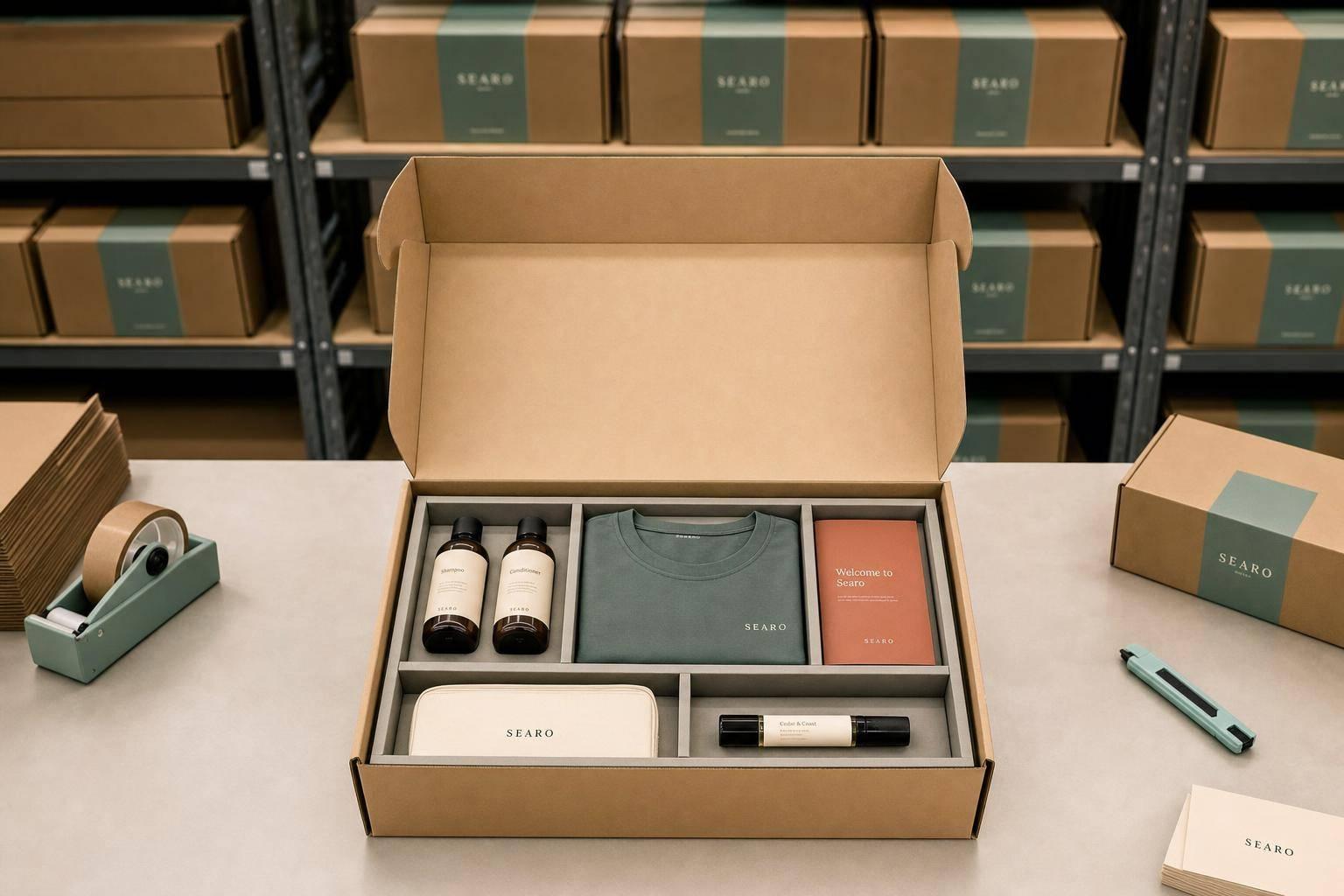
If your brand sells more bundles, inserts, and promo packs, standard pick and pack starts to slow down and cost more. I’d sum it up this way: custom kitting turns a multi-item order into one ready-to-ship unit, which cuts handling steps, lowers mistakes, and keeps orders more consistent as volume climbs.
Here’s the short version:
- I see custom kitting as pre-assembling products, packaging, and inserts into one kit before orders arrive
- That kit gets its own SKU and barcode
- Instead of picking several items per order, the warehouse makes one pick and one scan
- This can cut order processing time by up to 40%
- Teams using kitting setups have hit 99%+ order accuracy
- Pick and pack can take 55% of labor time and up to 75% of warehouse costs, so reducing touches matters
- It also helps keep inventory, retail compliance, and unboxing more consistent
- For me, the main trigger is simple: when bundles and SKU variation keep growing, kitting stops being optional
What changes when I use custom kitting?
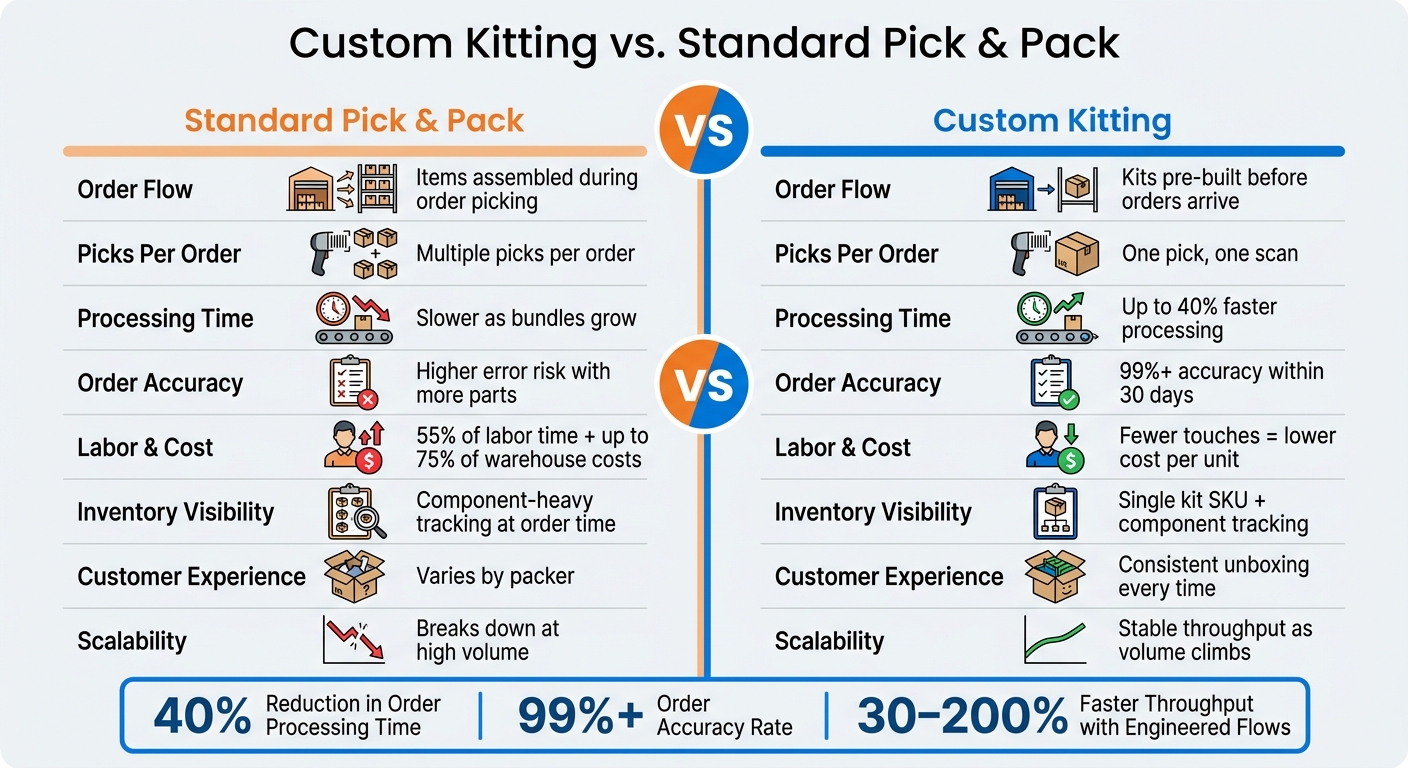
- Order Flow: In a standard pick-and-pack operation, items are assembled into an order during the picking process. With custom kitting, kits are pre-assembled before orders are placed, streamlining fulfillment once demand arrives.
- Picks per Order: Standard pick-and-pack typically requires multiple picks for each order, while custom kitting reduces fulfillment to a single pick of the completed kit.
- Error Risk: Standard pick-and-pack carries a higher risk of errors because more individual components must be selected and packed. Custom kitting generally reduces errors through pre-assembly and barcode verification processes.
- Shipping Speed: As bundles become more complex, standard pick-and-pack operations can experience slower fulfillment times. Custom kitting tends to maintain more consistent shipping speeds, especially at higher order volumes.
- Inventory Visibility: Standard pick-and-pack focuses on tracking individual components at the time of order fulfillment. Custom kitting requires tracking both finished kit SKUs and the underlying component inventory.
- Customer Experience: Standard pick-and-pack outcomes can vary depending on the individual packer and process execution. Custom kitting typically delivers a more consistent presentation, packaging, and unboxing experience.
In plain terms, this article says that high-growth brands need custom kitting because growth adds complexity faster than basic fulfillment can handle. When that happens, prebuilt kits help protect speed, accuracy, and <u>brand presentation</u> without forcing the warehouse to assemble every order by hand.
Custom Kitting vs. Standard Pick & Pack: Key Differences for High-Growth Brands
How it Works: 3PL Kitting Services
sbb-itb-eafa320
The problem: standard pick and pack breaks down at scale
Standard pick and pack can work for a while. Then bundles, inserts, and multi-SKU orders start piling on extra manual work. That’s usually when the cracks show: first in labor, then in inventory accuracy, and then in how the order looks when it lands on the customer’s doorstep.
More SKUs per order raise labor cost and slow shipping
Every extra SKU adds another pick, scan, and pack step. That means more labor and slower throughput. Picking and packing already takes up 55% of labor time and as much as 75% of warehouse operating costs in standard fulfillment setups.
Now add multi-item bundles. Labor cost per order goes up, even when order volume grows. In a standard pick-and-pack model, more volume doesn’t cancel out the extra work that comes with more complex orders.
The strain gets worse during product launches and seasonal peaks. Teams move faster, pull more parts, and build kits on the fly while still handling regular orders. That’s when aisles get crowded, work backs up, and shipping speed starts to slip.
Bundle complexity creates inventory and accuracy problems
Then there’s the control issue. When teams pull components one order at a time, inventory counts can drift out of sync. And a kit only ships if every single part is there. If one component is missing, the whole kit gets stuck.
Mis-picks also become more common when workers are grabbing similar-looking items under pressure. Those mistakes eat into margin fast. And for retail-channel orders, the cost can hit even harder because labeling and pack-out rules leave less room for error.
Unboxing becomes inconsistent
Even if an order goes out on time, the job still isn’t done. If packing happens ad hoc, the unboxing experience can feel uneven from one order to the next. That can lead to avoidable returns.
At that point, custom kitting stops being a nice extra. It becomes the only sane way to keep the process under control.
The solution: how custom kitting improves speed, control, and growth
Custom kitting fixes that mess by changing fulfillment from item-by-item assembly to prebuilt, single-SKU shipping. Instead of pulling each product on its own, the team works with one pre-assembled kit. In plain English: one scan, one pick, and the order keeps moving.
Fewer handling steps improve throughput and reduce errors
Once a kit has its own barcode, the fulfillment team doesn't need to handle every component one by one. A single scan confirms the full order. That shift can reduce order processing time by up to 40% compared to old-school multi-item picking. Engineered conveyor flows can also run 30% to 200% faster than standard table builds.
There’s another upside here: fewer touchpoints usually mean fewer mistakes. Dedicated kitting stations use visual guides and quality checks at each stage, so issues get caught before the box is sealed. Teams using this setup have reached 99%+ accuracy rates within 30 days of making the switch.
Kit SKUs simplify inventory planning and promotions
Managing a bundle as a single kit SKU gives your team a cleaner view of demand and replenishment. It also helps avoid a common headache: one missing item holding up the whole batch.
Pre-built kits turn fulfillment into a single pick-and-ship motion, which makes it easier to launch new offers fast. And when demand is hard to predict, on-demand kitting gives you more room to move. Components stay separate until an order triggers assembly, so inventory isn't tied up in a bundle that may sit on the shelf.
That kind of repeatability is what makes kitting easier to run at scale.
Custom packaging supports customer experience and order value growth
A consistent kit creates a consistent unboxing experience for every customer. Kitting helps keep presentation uniform, which protects brand perception. HiSmile bundled over 80% of orders, lifting average cart size fourfold. And with a standardized BOM, each kit stays repeatable from one order to the next.
How a 3PL makes custom kitting scalable
For high-growth brands, scalable kitting comes down to tight process control, not just more warehouse space. The aim is simple: keep kits moving even as order volume grows, SKU counts climb, and promo bundles get more complicated. At that point, the big factor is how the 3PL receives, tracks, and stages each component.
How a kitting program runs inside a 3PL
A solid kitting program starts before a single box gets packed. When components arrive, the receiving team samples one carton per pallet for each SKU to catch hidden shortages before anything hits the production floor. That step matters more than it may seem. If missing units slip through receiving, they can stall the whole line later.
From there, work orders move through the WMS/ERP, and barcode checks at each station confirm that the correct components go into each kit. A strong WMS tracks every part from receiving through finished goods. For brands selling through major retailers, that visibility also helps meet compliance rules and tight timing tied to retail orders and seasonal launches.
What to look for in a logistics partner
The right partner makes kitting a repeatable process, not a manual scramble. The difference shows up fast when kits change, volumes jump, or timelines get tight. Generic providers often treat kitting like an extra service. That usually falls apart when BOMs shift, demand spikes, or a promo bundle needs to launch in days.
A capable kitting partner should be able to scale staffing from 20 to 150 workers in one to two days without losing accuracy. On the tech side, look for WMS/ERP integration that takes days, not months. That kind of speed matters when a launch or retail order has a hard deadline.
Fixed cost-per-unit pricing is another strong signal. It gives the 3PL a direct reason to get more efficient as volume grows. And kitting alone isn't enough. As operations get bigger, it helps to have one partner that can also handle:
- pick & pack
- returns management
- testing
- white glove handling
That way, you don't end up patching together several vendors just to keep orders moving.
Where JIT Transportation fits
That is where JIT Transportation fits for brands that need kitting, fulfillment, and transportation under one system. JIT Transportation supports custom kitting, fulfillment, and transportation for brands that need one logistics partner to keep inventory visible and orders moving.
Conclusion: custom kitting becomes necessary as volume and complexity grow
Standard pick and pack works when orders are simple and volume stays steady. But fast-growing brands don’t stay in that stage for long. As catalogs get bigger and promo calendars get packed into tight windows, cracks start to show: labor costs climb, mistakes happen more often, and presentation gets uneven.
When those issues keep coming back, kitting is no longer a nice extra. It becomes part of the job. That shift happens when growth brings repeat complexity, like monthly subscription boxes with changing item lists or retail orders with strict compliance rules.
Inventory mistakes can eat into margins fast. And the damage doesn’t stop in the warehouse. It reaches the customer. Incomplete kits lead to returns and chip away at trust.
That’s why custom kitting moves from convenience to a core fulfillment function. As order complexity goes up, pre-built kits help keep fulfillment fast, accurate, and on-brand.
For brands moving past simple single-item shipments, custom kitting becomes a core fulfillment requirement. It helps protect speed, accuracy, and brand presentation as growth picks up.
FAQs
When should I switch to custom kitting?
Switch to custom kitting when your product mix gets more complicated, order mistakes start piling up, or fulfillment becomes harder to scale. That usually happens when you add bundles, promo kits, or more orders with multiple items.
A clear kitting process helps your team pack orders with better accuracy and consistency. It can also cut turnaround time and reduce delays, mistakes, and wasted labor. This becomes even more helpful during demand spikes or when you're launching new products.
What’s the difference between prebuilt and on-demand kitting?
Prebuilt kitting means your team assembles kits before orders come in, then stores them so they can ship right away. It’s a good fit for fixed bundles, subscription boxes, and promo kits where the contents don’t change much.
On-demand kitting means kits are put together after a customer places an order. That setup works better for variable orders or custom configurations. It also helps keep inventory lean because final assembly happens only when demand is confirmed.
How do I know if my 3PL can handle custom kitting?
Ask whether your 3PL has workflows built for variability, not just volume. It should also be able to connect your ERP, WMS, and EDI so it can manage BOMs and track inventory movement without things slipping through the cracks.
You’ll also want to confirm that it can handle demand surges, tighten up processes, maintain quality control, and provide transparent pricing, clear SLAs, and flexible, scalable support.
Related Blog Posts
Related Articles

Demand-Driven Replenishment for Multi-Node 3PL

3PL Models Compared for Reverse Logistics Carbon