
How 3PLs Build Collaborative Supply Chains with Tech

If your 3PL and your systems do not share the same data, errors spread fast. I’d boil this down to one idea: good 3PL collaboration depends on shared data, clear rules, and regular review.
Here’s the short version:
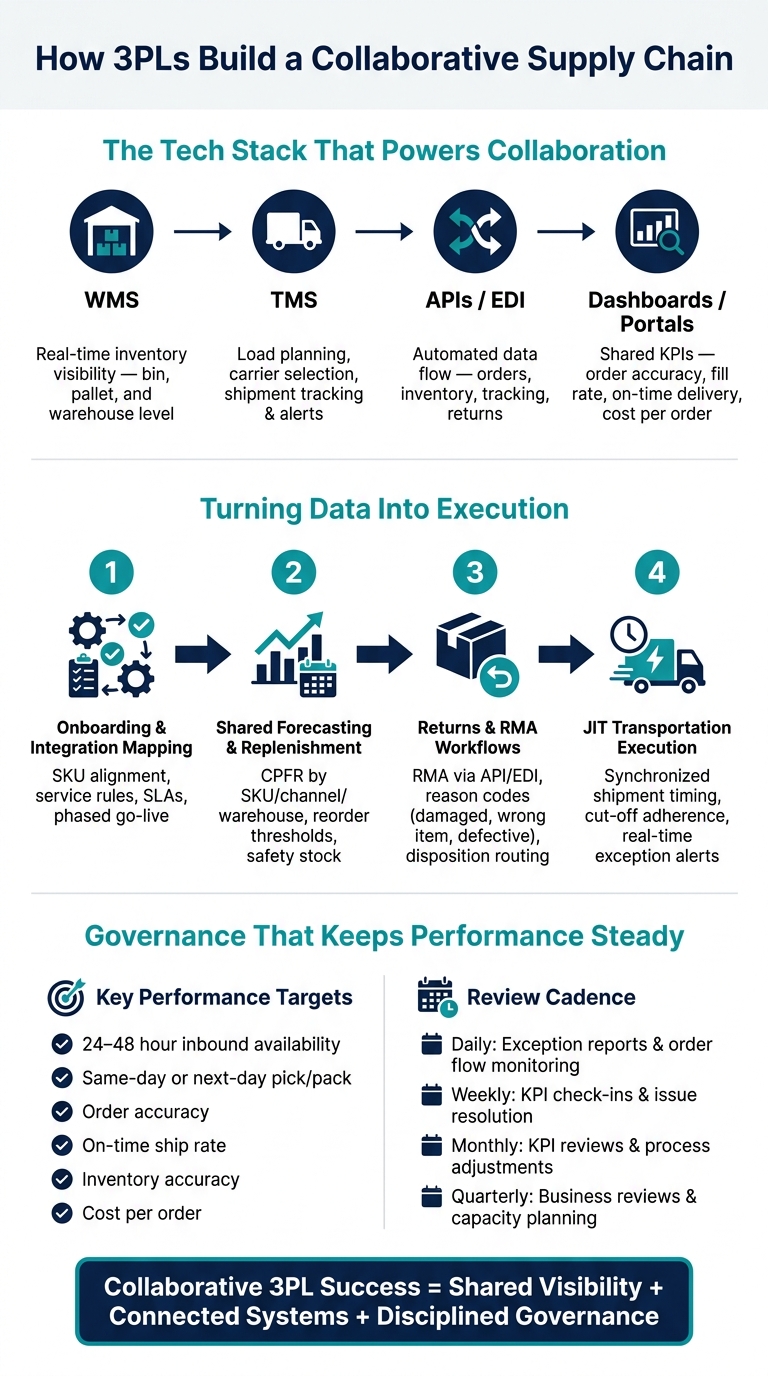
- WMS keeps inventory counts aligned across bins, pallets, and warehouses.
- TMS helps track loads, carriers, delivery times, and delays.
- APIs and EDI move orders, inventory updates, tracking events, and return data between systems.
- Dashboards and portals give teams one place to check KPIs like order accuracy, fill rate, on-time delivery, and cost per order.
- Onboarding matters because bad SKU mapping, unit errors, or shipping-rule mistakes can lead to mis-picks and late orders from day one.
- Forecasting and replenishment work better when the brand and 3PL use the same demand data by SKU, channel, and warehouse.
- Returns and RMAs need the same level of system connection as outbound orders.
- Governance is what keeps the relationship working after launch: SLAs, escalation paths, weekly reviews, monthly KPI checks, and quarterly business reviews.
A few numbers stand out in the article: teams often work toward 24–48-hour inbound availability and same-day or next-day pick/pack for standard orders. Those targets only hold when system rules, carrier plans, and warehouse processes match.
What I take from the piece is simple: a 3PL stops feeling like an outside vendor when both sides work from the same inventory view, the same shipment data, and the same scorecard. That is what turns day-to-day coordination into a repeatable way of working.
Below, I’ll walk through the systems, workflows, and review habits that make that happen.
How 3PLs Build a Collaborative Supply Chain: Systems, Workflows & Governance
The Core Technologies 3PLs Use to Build Collaboration
WMS and Inventory Visibility Across Fulfillment Operations
A WMS sits at the center of shared inventory visibility. It tracks stock at the exact location level, down to the bin, pallet, or zone, so the 3PL and the client are working from the same numbers. That single view replaces delayed spreadsheets and manual stock checks.
Each warehouse move is scanned and timestamped: receiving, putaway, picking, packing, cycle counts, and returns. That scan-based process helps keep inventory accurate over time. JIT Transportation describes real-time data as the shift from static planning to active control. When a client can see on-hand stock, available-to-promise inventory, and exception alerts in near real time, they can make replenishment calls before a stockout hits instead of reacting after the fact.
This gets even more important in multi-channel operations. A WMS keeps each client’s inventory separate while still showing one view across all locations. So if a brand sells through e-commerce storefronts, marketplaces, and EDI retail partners, it can trust that inventory numbers stay consistent across every channel.
Once inventory is visible, the next step is making sure it moves on time.
TMS, Shipment Tracking, and Carrier Coordination
A TMS plans loads, selects carriers, routes shipments, and tracks delivery from pickup through proof of delivery.
Across U.S. time zones, cutoff times, pickup windows, and delivery appointments all need to stay in sync, especially during peak periods when carrier capacity gets tight. A TMS gives the 3PL and the client a shared view of appointment status, in-transit milestones, and on-time performance. That way, teams can deal with exceptions before they turn into service failures.
The best tracking does more than just report status. Automated alerts can flag a late carrier scan, a changed delivery appointment, or a missed shipment milestone. That gives both sides time to act, whether that means re-routing freight, notifying a customer, or triggering expedited replenishment.
Those shipment events only help if they feed into the same data layer the client already uses.
APIs, EDI, Portals, and Analytics for Shared Decision-Making
APIs and EDI keep systems aligned without manual re-entry. Orders, inventory updates, shipment events, and returns move automatically between the e-commerce platform, ERP, WMS, and TMS. That data loop cuts latency and lowers errors across the operation.
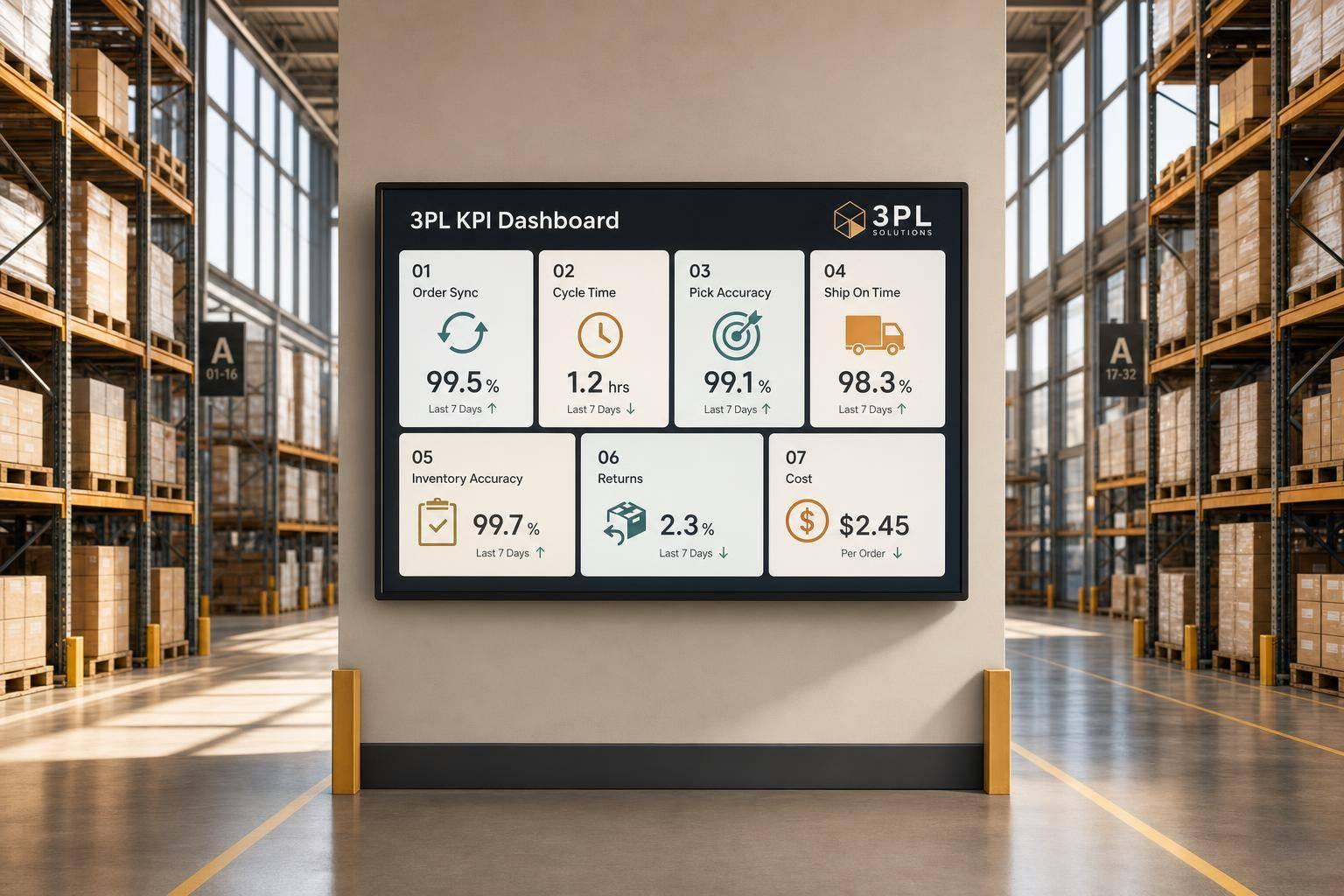
Modern fulfillment depends on data moving cleanly between sales channels, ERPs, carriers, and warehouses. Client portals and analytics dashboards bring forward the KPIs that drive day-to-day decisions:
- Order accuracy
- Fill rate
- On-time delivery
- Return cycle time
- Cost per order
- Dock-to-stock time
These metrics only help when both sides use the same definitions and review them on a set cadence. If that shared review is missing, even a strong system stack can spit out conflicting numbers and leave exceptions unresolved.
JIT Transportation shows how a connected tech stack can keep fulfillment, transportation, and value-added services in one shared operational picture. That shared data becomes the basis for the workflows that follow.
sbb-itb-eafa320
How Are 3PLs Embracing Warehouse Automation and AI?
How 3PLs Turn Technology Into Collaborative Workflows
Once systems share clean data, the job moves from simple visibility to actual execution.
Onboarding, Integration Mapping, and Go-Live Preparation
A connected tech stack only works if the data moving through it is right from day one. That makes onboarding the point where teamwork turns into day-to-day operations. WMS, TMS, APIs, and portals don’t run on good intentions. They run on data rules that match the operating plan.
Before a single order goes out, the brand and 3PL need to line up on service rules and SLAs. That includes same-day pick/pack cut-off times, carrier mix, packaging rules, and value-added services such as kitting and white-glove handling. Those commitments then need to be turned into clear targets, like 24–48-hour inbound availability and same-day or next-day pick/pack for standard orders.
Next comes data mapping. Every field has to line up across systems: SKU IDs, unit of measure, pack sizes, shipping methods, and return reason codes. If an ERP and WMS don’t match on SKU data, mis-shipments can pile up fast. Strong 3PLs test both normal and exception flows, including partial shipments, split orders, address corrections, and label errors. They also test USPS address normalization and service mapping for Ground, 2-Day, and Next Day. After go-live, those mappings stop being setup details and become the rules that drive daily work.
The safest way to launch is usually a phased go-live. Start with a smaller SKU set or one sales channel, then expand. It’s a simple way to catch mapping problems before they snowball.
Shared Forecasting, Replenishment, and Inventory Control
Once integrations are live, the brand and 3PL can plan from the same demand signal. At that point, the focus shifts to keeping inventory in the right place at the right time. This is where Collaborative Planning, Forecasting, and Replenishment (CPFR) starts to show up in actual warehouse and transport decisions.
Using the WMS inventory view, teams can set weekly or monthly forecasts by SKU, channel, and warehouse. They can also layer in promotional calendars and planned product launches. The 3PL uses that shared view to plan labor schedules, carrier commitments, and slotting changes. Replenishment workflows then set minimum and maximum inventory thresholds for each SKU, with reorder points tied to lead time and safety stock rules. When stock gets close to a threshold, the 3PL sends a replenishment alert.
A strong WMS protects brand reputation by keeping every shipment accurate.
For Q4 spikes, early SKU-level forecast uplifts give the 3PL time to prebuild kits, re-slot fast movers, and add carrier capacity. That kind of early signal can be the difference between smooth execution and a warehouse scrambling to catch up.
In a Vendor-Managed Inventory (VMI) setup, the 3PL or supplier takes direct responsibility for watching stock levels and starting replenishment based on agreed rules. That cuts down on the manual follow-up that tends to slow reactive operations.
Returns, RMA Workflows, and Time-Sensitive Transportation Execution
The same shared data also tightens the reverse flow. RMA data should move through the same API or EDI links used for orders and tracking. A solid RMA process starts when the brand’s system creates a return authorization and sends it to the 3PL through API or EDI. The customer gets an automated return label that matches the 3PL’s receiving process. When the item arrives, it’s checked in against the RMA and moved to a quarantine bin, where it stays separate until inspection is done.
During inspection, warehouse staff apply reason codes such as "damaged in transit", "wrong item shipped", "buyer remorse", or "defective." Each code ties to a disposition: restock, refurbish, send to secondary markets, or dispose. Each option carries a different financial result. Because both sides share the same reason-code data, patterns are easier to spot. If "wrong item shipped" jumps for one SKU, that can point to a pick-location problem that should be fixed before it leads to more returns.
On the outbound side, just-in-time (JIT) transportation applies that same data-led discipline to shipment timing. In a 3PL setting, JIT transportation means tightly scheduled moves that arrive exactly when needed. The goal is to cut dwell time and storage costs while keeping service reliability high. For that to work, teams need accurate real-time inventory data, clear order cut-off times, carrier transit times, and alert systems that flag risks such as weather delays or capacity shortfalls before service levels are missed.
JIT Transportation shows how synchronized systems keep orders and transport aligned in one operating model.
How to Build a Tech-Enabled Collaborative 3PL Strategy
Audit Your Current Operation and Define the Collaboration Model
Once your systems are set up, the next move is figuring out how the 3PL relationship should run day to day.
Start with a 12-month baseline of order data, SKU mix, sales channels, and service failures. That gives you a clear picture of the right 3PL model for your business. Look at volume trends, seasonality, channel mix, customer location, and any SKUs that need special handling. Then document each failure point and tie it to a business cost, like stockouts, late shipments, or extra safety stock that locks up cash.
Your success criteria should be framed in business terms, such as:
- better order accuracy
- lower shipping cost per order in USD
- faster order cycle times
- better inventory turns
These targets become the benchmarks used to judge the 3PL relationship.
That baseline also shows which workflows need to be connected first.
Connect the Right Systems and Pilot the Workflow
Start with the data flows that carry the most risk: order creation, inventory sync, shipment events, and return and RMA status.
After the core integrations are mapped and tested, run a controlled pilot before rolling the process out across the full operation. Keep the pilot tight. Use a defined SKU set and just one region or sales channel, then monitor it with daily exception reports and weekly review meetings.
The point is simple: test system accuracy and shared operating rules under live conditions before you scale.
Scale With Governance, Reporting, and Continuous Improvement
Once the pilot shows the model works, governance is what keeps performance steady as volume grows.
When pilot metrics hit their targets, expand in stages by adding regions, channels, and value-added services over time. SLAs should spell out targets for pick/pack accuracy, on-time ship rates, inventory accuracy, and issue resolution time. Escalation paths should also be clear about who gets contacted and how fast. For example, if the on-time ship rate falls below the agreed target, the issue may need same-day escalation.
Shared dashboards should be built around each team's job:
- Operations leaders need daily order flow and transportation cost per order.
- Planners need inventory turns, forecast versus actual demand, and aging stock.
- Customer service teams need order status plus return and RMA progress.
Monthly KPI reviews and quarterly business reviews should use that shared data to guide decisions like capacity changes, process fixes, and carrier adjustments, instead of leaning on ad hoc emails or calls.
Continuous improvement works best when the team follows the same cycle each time: spot the issue, review the data, make a change, and measure the result. If late deliveries jump in one state, the team can review carrier performance, cut-off adherence, and warehouse processing times together. If return rates go up for a product line, they can check picking accuracy and packaging quality.
Those controls help turn collaboration from a one-time launch project into a repeatable operating model.
Conclusion: The Systems and Practices That Make 3PL Collaboration Work
In practice, collaborative 3PLs do well when WMS, TMS, APIs, EDI, and clear governance work together as one system. A collaborative supply chain doesn't run on goodwill alone. It runs on shared visibility, connected systems, disciplined onboarding, measurable KPIs, and continuous improvement. When those pieces are in place, high-growth brands can scale order volume, channels, and geography with less friction.
At this point, technology is the baseline in 3PL collaboration. Brands that treat their 3PL as an extension of day-to-day operations - and share the same dashboards, review the same KPIs, and work from the same data - can move faster and fix problems before customers feel them.
What often separates partnerships that scale well from those that stall is governance. The nuts and bolts matter: who owns escalations when service levels slip, how often KPI reviews take place, and whether both sides are working from the same numbers. JIT Transportation provides the infrastructure; governance shapes how well brands use it. And even the best infrastructure falls short if the operating model lacks discipline.
The brands that get the most from their 3PL relationships treat collaboration as an operating discipline, not a one-time launch event. As volume grows, they keep systems, workflows, and accountability in sync. That's what turns a 3PL relationship into a growth advantage.
FAQs
What should a brand prepare before integrating with a 3PL?
Before a brand plugs into a 3PL, it needs to map the full order flow from checkout all the way to refund. That means getting clear on what happens at each step, which system owns which part of the process, and what data each one needs to send or receive. One thing helps a lot here: using a single order format across systems so data doesn’t get messy halfway through.
The setup also needs clear rules for routing, holds, and exceptions. If an order needs to be paused, split, rerouted, or flagged, everyone should know what triggers that action and where it happens. On top of that, define your key performance indicators early so there’s no guesswork once orders start moving.
And don’t skip testing. Run the integration in a sandbox and push it through edge cases before go-live, including:
- Partial shipments
- Cancellations
- System failures
That kind of testing can save a lot of cleanup later.
How long does it take to build a collaborative 3PL workflow?
It’s usually a phased process.
You start by mapping current operations, spotting high-friction handoffs, defining the workflow, and setting KPIs.
The timeline depends on complexity. But once your WMS is connected to your ERP and supplier platforms, companies may start seeing strong results within six weeks, such as auto-routing 40% to 60% of inbound orders.
Which KPIs matter most in a tech-enabled 3PL partnership?
The most important KPIs in a tech-enabled 3PL partnership track three things: reliability, efficiency, and financial performance.
That usually comes down to a short set of metrics:
- OTIF delivery rates
- inventory turnover
- lead time variability
- cost savings and overall ROI
These numbers often reflect work on both sides, not just one partner’s performance. So it helps to agree on shared KPIs early and track them the same way from start to finish.
Related Blog Posts
Related Articles
7 WooCommerce 3PL KPIs Teams Track

Centralized vs Decentralized Replenishment
