
How 3PLs Support Collaborative Demand Planning
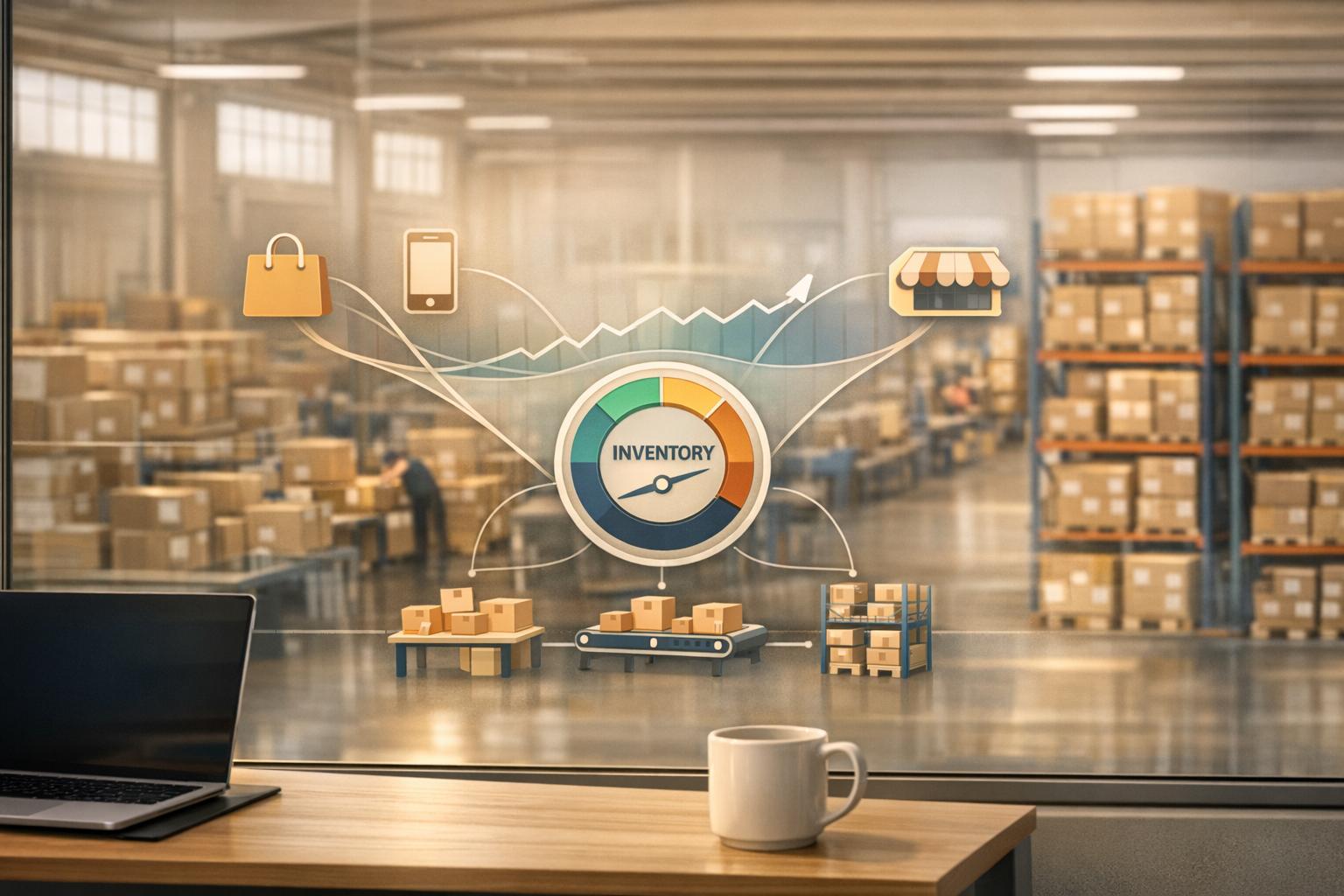
Collaborative demand planning brings together sales, operations, finance, suppliers, and customers to create a single, reliable forecast. For e-commerce brands, this approach is crucial as they face challenges like multi-channel shopping behavior, unpredictable trends, and global supply chain issues. When brands exceed 3,000 orders per month, scaling fulfillment often requires professional logistics support.
Key Takeaways:
- 3PLs (Third-Party Logistics) streamline demand planning by integrating real-time data, advanced forecasting tools, and effective communication methods.
- They use APIs, EDI, and AI-driven systems to share data, predict demand, and optimize inventory.
- Better forecasting reduces inventory costs, prevents stockouts, and aligns resources with sales peaks.
- Flexible solutions help manage seasonal surges and unexpected demand changes.
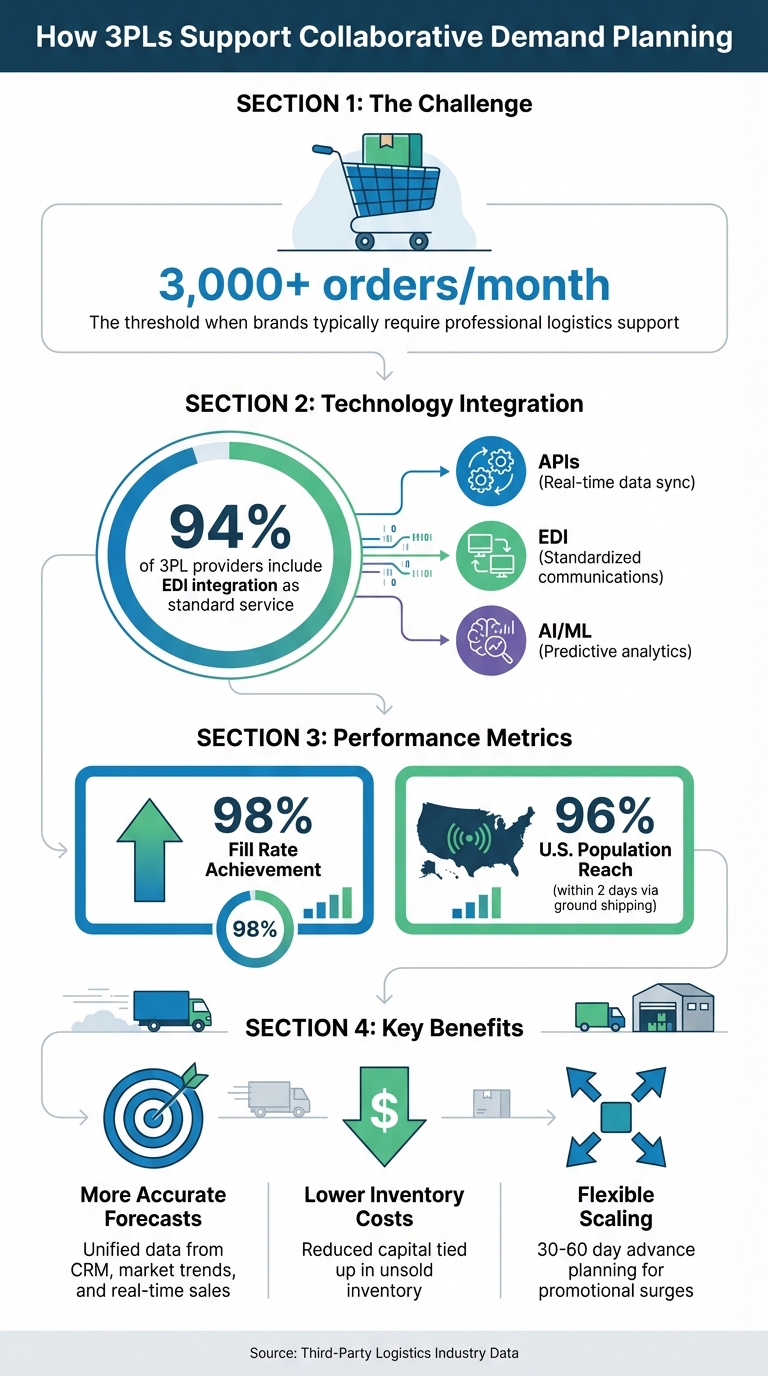
How 3PLs Enhance Demand Planning: Key Statistics and Benefits
What 3PLs Do in Demand Planning
Real-Time Data Sharing Through Integrated Systems
Integrated systems play a crucial role in collaborative demand planning, allowing 3PLs to synchronize data across the entire supply chain. Modern 3PL providers use APIs to connect their Warehouse and Order Management Systems directly with e-commerce platforms for instant data sharing, while EDI facilitates standardized batch communications. In fact, about 94% of 3PL providers include EDI integration as a standard service. This seamless exchange of information lays the groundwork for advanced forecasting tools that refine demand planning.
"A good WMS tracks inventory through the warehouse at every point that you touch it. And that data can then be exposed through portals and integrations." - Bryan Wright, CTO and COO at G10 Fulfillment
For retail distribution, these integrated systems automatically generate Advance Ship Notices (ASNs), routing confirmations, and specific labeling to avoid costly chargebacks. Some systems even support duty suspension through bonded warehousing, helping businesses manage cash flow while products remain in storage.
Technology Tools for Better Forecasting
Top-tier 3PLs use AI-driven Fulfillment Management Systems (FMS) to optimize omni-channel inventory routing. These systems rely on machine learning to automate inventory allocation and predict volume surges. By applying predictive analytics to shipment data, they can proactively adjust labor needs, maintaining fill rates as high as 98%.
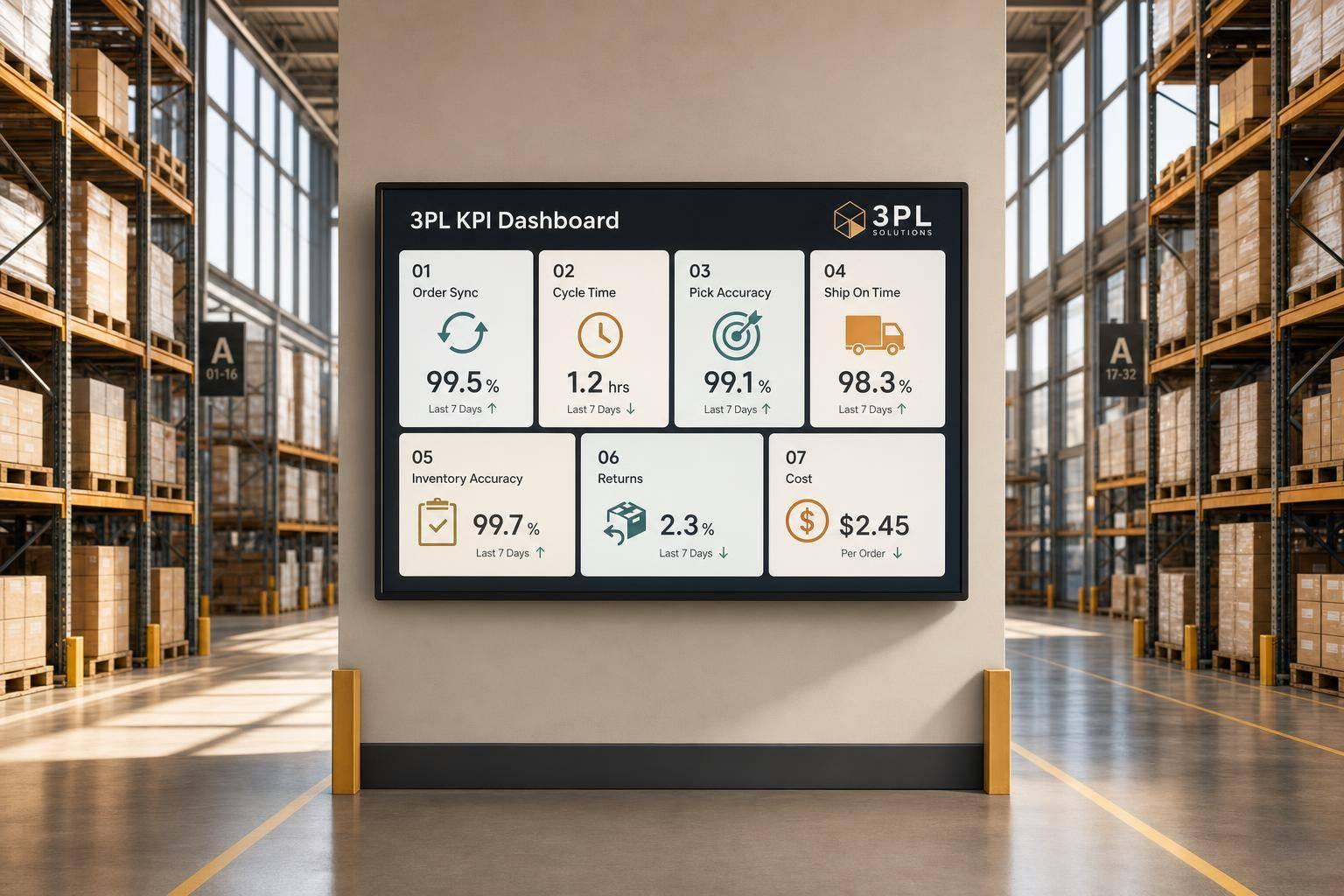
Real-time dashboards provide visibility into inventory movement, order progress, and carrier performance, supporting precise demand forecasting.
"What these real-time portals provide our customers is 100% visibility. They can actually watch those progressions going on." - Maureen Milligan, Director of Operations and Projects at G10 Fulfillment
This level of transparency allows businesses to make decisions based on live data instead of relying on assumptions. These advanced tools are complemented by strong communication practices, ensuring both automated insights and human expertise guide planning efforts.
Communication Methods That Improve Planning
Successful 3PLs actively engage in Sales and Operations Planning (S&OP) cycles to align logistics capacity, labor, and warehouse space with upcoming sales forecasts and marketing initiatives. For peak seasons or promotional campaigns, advance notice enables 3PLs to scale staffing and secure the necessary capacity, addressing the complexities of multi-channel operations for growing e-commerce brands.
Communication happens through various channels. Routine updates, like shipment confirmations (EDI 945) and stock transfer receipts (EDI 944), are managed via automated EDI transactions. At the same time, cloud-based visibility portals provide a shared "single source of truth" accessible to both parties. For unique requirements or urgent changes, direct communication ensures quick resolutions.
"Our in-house team handles integration and customization efficiently." - Connor Perkins, Director of Fulfillment at G10 Fulfillment
sbb-itb-eafa320
Executing the Vision: The Role of 3PLs in Modern Supply Chains
Benefits of Working with 3PLs for Demand Planning
Collaborating with third-party logistics (3PL) providers can bring significant advantages to e-commerce brands, especially when it comes to demand planning. By integrating advanced tools and expertise, 3PLs help businesses optimize their operations in several key areas.
More Accurate Demand Forecasts
3PLs break down forecasting silos by merging data from CRM systems, market trends, and real-time sales into a single, cohesive platform. This unified approach leads to forecasts that are far more reliable than those based on isolated spreadsheets. By leveraging insights from multiple clients, 3PLs can identify larger market trends that individual brands might miss. They use a combination of statistical models, machine learning, and human analysis to refine predictions. Plus, real-time feedback loops ensure that forecasts are updated immediately as new data becomes available, significantly boosting accuracy.
"Collaborative forecasting demolishes these walls [forecasting silos]. It unites sales, operations, finance, suppliers, and customers around a single, precise demand forecast."
– Steve Rajeckas, Content Marketing Manager, Red Stag Fulfillment
Lower Inventory Holding Costs
With better demand planning, brands can reduce the amount of capital tied up in unsold inventory. 3PLs use historical data to maintain leaner stock levels, cutting costs associated with warehousing, insurance, and taxes. For businesses handling perishable or trend-sensitive products, this means quicker inventory turnover and fewer losses from expired or unsold goods. Improved forecasting also reduces the need for steep discounting or liquidation. Additionally, aligning labor with anticipated order volumes helps avoid unnecessary staffing costs during slow periods and minimizes overtime expenses during busy times. Strategic inventory placement near high-demand regions and access to volume-based shipping discounts further help control operational costs.
Flexible Solutions for Changing Demand
3PLs are equipped to adapt quickly to shifts in demand. By sharing promotional plans, flash sale schedules, or influencer campaigns 30–60 days in advance, brands enable their 3PL partners to scale staffing, storage, and transportation resources efficiently, avoiding the high costs of last-minute adjustments.
"Teaming up with a third-party logistics (3PL) provider with expertise in demand planning is an effective way to meet demand and ensure order accuracy while keeping costs in check."
– Smart Warehousing
Through their extensive networks, 3PLs allow brands to reach 96% of the U.S. population within two days using ground shipping by positioning inventory across multiple fulfillment centers. When unexpected demand spikes occur, 3PLs can tap into their established carrier relationships to provide quick access to trucking, air freight, or drayage services. They also employ strategies like regular cycle counts and optimized buffer stock to handle seasonal surges effectively.
JIT Transportation exemplifies how these methods keep e-commerce brands nimble and competitive in a fast-changing market.
Managing Demand Changes and Fluctuations
By leveraging advanced forecasting tools and integrated systems, 3PLs can adjust their operations in real time to handle shifts in demand. These strategies, combined with collaborative demand planning, enable them to respond effectively to both predictable and unexpected changes.
When demand takes an unexpected turn, 3PLs depend on dynamic inventory management and scalable infrastructure to keep supply chains functioning smoothly. Instead of sticking to static rules, they continuously tweak safety stock levels and reorder points based on real-time market data and lead time variations.
Setting Safety Stock and Reorder Points
To maintain optimal inventory levels, 3PLs use algorithms that adjust safety stock dynamically, factoring in demand variability and lead time changes. This eliminates the need for fixed buffer levels, allowing inventory to respond to market shifts. Automated reorder point (ROP) systems, integrated with warehouse management systems (WMS) and real-time sales data, use a formula like this: (Average Daily Sales × Lead Time) + Safety Stock. When inventory dips to the ROP, the system triggers replenishment orders automatically, cutting out the need for manual oversight.
This approach ensures that stockouts are avoided during demand surges, while excess inventory is minimized during slower periods, freeing up capital. These real-time adjustments build on earlier forecasting efforts, making supply chains more responsive and efficient.
While these methods work well for routine fluctuations, seasonal demand spikes call for a different set of strategies.
Handling Seasonal Demand Spikes
To prepare for busy seasons, 3PLs rely on collaborative forecasting that combines historical sales trends, promotional schedules, and AI-driven scenario modeling. By running "what-if" analyses ahead of peak periods, they can plan for a range of demand scenarios.
When demand surges, 3PLs ramp up operations by employing temporary staff, utilizing cross-trained employees, and increasing automation to reduce reliance on manual labor. Many 3PLs also operate shared warehouse models, which let them reallocate space between clients as needed. For additional flexibility, they may secure overflow storage or short-term leases during peak times. On the transportation side, 3PLs maintain diverse carrier networks and can switch modes - such as from truck to air freight - depending on urgency.
Once the peak season ends, 3PLs review data to evaluate what worked well and identify areas where costs, like temporary staffing, could be reduced in the future.
Conclusion
Collaborative demand planning thrives when technology, real-time data, and adaptable strategies work together seamlessly. Third-party logistics providers (3PLs) play a key role in bridging the gap between e-commerce businesses and their logistics operations. By offering integrated systems that share real-time inventory updates, sales forecasts, and shipment statuses, 3PLs provide the visibility brands need to make informed decisions. This transparency removes the guesswork, enabling businesses to act based on actual conditions in their warehouses and distribution centers. Beyond operational clarity, this approach also delivers measurable financial benefits.
When forecasts are accurate and inventory levels are optimized, brands can lower carrying costs and minimize losses caused by overstocking or stockouts. Additionally, flexible partnerships with 3PLs allow businesses to scale warehouse space and labor as demand fluctuates. This adaptability helps teams maintain efficiency and performance over time.
Collaboration across departments further strengthens these results. When sales, marketing, operations, and logistics teams align around shared KPIs and use unified dashboards, they stay focused on common objectives. This alignment creates feedback loops that continuously improve forecasting models and enhance supply chain responsiveness.
JIT Transportation exemplifies this approach with tailored 3PL solutions. Their technology integrates transportation management systems (TMS), warehouse management systems (WMS), and fulfillment platforms into a single digital framework. This setup provides real-time inventory visibility, predictive analytics for capacity planning, and centralized dashboards to monitor performance across all sales channels. Additional services like kitting, assembly, and vendor-managed inventory ensure logistics operations stay in sync with production schedules and shifting demand.
The result is a supply chain that adapts to market dynamics, transforming demand planning into an ongoing, data-driven process that keeps inventory moving efficiently.
FAQs
What data should I share with my 3PL for better forecasts?
To improve forecasting with your 3PL, make sure to share real-time data on key metrics like inventory levels, sales trends, and supplier performance. This information helps fine-tune replenishment processes and minimizes the risk of stockouts. Including details such as demand patterns, lead times, and sales forecasts provides an even clearer picture, allowing for better planning.
You can also boost accuracy by sharing insights into customer orders and external influences. For example, factors like weather changes or viral trends on social media can significantly impact demand. By incorporating this data, your 3PL can enhance demand sensing and deliver more precise forecasts.
How long does 3PL integration (API/EDI) usually take?
3PL integration through API or EDI typically requires anywhere from several weeks to a few months. The exact timeline hinges on factors such as the complexity of the systems involved and the overall scope of the project. Establishing clear communication and thorough planning from the outset can help make the process smoother and minimize potential delays.
How do 3PLs decide safety stock and reorder points?
Third-party logistics providers (3PLs) use a mix of data analysis and advanced inventory tools to calculate safety stock and reorder points. By pulling in real-time data from sales, current inventory levels, and supplier performance, they can predict demand with precision. This helps in setting safety stock levels that prevent stockouts without overstocking.
Additionally, automated replenishment systems take into account trends, lead times, and turnover rates. These systems ensure inventory is restocked at the right time, striking a balance between managing costs and keeping up with customer needs.
Related Blog Posts
Related Articles
7 WooCommerce 3PL KPIs Teams Track

Centralized vs Decentralized Replenishment
