
How to Design Reusable Packaging for Scalability
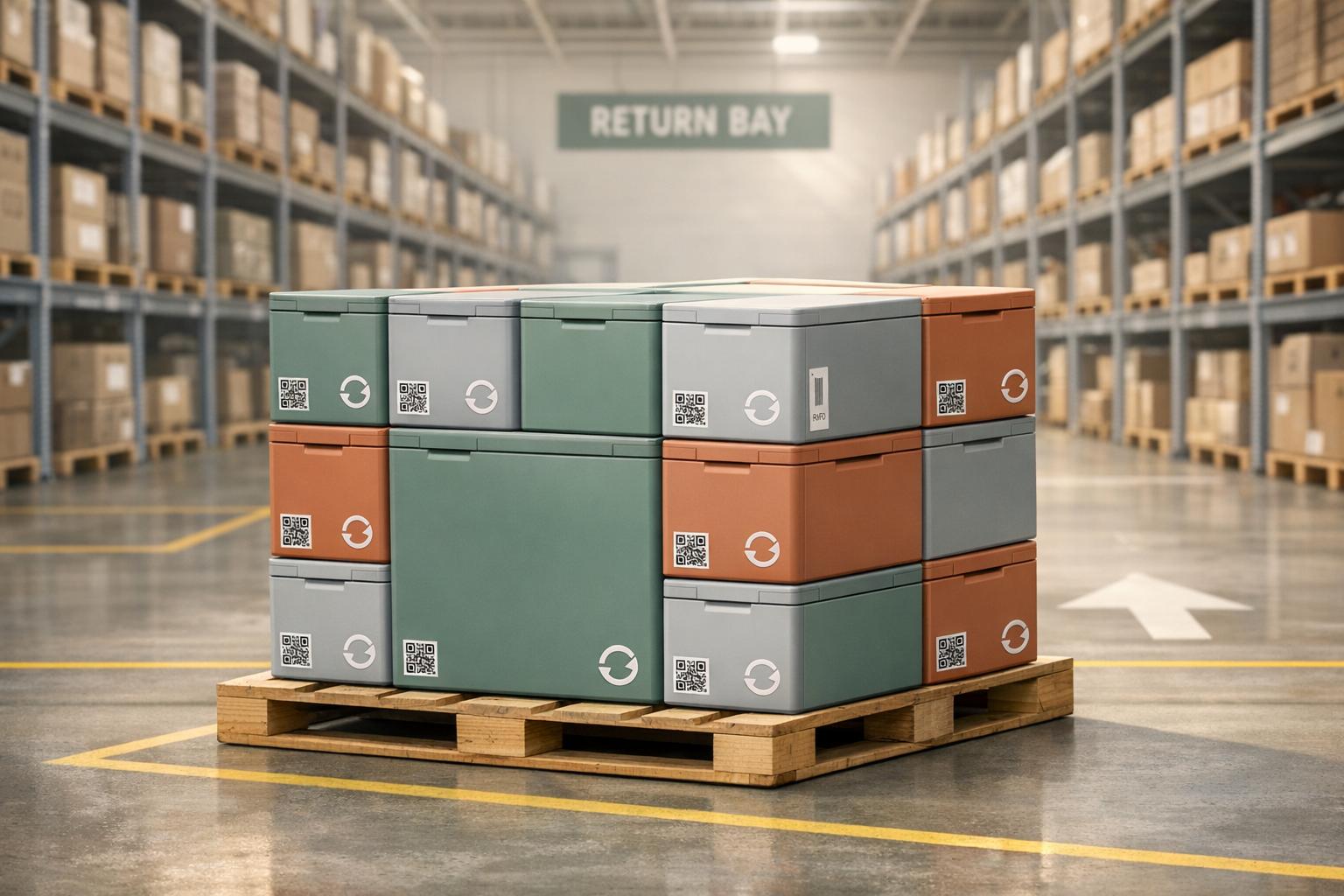
Reusable packaging can save costs and reduce waste, but scaling it requires careful planning. Here’s the key takeaway: Reusable packaging is only effective when designed for durability, efficiency, and high return rates. To make it work:
- Costs: Reusable containers cost $3–$10 upfront but can drop to $0.10 per use after 150 trips. They replace up to 100 single-use packages.
- Return Rates: Success hinges on return rates above 90%. Low rates increase costs and reduce reuse cycles.
- Materials: Use durable yet lightweight materials like recycled PET (RPET) or polypropylene (PP) to balance longevity and shipping costs.
- Logistics: Reverse logistics is critical. Plan for storage, cleaning, and tracking to minimize losses (3–10% annually).
- Standardization: Simplify operations by using 5–10 standard packaging sizes to cut costs and improve efficiency.
- Technology: Use QR codes or RFID tags for tracking and partner with third-party logistics (3PL) providers to handle returns and scaling.

Reusable Packaging Cost Analysis and Key Metrics for Scalability
Lessons for scaling up reusable packaging
sbb-itb-eafa320
Assess Your Scalability Needs and Packaging Challenges
To make reusable packaging a viable option, your return rates must support scalability. Balancing return metrics, logistics, and costs is essential for durable reusable packaging to work effectively.
Evaluate E-Commerce Volume and Growth Projections
Your business model plays a big role in determining whether reusable packaging is a good fit. For example, if you operate a subscription or rental service (Model 1), where packaging is returned with goods inside, return rates are naturally higher. On the other hand, if customers need to return empty packaging (Model 2/3), success depends heavily on how many actually follow through.
Here’s why return rates matter: A 75% return rate means each package might only be reused four times. To hit around 20 uses per package, you’ll need return rates above 90%. Michael Newman, CEO of Returnity, puts it plainly:
"75% isn't good enough. 90% is the floor in most circumstances".
Reusable packaging typically requires 4 to 9 cycles to become environmentally competitive with single-use options. If your return rate doesn’t meet that threshold, the system could fail both financially and environmentally. Analyze your historical order data to forecast demand. Many brands find that once they hit 3,000+ orders per month, managing reusable inventory internally becomes increasingly difficult.
These return rate challenges also directly impact how you handle logistics and warehouse space.
Identify Operational Constraints in Logistics
Handling reusable packaging introduces unique logistical challenges. For one, you’ll need dedicated warehouse space for receiving, sorting, cleaning, sanitizing, and storing returned packaging . Unlike flat cardboard boxes, reusable containers are bulkier and take up more room even when empty.
Shipping weight is another factor. Reusable materials are generally heavier than single-use packaging, which can increase transportation costs. If not managed carefully, these added expenses might cancel out any environmental benefits .
For high-volume operations, automation is a must. Your reusable packaging should work seamlessly with existing conveyors, sorters, and scanners to avoid slowing down your processes. Automation can improve packaging operations by up to 25% and cut downtime by 15%.
These logistical hurdles also impact costs and overall operational efficiency, so they require careful consideration.
Understand Cost and Efficiency Trade-Offs
Reusable packaging comes with higher upfront costs. Corrugated boxes typically cost $0.50–$2.50, and poly mailers range from $0.10–$0.40. In contrast, reusable containers cost $3.00–$10.00 per unit. The return on investment only materializes after replacing a significant number of single-use packages.
Efficiency can also take a hit. RePack notes that environmental benefits diminish if packing times double. Single-use options typically allow for packaging speeds of under 10 seconds per unit, and failing to match that can make scaling difficult.
Reverse logistics add another layer of cost. Returning empty packaging to your facility or a network node can cost $3.50 or more per return. Plus, some packaging will inevitably be lost or damaged over time, requiring replenishment. Offering small incentives, like $1 or $2 credits, can encourage returns, but you’ll need to ensure these costs align with your overall unit economics and projected return rates.
Design Packaging for Durability and Efficiency
Plan your packaging with materials and features that can handle multiple shipping cycles while keeping shipping costs low.
Choose Durable and Lightweight Materials
Once you've outlined your scalability needs, focus on materials that strike a balance between durability and cost-effectiveness.
Recycled PET (RPET) and polypropylene (PP) are standout choices for reusable e-commerce packaging. RPET, made from recycled plastic bottles, is transformed into water-resistant fabrics that can last through 100 shipping cycles. These materials also perform better than paper-based options in wet conditions.
Striking the right balance between weight and durability is key. For example, lightweight recycled polyester mailers reach efficiency after 4 cycles, while sturdier 600D versions require 9 cycles but offer greater resilience. LimeLoop addresses this by using a durable exterior paired with a lightweight interior, helping to control shipping costs.
For rigid containers, light gauge plastic (.150 or less) can support up to 2,000 lbs, while heavy gauge plastic (.350) can handle up to 8,000 lbs. The choice of gauge depends on product weight and shipping conditions. While heavier gauges cost more and add weight, they extend the container’s lifespan.
Incorporate Modular, Repairable Features
Design packaging with features like folding, collapsing, or nesting to cut down on return shipping costs and save space in warehouses. Soft mailers that adjust to their contents are another way to eliminate wasted space .
Consider modular closures - like interlocking zippers, snap buttons, or velcro - rather than single-use adhesive tapes. These closures ensure the packaging remains functional for multiple uses and make it easy to replace worn-out parts without discarding the entire unit. Smooth, wipeable surfaces also simplify cleaning, maintaining a polished look over time.
Royal Mail offers a great example of modular design at scale. In 2025, they added Wiliot's IoT tracking pixels to 850,000 reusable roll cages across 5,000 sites. This system improved fleet efficiency, reduced the need for new assets, and saved millions of dollars. It also cut carbon emissions by minimizing empty return trips.
These design strategies not only improve reverse logistics but also help support growth and scalability.
Standardize Packaging for Operational Efficiency
Once you've established durable design and reverse logistics strategies, the next logical step is standardizing your packaging. Why? Because standardizing dimensions simplifies scaling and streamlines warehouse operations. By narrowing your packaging options to just 5–10 standard sizes, you eliminate the delays caused by guesswork in handling. This efficiency directly impacts costs - shipping makes up about 75% of supply chain expenses, and optimizing your packaging choices could cut outbound shipping costs by roughly 20%.
Develop Standard Dimensions and Configurations
When designing reusable packaging, consider carrier cubic volume thresholds to avoid additional fees. For example, in 2026, FedEx will apply Additional Handling fees for packages exceeding 10,368 cubic inches and Oversize penalties above 17,280 cubic inches. Staying under these thresholds requires precise planning across all dimensions.
"Standardized box sizes make shipping operations more predictable... it simplifies managing weight thresholds, minimizes wasted space, and keeps packages within dimensional limits." - Ucanpack Team
Rather than grouping products by category, cluster them by size and fragility to determine your standard packaging dimensions. This approach reduces the number of container SKUs needed. Additionally, rigid, rectangular designs prevent bulging, which could push packages into higher surcharge tiers during transit.
To make this process even more efficient, integrate your standard sizes into your Warehouse Management System (WMS) using SKU-to-carton mapping. This step reduces manual errors, speeds up processing, and ensures that oversized containers are avoided. With this foundation in place, you can further refine your designs to meet various product needs.
Include Adjustable and Flexible Design Options
Flexible solutions like multi-depth boxes - pre-scored to adjust height while keeping a consistent footprint - offer adaptability without increasing your SKU count. Pair these with modular inserts, such as foam cradles, corrugated trays, or adjustable dividers, to secure different products within the same outer container.
For soft goods or non-fragile items, collapsible mailers are a game-changer. They conform to the contents, eliminating up to 40% of wasted space commonly found in average packages. Plus, they simplify reverse logistics, making returns more efficient.
The key is balancing standardization with adaptability. Use rigid, geometric designs while incorporating adjustment points that handle product variations without requiring entirely new packaging for every SKU. These standardized systems not only improve efficiency but also position you to collaborate with providers like JIT Transportation, leveraging their nationwide network and value-added services to maximize these gains.
Set Up Reverse Logistics for Packaging Returns
Once you've streamlined your packaging design and standardized its use, the next step is establishing a reliable reverse logistics system. Reusable packaging only works if it makes its way back to you. With 30% of all e-commerce purchases being returned, having a smooth process for packaging recovery is essential - not just for your operations but also for customer satisfaction. Here's why it matters: 92% of customers are more likely to shop again with a brand if returns are hassle-free. And since packaging plays a role in shaping that experience, it directly impacts loyalty.
Design Easy-to-Use Return Systems
Your packaging needs to be built with returns in mind. For example, using 32 ECT corrugated cardboard ensures boxes stay intact during multiple trips, making them durable enough for reuse. Features like perforated tear strips allow customers to open boxes without damaging them, which is crucial for reusing the same packaging. If you're using poly mailers, include double-seal adhesive strips - this makes it easy for customers to reseal the package for returns without needing extra tape or materials.
Clear communication is equally important. Print simple return instructions directly on the packaging, packing slips, or a separate insert card. If you're in a category like apparel or "try-on" products, consider including a pre-paid return mailer to make the process even easier. You can also add a reminder, such as "Keep this packaging until you're satisfied with your purchase", directly on custom boxes to reduce the chances of early disposal.
Pair these return-friendly features with digital tracking systems to ensure full visibility throughout the process.
Use Digital Tracking Systems
Without visibility, reusable packaging can quickly turn into a costly headache. Companies lose between $800 million and $1.5 billion worth of transport containers annually, with typical loss rates ranging from 3% to 10%. Digital tracking helps turn this challenge into an opportunity.
Start with QR codes. They can hold more data than traditional barcodes, scan from any angle, and still work even if partially damaged. For larger operations, RFID tags are a game-changer. These tags allow for bulk scanning, identifying hundreds of items at once, which cuts down on labor time. Passive RFID tags, in particular, are a cost-effective, battery-free option for standard containers.
Choose your tracking tools based on your needs and budget. QR codes work well for basic, low-cost containers, while RFID or GPS trackers are better suited for high-value, custom-built packaging. Make sure your tracking system integrates with your WMS or ERP software using APIs. This eliminates data silos and allows you to set up automated alerts for critical situations, like packaging sitting idle for too long or inventory shortages at collection points.
Partner with Scalable 3PL Services
Once you've got tracking in place, you can tap into third-party logistics (3PL) services to handle returns as your volumes grow. Managing reverse logistics in-house can quickly become overwhelming, which is where specialized partners come in.
For example, JIT Transportation offers returns management (RMA) as part of their services. They handle everything - from receiving returned packaging to cleaning, inspecting, and redistributing it back into your supply chain. Their nationwide network and strategically located warehouses allow for regional collection points, so you don’t have to invest in building your own infrastructure. Plus, their ERP integration ties directly into your tracking systems, giving you real-time updates on packaging inventory across locations.
With additional services like pick & pack and kitting & assembly, these partners can reintegrate returned packaging into outbound orders right away. This minimizes idle inventory and maximizes how much you can reuse, keeping your reverse logistics efficient as your business scales - without the need to manage recovery operations on your own.
Calculate Economic Viability and Test Your Packaging
Lifecycle cost analysis is key to determining whether reusable packaging can deliver financial returns when scaled. Just like logistics and operations affect overall efficiency, accurate cost modeling ensures your approach works in the long term.
Model Lifecycle Costs and Savings
To understand the true cost per unit, you need to factor in more than just the supplier invoice. Include reverse logistics, labor for processing returns, and storage costs. Many brands underestimate packaging expenses by 30–60% when they only consider the supplier invoice.
Your breakeven point depends on how many cycles your packaging completes. A cycle is one outbound shipment to a customer and its return to you. For example, a lightweight reusable mailer generally requires at least 4 cycles to outperform a 100% recycled poly mailer, while a heavy-duty version may need 9+ cycles. Achieving 4 cycles means about 74% of customers must return the packaging, whereas 9 cycles require a return rate of 89%.
"The cost of manufacturing a reusable package is several times more than that for a single-use alternative. Much like the environmental impact, the benefit comes over time with needing fewer packages." - Angela Kwok, VP of Operations, LimeLoop
Reverse logistics add up quickly. For each package, return shipping costs exceed $3.50, and third-party logistics (3PL) returns processing costs range between $1 and $3.50 per return. Then there’s the cost of storing empty packaging until it’s reused. If your return rate is low, these ongoing expenses can eat into your savings.
Direct-to-consumer brands often aim to keep total packaging costs at 3–6% of gross revenue. Use this as a benchmark when modeling your transition to reusable packaging.
Once your cost model is ready, it’s time to validate it through real-world testing.
Pilot Prototypes in Live Conditions
After crunching the numbers, test your reusable packaging prototypes in real-world conditions. While lab tests can estimate how many times a package could be reused, only live pilots will show how many times it actually gets reused. Start small with 500 to 2,000 units on a single high-traffic product. Track key metrics like return rates, customer feedback, and the condition of the packaging after multiple uses.
Ship prototypes across long distances - like from the East Coast to Colorado - several times to see how they perform in real carrier networks. Look for issues like scuffing, tearing, or zipper failures that lab tests might not catch. Pay attention to how the packaging is handled at every stage: by your warehouse team, carriers, customers, and retail collection points.
"While it may only take weeks to design and develop a first prototype, it takes months or even years to iterate and launch a new reusable package that is efficient, durable, and sustainable." - Angela Kwok, VP of Operations, LimeLoop
Run your pilot for at least 30 days to gather meaningful data on conversion rates, average order value, and how the packaging affects product returns. Use digital tracking tools like QR codes or RFID tags to monitor each unit’s journey and figure out where packages are being lost or forgotten. Most packaging "leakage" happens because customers intend to return it but simply forget.
Striking the right balance between durability and weight is critical. Thicker materials may last longer but cost more to ship and increase your carbon footprint. Experiment with combinations, such as a tough exterior paired with a lighter interior lining, to find the best mix of longevity and cost. Insights from these pilot tests will help you refine your packaging design for full-scale operations.
Scale Operations with 3PL Logistics Partners
After proving success in your pilot tests, a 3PL partner can help you expand those results into a fully integrated supply chain. Scaling reusable packaging requires infrastructure that often exceeds what most brands can manage internally. That’s where third-party logistics (3PL) providers come into play.
Use Nationwide 3PL Networks
A strong 3PL network gives your business the flexibility to handle sudden surges in demand without the need to build your own warehouse system. For example, JIT Transportation’s nationwide distribution network can ramp up from handling 100 orders daily to managing 10,000 orders within just 48 hours. This capability is critical during high-pressure moments like product launches or promotional events, where reusable packaging needs to move quickly and efficiently.
A unified 3PL also integrates reverse logistics, managing both outbound shipments and inbound returns seamlessly.
"Think of your 3PL as your execution partner rather than a simple shipping provider. You're outsourcing complexity - not control." – JIT Transportation
When order volumes exceed 3,000 per month, managing logistics in-house can become a bottleneck. Negotiating directly with carriers like FedEx, UPS, DHL, or regional providers is time-intensive. A 3PL partner with established carrier relationships simplifies this process, providing faster access and competitive shipping rates.
But a 3PL does more than just shipping. They also offer services that can streamline your entire operation.
Add Value-Added Services
Strategic kitting and assembly services offered by 3PLs can help reduce labor inefficiencies and improve accuracy. For instance, bundling products with packaging inserts or promotional materials becomes more precise and cost-effective. JIT Transportation emphasizes that kitting is not just an add-on but a smart cost-control measure, ensuring accuracy while protecting your profit margins.
"Strategic kitting reduces labor waste, improves accuracy, and protects margins - making it a cost-control strategy rather than just a value-added service." – JIT Transportation
For premium or intricate packaging, white-glove handling becomes essential. Other advanced services include inbound receiving with full visibility, dynamic slotting for optimized storage (including climate control when necessary), and technologies like GS1 barcoding to ensure accurate tracking and storage. When choosing a 3PL partner, request documented Service Level Agreements (SLAs) and clear metrics on pick accuracy. An underperforming 3PL can hurt your margins through mispacks, reships, or inefficient returns - issues that are even more costly when dealing with reusable packaging.
Monitor and Optimize Packaging Performance
Scaling reusable packaging requires ongoing performance tracking. Leverage your 3PL’s data systems to identify where packaging is being lost or damaged along the supply chain. By monitoring return rates, cycle counts, and packaging conditions across different SKUs and customer groups, you can refine your processes to maintain efficiency as volumes grow. These insights can also guide design updates, improving your packaging for future use.
Integrated logistics simplifies operations by replacing fragmented vendor management with a cohesive strategy. This level of coordination is particularly crucial for reusable packaging, where every step - from the initial shipment to the final return - impacts cycle counts and cost savings. A well-managed 3PL partnership ensures that the efficiency gains achieved during your pilot phase remain intact as you scale.
Conclusion
Design reusable packaging systems that promote growth and minimize waste by focusing on durable, lightweight materials like recycled polyester (RPET) or polypropylene. These materials can handle anywhere from 20 to over 100 shipping cycles, making them a practical choice for long-term use. Simplify operations by standardizing packaging to just a few core sizes - this reduces warehouse complexity and speeds up packing processes.
To boost recovery rates, it's essential to build a scalable and reliable reverse logistics system. Features like QR codes, prepaid return labels, and local drop-off networks make returns easy and convenient for customers. However, even the most durable packaging won’t hit its environmental or financial breakeven point without maintaining a strong return rate - ideally 74% or higher.
This approach to packaging design reflects a broader shift in the industry:
"Reusable packaging isn't just about containers - it's about redesigning systems. It requires collaboration between manufacturers, retailers, logistics providers, policymakers, and consumers to truly make the shift." – The Packaging Edge
As your business grows, partnering with a reliable third-party logistics (3PL) provider becomes increasingly valuable. A competent 3PL can handle essential tasks like cleaning, sanitization, inventory tracking, and redistribution. Digital tracking tools, such as RFID or QR codes, provide valuable insights into the lifecycle of your packaging, helping you identify loss patterns and refine return routes. For instance, JIT Transportation offers tailored 3PL solutions that simplify reverse logistics and support scalable supply chain management. These integrated strategies lay the groundwork for thorough testing before a full-scale rollout.
Testing prototypes in real-world conditions is crucial. Model lifecycle costs - including energy used for cleaning - and establish end-of-life recycling partnerships. When continuously monitored and fine-tuned, reusable packaging can transform waste management challenges into a competitive advantage.
FAQs
How do I estimate my return rate before launching reusable packaging?
To get a clear idea of your return rate, consider how frequently the packaging will be reused instead of simply counting how many times it’s reused. Take a close look at your current or anticipated return volume alongside typical reuse cycles. Comparing this with industry trends and evaluating your specific product and operational needs can provide valuable insights. By monitoring reuse frequency and incorporating this data into your planning, you’ll be better equipped to scale effectively and ensure long-term success.
What’s the best way to keep reusable packaging losses under 10% per year?
To minimize reusable packaging losses to under 10% annually, a solid management approach is essential. This should include tracking systems, quality control measures, and efficient return processes. Prioritize packaging that’s built to last, and ensure tracking technology is in place to monitor usage. Streamlining the return process can also make a big difference.
Regular inspections and maintenance are key to keeping packaging in good condition, which helps reduce losses. Additionally, aiming for high return rates and specific rotation targets - like achieving 20 uses per item - can significantly lower losses over time.
When should I move reverse logistics to a 3PL like JIT Transportation?
If rising return volumes are overwhelming your internal resources and affecting efficiency or customer satisfaction, it might be time to shift reverse logistics to a third-party logistics provider (3PL) like JIT Transportation. This move is particularly helpful when high return rates, complicated processes, or unpredictable volumes become difficult to handle. A 3PL can simplify the returns process, help cut costs, and offer flexible solutions to support your business as it grows.
Related Blog Posts
Related Articles
7 WooCommerce 3PL KPIs Teams Track

Centralized vs Decentralized Replenishment
