Top Legal Issues in 3PL Agreements
A poorly structured 3PL contract can cost your business more than you think. From unclear service terms to hidden fees, many brands lose money not due to bad logistics but due to bad agreements. This guide breaks down the critical elements you need to include in your 3PL contract to protect your business and ensure smooth operations.
Key Takeaways:
- Scope of Services: Clearly outline included and excluded services to avoid disputes and unexpected costs.
- Performance Metrics (SLAs): Define measurable KPIs like order accuracy (99.5%+), on-time delivery, and inventory accuracy. Include penalties for non-compliance.
- Liability and Insurance: Negotiate liability caps based on product value, not weight. Ensure the 3PL carries adequate insurance.
- Data Ownership: Retain ownership of your data and require access to it in standard formats.
- Termination Terms: Specify notice periods, exit conditions, and transition support to avoid disruptions.
- Dispute Resolution: Include a clear process for resolving issues, from escalation to mediation or arbitration.
A strong 3PL contract isn't just about pricing - it's about protecting your business and ensuring accountability. Let’s dive into the details.
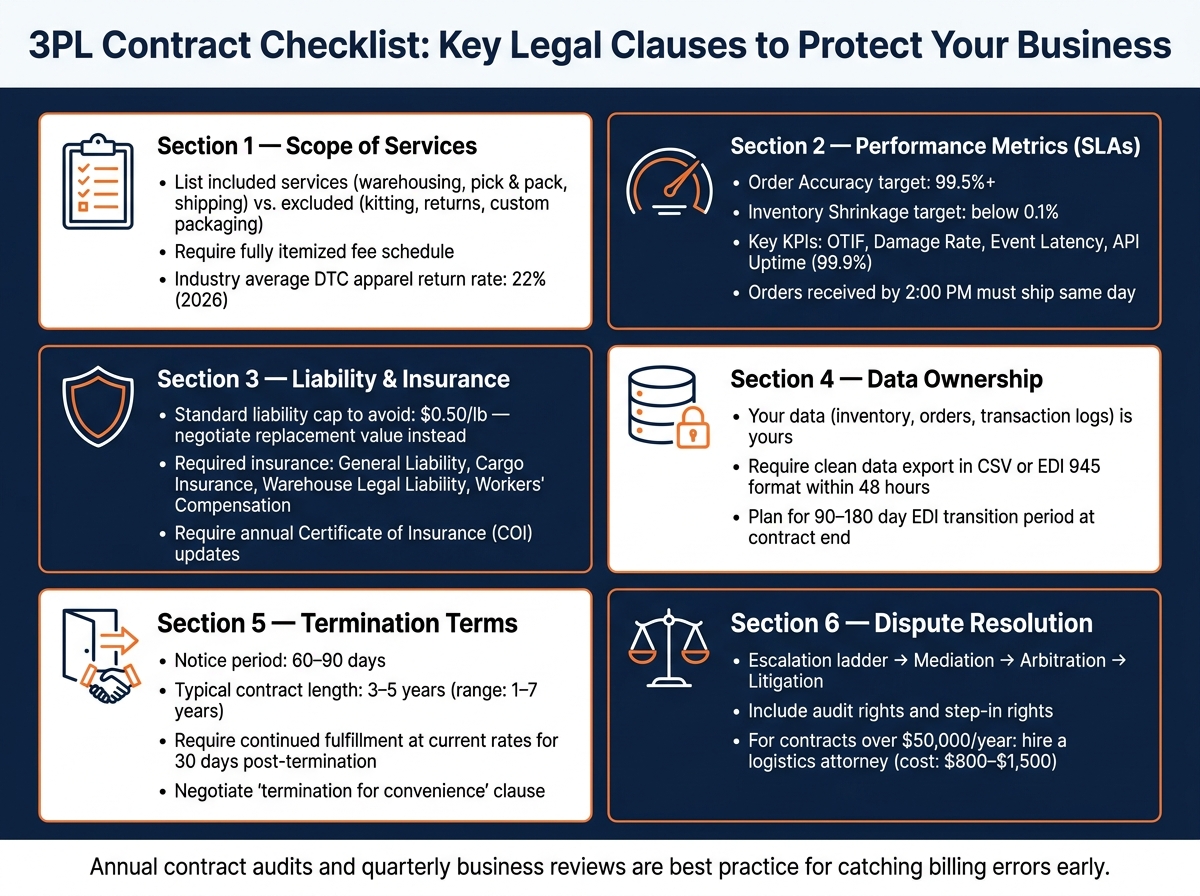
3PL Contract Checklist: Key Legal Clauses to Protect Your Business
Scope of Services and Responsibilities
When defining roles in a 3PL contract, it's crucial to clearly outline the services and responsibilities included. Vague definitions often lead to disputes, unexpected charges, and overlooked tasks.
What Services Are Included and Excluded
Start by listing core services covered under the base rate - like transportation, warehousing, receiving, pick and pack, and outbound shipping. Then, explicitly identify excluded services, such as kitting, custom packaging, subscription box assembly, and returns processing. These are often treated as separate "special projects" and billed separately unless specified upfront.
Ambiguity in these details can lead to rate card drift, where invoices gradually deviate from the agreed terms. Erin Castellano, Director of Operations at Fulton Goods, highlights this issue:
"Most merchants assume their invoices match their contracts. They almost never do past 18 months. The 3PL industry runs on rate card drift, and operators who don't audit annually are subsidizing everyone else's discount."
To prevent this, request a fully itemized fee schedule. This should detail charges for every receiving event - whether billed per pallet, carton, or SKU. Additionally, clearly define how returns will be handled. With the industry average return rate for apparel DTC reaching 22% as of 2026, transparency on returns processing fees is essential to avoid surprises.
Assigning Responsibility for Inventory and Handling
Assigning clear responsibilities for operational tasks like cycle counts, dock-to-stock timelines, packaging standards, labeling, and inventory accuracy is equally important. Contracts should specify an inventory accuracy target - typically 99.5% or higher.
Another critical area is liability for lost or damaged inventory. Many standard 3PL agreements cap liability at $0.50 per pound, which can be far less than the actual replacement cost for high-value products. Negotiating liability terms based on replacement costs rather than weight can save significant losses in the event of a claim. Pair this with real-time inventory visibility and automated alerts for handling errors to ensure swift resolution and better operational oversight. Detailed, proactive agreements can help avoid costly misunderstandings at every stage of the process.
sbb-itb-eafa320
Performance Metrics and Service Level Agreements (SLAs)
Setting measurable performance standards is critical for holding parties accountable in any 3PL contract. As Stephen T. Hopper, Founder & Principal at Inviscid Consulting, aptly puts it:
"You can't manage what you don't measure, right?"
Failures in service levels - like missed shipments, inaccurate orders, or inventory errors - often lead to legal disputes between 3PLs and their clients. Clearly defined SLAs help minimize these conflicts. Just as defined services prevent pricing inconsistencies, measurable KPIs and actionable remedies ensure the 3PL meets its obligations.
Key Performance Indicators (KPIs) to Track
Every SLA should include specific, measurable KPIs. These metrics, along with clear penalties for non-compliance, are just as important as defining roles and responsibilities in the contract. For example, the industry generally expects order accuracy rates of 99.5% or higher, and top-tier agreements aim for inventory shrinkage rates below 0.1%. Key metrics to monitor include:
- On-Time In-Full (OTIF): Tracks the percentage of orders delivered on time and in full, using scan chain data and Proof of Delivery (PoD) for verification.
- Order Accuracy: Measures the proportion of error-free orders against total orders, verified through fulfillment logs and condition reports.
- Inventory Accuracy: Compares physical inventory counts to system records, validated through Warehouse Management System (WMS) reports and physical audits.
- Damage Rate: Calculates the percentage of damaged shipments relative to total shipments.
- Event Latency: Measures the delay between an actual event and its system update, verified through timestamps in Transportation Management System (TMS) or WMS logs.
Contracts should also set clear operational standards, like requiring orders received by 2:00 PM to ship the same day. Increasingly, agreements include technical service level objectives, such as 99.9% API uptime or data quality benchmarks requiring 95% event accuracy within a five-minute window.
Defining these metrics is only half the battle - enforceable penalties must accompany them to ensure compliance.
Remedies for SLA Breaches
SLAs only hold weight if there are clear consequences for missed benchmarks. Remedies like service credits or liquidated damages ensure accountability when performance falls short. As the 3PLGuys Team points out:
"SLAs in your 3PL contract mean nothing without penalties. If the 3PL misses their SLAs, what happens? Credits? Free shipping? Nothing?"
Service credits act as performance-based refunds, applied when specific metrics are not met. Liquidated damages, on the other hand, are pre-agreed, often larger penalties for broader contract violations, though they can be more complex to negotiate. Contracts should clearly outline the conditions that trigger these remedies and distinguish between the two.
To encourage collaboration rather than solely punitive measures, consider including an "earn-back" clause. This allows the 3PL to reclaim previously issued service credits if they demonstrate sustained performance improvements over a set period. Additionally, granting explicit audit rights ensures transparency, allowing clients to independently verify SLA data, invoices, and carrier records when discrepancies arise.
Liability, Indemnity, and Insurance
When it comes to 3PL agreements, managing financial risk isn't just a good idea - it's essential. A well-crafted contract should clearly outline who takes on the financial burden when things go wrong. That's where liability, indemnity, and insurance clauses come into play, serving as the backbone of your protection.
How Liability Should Be Allocated
In most cases, 3PL providers are responsible for inventory damage or loss caused by their negligence. This might include mishandling goods, poor security measures, or failing to maintain proper climate controls. However, the specifics matter. Contracts need to clarify whether liability is strictly tied to provider negligence or extends to broader claims. Without this clarity, your business could face unnecessary risks.
One major sticking point during negotiations is the liability cap. Providers often push for caps as low as $0.50 per pound or a fixed multiple of monthly fees. But as Genie AI cautions:
"If you ship high-value products, standard liability caps may leave you significantly underprotected."
For high-value goods, weight-based caps simply won't cut it. Instead, negotiate limits tied to the declared value of your products . Also, make sure the contract addresses consequential damages - many standard agreements exclude these. It's crucial to include carve-outs for gross negligence or willful misconduct so liability caps can't shield the provider from serious failures.
Strong liability terms naturally lead to the need for robust insurance coverage.
Insurance Requirements
Insurance is a cornerstone of risk management. Your 3PL contract should require the provider to carry general liability, cargo insurance, and warehouse legal liability policies to safeguard your goods while they're in their care . Equally important is workers' compensation coverage, which protects your business from liability for employee injury claims.
To ensure coverage remains active, the agreement should include provisions for naming your company as an additional insured and require updated certificates of insurance (COI) annually . If the 3PL relies on subcontractors for transportation or specialized handling, the contract should also mandate that these subcontractors maintain adequate insurance.
As Matt Putterman, Managing Partner at Putterman Law, explains:
"Ensuring liability is appropriately distributed is vital for protecting all parties involved. Including clauses that specify insurance requirements... can add an extra layer of protection."
Indemnity Provisions
Indemnity clauses take risk management a step further by specifying who pays when a third party - like a customer - files a claim related to the 3PL's actions. The goal here is mutual indemnification, meaning each party is responsible for claims tied to its own negligence or contractual breaches .
Steer clear of one-sided clauses that unfairly shift all risk to your business. Also, avoid vague language around third-party claims. As Genie AI explains:
"Indemnification provisions allocate responsibility for third-party claims. Typically, each party indemnifies the other for claims arising from its own negligence or breach of contract."
The clause should also clarify defense obligations - whether the indemnifying party must actively defend a claim in court or just reimburse legal costs afterward. This distinction can have a big impact on your exposure during litigation. Aligning indemnity terms with the insurance requirements ensures that the provider has the financial resources to meet its obligations .
Data Ownership, Confidentiality, and Technology
After finalizing liability and insurance terms, the next priority in a 3PL partnership is managing and safeguarding your data. Information like inventory records, customer orders, and pricing structures is highly sensitive, making it crucial to establish clear terms for data ownership and usage in your contract.
Who Owns the Data and How It Can Be Used
The general rule is simple: your data is yours. This includes inventory records, order histories, and transaction logs created during the partnership. On the other hand, the 3PL retains control over its proprietary data, such as pricing algorithms and operational benchmarks.
Since customer and 3PL data often share space in the same Warehouse Management System (WMS), your contract must clearly separate ownership to avoid disputes. Ryan Wilson of Ecommerce Times emphasizes this point:
"Many merchants discover during an exit that their 3PL treats WMS data as proprietary. Negotiate explicit data ownership terms from the outset."
Your agreement should also require the 3PL to provide a clean data export - in widely used formats like CSV or EDI 945 - within 48 hours of your request. This provision is especially critical when transitioning to a new provider, as quick access to historical data ensures minimal disruption.
System Integration and Access Rights
Modern 3PLs rely heavily on Electronic Data Interchange (EDI) systems, particularly ANSI X12 transaction sets like 940 for shipping orders, 943 for inbound stock transfers, 945 for dispatch confirmation, and 947 for inventory adjustments. Many businesses also integrate REST or SOAP APIs with EDI systems, which introduces added complexity in managing authentication and endpoints.
Your contract should guarantee real-time access to inventory and performance data, rather than limiting you to periodic reports. Additionally, it should outline who bears the cost of setting up and maintaining these integrations. As 3PLs upgrade their systems, they may try to pass along API access fees - explicitly cap or exclude these costs in your agreement.
When the partnership ends, plan for a 90- to 180-day transition period to migrate EDI connections and export historical data. This ensures a smooth handoff without disrupting order fulfillment. These integration details also tie directly into confidentiality measures, which are equally important.
Confidentiality Obligations
Once data ownership and integration are secured, confidentiality provisions become the next layer of protection. These clauses should cover all sensitive information shared during the partnership, including pricing details, proprietary processes, and operational data. As stated:
"Data security and confidentiality provisions protect sensitive business information. The contract should specify how the provider will safeguard your customer data, pricing information, and proprietary business processes."
To ensure compliance, include audit rights in your contract so you can periodically verify that the 3PL is meeting its data security obligations. Additionally, as state-level data privacy laws continue to evolve in the U.S., your agreement should require the 3PL to stay compliant with these regulations and notify you immediately in the event of a data breach.
Termination and Transition Planning
Every partnership with a third-party logistics provider (3PL) has an expiration date. Most 3PL contracts span anywhere from one to seven years, with three to five years being the most common duration. Without a clear exit strategy, ending the relationship can become both expensive and chaotic. Termination terms build on earlier performance and liability benchmarks, ensuring the 3PL remains accountable until the very last day.
"Most brands lose money on their 3PL relationship not because of bad fulfillment, but because of bad contract terms they agreed to before shipping a single order." - Michael DeSarno, ShipDudes
Termination Clauses and Notice Requirements
A well-constructed termination clause is essential. It should clearly define the notice period and the conditions under which the contract can end. Typically, notice periods range from 60 to 90 days. It's smart to link termination rights to measurable performance standards, like maintaining an order accuracy rate of at least 99.5% or ensuring ship times don’t exceed one day for two consecutive months. By tying these triggers to pre-established service level agreements (SLAs), you create a transparent and enforceable framework.
Be wary of auto-renewal clauses, which can extend the contract automatically unless cancellations are made on time. Larger shippers often negotiate a "termination for convenience" clause, allowing them to exit the agreement without proving a breach. If possible, ensure this option is available to both parties - it could save considerable legal costs later.
Once termination is initiated, the focus should shift to ensuring a smooth transition that keeps operations running seamlessly.
Transition Support and Service Continuity
Ending a 3PL agreement shouldn’t mean disrupting your business. Your contract should require the 3PL to continue fulfilling orders at current rates during the transition period, typically 30 days after the termination date. Without this safeguard, shipments could grind to a halt, causing major disruptions.
It’s also crucial to negotiate upfront terms for transferring inventory and data. Fixed rates for outbound transfers - whether per pallet or per carton - can prevent unexpected costs. Additionally, the 3PL should provide all order history, customer records, and inventory data in standard formats within 30 days of termination, without charging extra. Some providers see data migration as an opportunity to impose hefty fees, so addressing this early can save you a headache.
"A good 3PL earns your business through service, not contract clauses. Look for partners who offer flexibility, transparency, and terms that let you walk if they don't deliver." - 3PLGuys Team
Clear termination and transition plans not only protect your business from hidden costs but also ensure your operations stay on track, even as you move to a new provider.
Dispute Resolution and Compliance
Even the most carefully crafted 3PL agreements can encounter challenges. How your contract addresses these situations - before they spiral out of control - can determine whether the issue remains manageable or escalates into an expensive legal battle.
Dispute Resolution Mechanisms
Most 3PL contracts are built around a step-by-step process to handle disputes. The goal is straightforward: resolve problems at the lowest level possible before they escalate further. This often starts with an escalation ladder - a structured approach where operational issues are flagged, documented, and escalated within specific timeframes. Supporting evidence, such as GPS timestamps or system logs, plays a key role here. As Komal Puri explains:
"A strong logistics agreement avoids [disputes] by codifying how data is shared, assigning ownership, setting evidence requirements, and defining service milestones."
If the escalation process doesn't work, the next step is often mediation, which provides a less confrontational way to resolve disagreements while preserving the business relationship. For more technical or private disputes, arbitration is a common choice. It's faster, legally binding, and keeps sensitive business details confidential. On the other hand, litigation is generally reserved for high-value or complex breaches that require a formal court ruling.
Other tools like audit rights allow independent verification of key data, ensuring disputes are resolved based on documented facts. Additionally, step-in rights empower shippers to temporarily take over operations if the 3PL's performance falls short, offering an immediate solution without waiting for lengthy legal processes.
To prevent disputes from dragging on, contracts can also include Service Level Objectives (SLOs) for data quality. For example, you might require 95% accuracy in event tracking or set specific latency thresholds for reporting. Poor data quality can delay resolutions, so setting clear expectations upfront is essential.
Together, these dispute resolution tools work hand-in-hand with the contract's performance and compliance measures.
Regulatory Compliance Clauses
Beyond resolving disputes, regulatory compliance is a cornerstone of any reliable 3PL agreement. Clearly defining compliance obligations strengthens the contract. In the U.S., this often involves referencing key regulations like the Carmack Amendment, which governs carrier liability for loss or damage during road freight transportation, and FMCSA Drug & Alcohol Testing requirements for commercial drivers. If your supply chain involves independent contractors, you’ll also need to address AB 5, California's contractor classification law, to avoid unexpected liabilities.
Force majeure clauses are another critical element. A well-crafted clause outlines the steps required during disruptions and adjusts service obligations accordingly. Without these specifics, "force majeure" risks becoming a blanket excuse for underperformance.
Maintaining clear regulatory standards not only reinforces the contract’s integrity but also helps ensure smooth operations. For contracts valued at over $50,000 annually, hiring a specialized logistics attorney can provide added protection. Keep in mind, regulations around labor classification and carrier liability are constantly evolving, so a once-compliant contract may no longer meet current standards. Staying proactive in this area is crucial.
Conclusion: Building Stronger 3PL Partnerships Through Better Contracts
A 3PL agreement is about much more than just pricing - it forms the backbone of your entire fulfillment process. As we've seen, elements like scope, SLAs, liability, data ownership, and termination planning are all deeply linked. For example, a poorly defined liability clause can weaken even the most rigorous SLA, and unclear termination terms can turn a smooth exit into a costly dispute. Addressing these challenges requires careful, actionable steps.
Here’s how you can build a stronger partnership:
- Put everything in writing: Document all operational commitments to avoid misunderstandings.
- Set clear SLA targets: Aim for industry benchmarks, such as 99% or higher order accuracy, and ensure that missed targets result in financial credits rather than vague promises of "best efforts".
- Control rate increases and data ownership: Limit annual rate hikes to 3%–5%, and ensure your business retains ownership of all order, customer, and inventory data. Confirm that this data can be exported in standard formats when needed.
Taking these steps strengthens both your operational efficiency and your legal safeguards. For contracts exceeding $50,000 annually, consulting a logistics-specialist attorney is a wise move. Legal reviews typically cost between $800 and $1,500 - a small investment compared to the potential risks of a poorly negotiated deal. Additionally, regular contract audits and quarterly business reviews are becoming standard among experienced operators, helping to catch billing errors early.
Partnering with a reliable 3PL provider like JIT Transportation - known for transparent, scalable solutions and clearly defined service terms - can set your operations up for success. Your contract isn’t just paperwork; it’s a critical tool that safeguards your business and drives long-term growth.
FAQs
How do I spot hidden 3PL fees before I sign?
To spot hidden 3PL fees, start by carefully examining the fee structure and requesting detailed documentation for every charge. Be cautious of vague language like "additional handling may apply" - ask for a clear, itemized fee schedule. Review sample invoices to get a sense of the total costs, and consider negotiating caps on fees to avoid surprises. Make sure your contract includes a clause requiring advance notice for any fee increases. For added protection, consult an attorney to pinpoint any unfavorable terms that could cost you down the line.
What SLA penalties actually work in a 3PL contract?
Effective SLA penalties in a 3PL contract often involve service credits for lapses in performance and liquidated damages for specific contract breaches. To safeguard your business and ensure accountability, these penalties must be clearly outlined and enforceable.
What should my 3PL provide when we terminate?
When wrapping up a 3PL agreement, it's essential that your provider lays out a well-defined exit strategy. This should cover key aspects like delivering precise inventory reports, arranging for the return of your inventory, and allowing access to physical facilities if needed. Having these steps planned ahead of time can minimize disruptions and make the transition as seamless as possible.
Related Blog Posts
Related Articles

Demand-Driven Replenishment for Multi-Node 3PL

3PL Models Compared for Reverse Logistics Carbon