
Pick and Pack Strategies for High-Growth Brands

Pick and pack operations are the backbone of e-commerce fulfillment. For growing brands, choosing the right methods can improve speed, accuracy, and cost efficiency. Here’s what you need to know:
- Key Methods: Piece picking (great for small teams), batch picking (reduces travel time), zone picking (ideal for large warehouses), and wave picking (aligns with shipping schedules).
- Warehouse Slotting: Organize inventory by demand (volume-based), category (class-based), or order patterns (like-with-like) to cut walking distances and improve accuracy.
- Technology: Tools like Warehouse Management Systems (WMS), barcode/RFID systems, and automation (e.g., robots) enhance productivity and reduce errors.
- 3PL Partnerships: Outsourcing to third-party logistics providers like JIT Transportation offers scalable solutions for order spikes, nationwide delivery, and added services like kitting.
Quick Comparison
| Method | Best For | Advantage | Limitation |
|---|---|---|---|
| Piece Picking | Small teams, low volume | High accuracy, simple setup | Inefficient for scaling |
| Batch Picking | Small orders, shared SKUs | Cuts travel time | Needs post-pick sorting |
| Zone Picking | Large warehouses, many SKUs | Reduces congestion | Requires zone consolidation |
| Wave Picking | High volume, time-sensitive | Aligns with shipping times | Needs advanced tech |
Efficient pick and pack strategies, combined with smart slotting and technology, help brands handle growth while keeping costs low and customers happy.
How to Win at E-Commerce Fulfillment | Pick, Pack and Ship Explained
sbb-itb-eafa320
Main Pick and Pack Methods for Growing Operations

Pick and Pack Methods Comparison: Best Practices for E-commerce Fulfillment
This section breaks down key pick and pack methods that help businesses scale efficiently. Each approach balances speed, accuracy, and complexity, and selecting the right one can significantly reduce labor costs.
Piece picking involves workers completing one order at a time, from start to finish. It's straightforward to train employees on this method, and it ensures high accuracy, making it a great choice for startups handling low order volumes or fragile items that need extra care. However, as operations grow, it becomes less efficient since workers repeatedly visit the same locations for different orders.
Batch picking allows workers to pick items for multiple orders in one trip, grouping similar SKUs together. This approach cuts down on travel time - a critical improvement given that travel can take up more than half of a picker's shift. However, the tradeoff is that items need to be sorted into individual orders afterward, usually using a system of cubbies or bins.
Zone picking divides the warehouse into sections, with workers assigned to specific areas. Orders pass through zones sequentially until they're complete. This method reduces congestion in large warehouses and lets workers become familiar with their zones, which is especially useful when specialized equipment is involved. The downside? Consolidating items from different zones can be tricky and often requires conveyor systems and a reliable warehouse management system to avoid delays.
Wave picking organizes orders into batches, or "waves", based on factors like shipping deadlines, carrier pickups, or item locations. This approach aligns picking schedules with carrier arrivals, blending the benefits of batch and zone picking to optimize labor and dock operations. However, wave picking isn't ideal for handling last-minute orders and requires technology to coordinate workflows effectively.
| Method | Best For | Primary Advantage | Primary Limitation |
|---|---|---|---|
| Piece Picking | Small teams, low volume, high-value items | Easy to train; ensures high accuracy | Inefficient for scaling; high travel time |
| Batch Picking | Small orders with overlapping SKUs | Cuts travel time significantly | Requires sorting items into individual orders |
| Zone Picking | Large warehouses with many SKUs | Reduces congestion; enables specialization | Needs order consolidation across zones |
| Wave Picking | High-volume, time-sensitive fulfillment | Syncs picking with carrier schedules | Limited flexibility; needs advanced technology |
Each method addresses specific operational needs, providing a foundation for refining warehouse slotting strategies in the next section.
Warehouse Slotting Methods to Improve Pick and Pack Speed
After selecting a picking method, the next step is organizing your warehouse to reduce unnecessary movement. Considering that travel time accounts for 57% of total pick time, optimizing warehouse slotting can make a huge difference. With effective slotting, you can cut order picking labor costs by over 50% and reduce picker walking distances by 30% to 50%.
Volume-Based Slotting
Volume-based slotting, also known as ABC slotting, organizes inventory based on how often items are picked. Here's how it works:
- A-items: The top 20% of SKUs that drive 80% of picking activity.
- B-items: The next 30% of SKUs, accounting for about 15% of picks.
- C-items: The remaining 50% of SKUs, making up only 5% of picks.
To maximize efficiency, place the fastest-moving items (A-items) in the "golden zone" - the area between a picker's waist and shoulders - close to packing stations. This reduces both travel distance and physical strain. For example, in 2025, VitalBloom, a D2C health and wellness brand, used Hopstack WMS to analyze 90 days of pick history at their California and Texas warehouses. By relocating A-class SKUs to golden zones, they reduced their average pick path from 650 feet to 440 feet - a 32% improvement. Picker throughput jumped from 92 to 121 picks per hour (a 31% increase), order accuracy rose from 97.1% to 99.2%, and labor costs per order dropped from $1.43 to $1.08.
To stay efficient, review slotting quarterly or whenever SKU velocity changes by 25% or more. Additionally, keep heavy or bulky items at waist height or lower to reduce injury risks, regardless of their pick frequency.
Next, consider grouping strategies designed for specialized handling and order consolidation.
Class-Based Grouping
Class-based grouping organizes inventory by product category, operational needs, or packing requirements rather than by pick frequency. This method is particularly useful for items requiring special handling, such as:
- Temperature-controlled storage for cosmetics.
- Fragile goods needing bubble wrap or specific box sizes.
By grouping items with similar packing needs, you can streamline packing and avoid congestion. Distributing high-activity items across multiple zones instead of clustering them in one aisle also improves speed and accuracy, making this approach ideal for growing operations.
Like-with-Like Arrangement
Like-with-like slotting, or affinity slotting, groups SKUs that are frequently ordered together. By analyzing order history, you can identify complementary items and place them close to each other. This reduces picker travel time and simplifies order consolidation. It’s especially helpful for subscription boxes, kitting processes, or brands with strong product families, leading to faster fulfillment and smoother operations.
However, avoid placing visually similar items next to one another to prevent mis-picks. Use clear labeling, color coding, or mandatory scan-to-verify checkpoints to ensure accuracy.
"Smart slotting is one of the quiet ways G10 makes that growth sustainable, turning the warehouse from an obstacle into an asset." - Mark Becker, CEO and Founder, G10 Fulfillment
Using Technology to Improve Pick and Pack Operations
Once your warehouse layout is running smoothly, incorporating technology can take operations to the next level. The right tools help automate repetitive tasks, ensure accuracy at every step, and provide real-time insights into floor activity.
Warehouse Management Systems (WMS)
Think of a Warehouse Management System (WMS) as the control center for your warehouse. It handles everything from task assignments to label generation, focusing on execution within the warehouse. Unlike an ERP, which manages financials and inventory records, a WMS oversees movement logic, task prioritization, and real-time operations.
Directed picking is one way a WMS streamlines tasks. It assigns jobs based on proximity, worker capability, and equipment availability, cutting down on unnecessary travel and reducing congestion. Instead of aimlessly searching for items, workers are guided to precise bin locations. The system enforces scan-to-verify workflows, requiring scans of the location, product barcode, and order reference before proceeding. This ensures that incorrect items can’t be picked by mistake.
Real-time inventory tracking solves the problem of "phantom inventory" - items that appear in the system but are no longer available. This visibility allows for dynamic adjustments, like dynamic slotting, which analyzes order patterns and SKU movement to place high-turnover items closer to packing stations. This reduces walking distances and improves efficiency.
On the shipping side, automated cartonization calculates the best box size for each order, cutting down on dimensional (DIM) weight charges and generating labels that meet carrier requirements. This approach can lower shipping costs by 5%–15% by minimizing wasted space and DIM-related fees. For warehouses utilizing robotics, the WMS acts as the coordinator, balancing tasks between human workers and Autonomous Mobile Robots (AMRs) to maintain efficiency.
The results speak for themselves: A WMS can increase labor productivity by 15%–30% and boost inventory accuracy to 99.5% or higher. Barcode-driven systems can also reduce picking errors by 50%–70%, compared to the 1%–3% error rates seen in manual environments.
| ROI Category | Typical Improvement | Annual Impact (Example: $10M Operation) |
|---|---|---|
| Labor productivity | 20% improvement | $400,000–$600,000 savings |
| Inventory reduction | 15% reduction in safety stock | $150,000–$300,000 savings |
| Order accuracy | 99.9% vs. 97% accuracy | $100,000–$200,000 in reduced returns |
| Shipping optimization | 8% shipping cost reduction | $80,000–$160,000 savings |
Source: JASCI LLC
"In 2026, the best WMS is the one that delivers fast time to value and keeps improving after go-live." - JASCI LLC
Barcode and RFID Systems
Barcode scanning and RFID technology add digital checkpoints throughout the warehouse, eliminating manual entry errors. For items with nearly identical packaging, mandatory double scans or barcode-driven bin flags help prevent costly mistakes.
RFID brings additional advantages. Unlike barcodes, which require a direct line of sight, RFID tags use radio waves and can be read through packaging or at a distance. This makes them ideal for bulk processing and high-volume operations, while barcodes remain a cost-effective option for individual items.
Both systems provide real-time updates on inventory levels, transit status, and reorder needs. This reduces the chances of stockouts or overstocking. They also scale well, supporting everything from small e-commerce businesses to large distribution centers without compromising performance.
The shift toward 2D barcodes, expected by 2027, will further improve operations. These barcodes can store more information - like lot numbers, expiration dates, and serial numbers - speeding up quality control and reducing manual data entry. Pairing barcode or RFID hardware with a WMS ensures seamless inventory tracking and real-time data updates. Weight checks can also serve as a backup, with the WMS flagging discrepancies between expected and actual carton weights.
Automation and Robotics
Automation takes over repetitive tasks, delivering consistent results and enabling 24/7 operations - essential for meeting tight shipping deadlines. Goods-to-person (GTP) technology, powered by Autonomous Mobile Robots (AMRs), brings inventory directly to workers, cutting travel time by up to 70% and doubling or tripling pick rates. These systems can handle 300–600 lines per hour, compared to 60–120 lines in traditional setups.
Light-directed systems, such as pick-to-light and put-to-light, use visual indicators to guide workers, reducing training time and increasing order accuracy. Voice picking offers a hands-free alternative, particularly useful in environments with a large number of SKUs, and can lower error rates by 3%. Meanwhile, robotic pickers maintain steady performance during peak seasons, handling high-volume tasks around the clock.
In 2025, Ocado Retail completely revamped its warehouse operations with automation. By adopting robotic systems for picking and packing, the company transitioned to a 24/7 model, enabling later order cutoffs and faster shipping.
| Automation Type | Typical Investment | Labor Equivalent | Payback Period |
|---|---|---|---|
| AMRs (collaborative) | $25,000–$50,000 per robot | 0.5–1.0 FTE per robot | 12–24 months |
| Goods-to-person | $2M–$10M system | 10–30 FTEs | 2–4 years |
| Automated sortation | $500,000–$5M | 5–20 FTEs | 2–3 years |
| Robotic palletizing | $150,000–$500,000 per cell | 2–4 FTEs per cell | 18–36 months |
Source: JASCI LLC
Before diving into advanced robotics, it’s essential to stabilize core processes. Start by optimizing slotting based on SKU velocity, ensuring high-demand items are stored in the "Golden Zone" (waist-to-shoulder height). Accurate item dimensions and weights should also be logged, as this information drives automated carton selection and prevents DIM weight penalties. Once these basics are in place, layer in technology where it addresses specific operational challenges.
"Travel time is the enemy of efficient order picking. In fact, it can comprise as much as 48% of the picking process - and up to half of your total warehousing costs." - Hector Sunol, Co-founder and CEO, Cyzerg
Next, learn how scalable 3PL solutions, like those offered by JIT Transportation, can further enhance these capabilities.
Working with Scalable 3PL Providers like JIT Transportation
As brands grow rapidly, they often reach a point where managing in-house fulfillment becomes overwhelming. Partnering with a scalable third-party logistics (3PL) provider can ease this burden. Instead of sinking money into maintaining underutilized warehouses or permanent staff, brands pay fees based on actual order volume, like pick and pack charges. This approach frees up resources, allowing businesses to focus more on marketing, product innovation, and acquiring new customers.
Custom 3PL Solutions
Modern 3PL providers, like JIT Transportation, go beyond basic fulfillment by offering tailored solutions. Their services are designed to adapt to the ebb and flow of demand. For instance, JIT uses both fixed and variable models, which means their infrastructure can expand during busy periods, like the Q4 holiday rush, and scale back during quieter months. This flexibility ensures brands aren’t stuck paying for unused resources while still having the capacity to handle spikes in demand when needed.
JIT’s Warehouse Management System (WMS) integrates directly with popular e-commerce platforms like Shopify, WooCommerce, Magento, BigCommerce, and Amazon FBA/SFP. This integration eliminates manual data entry by seamlessly transferring orders from online stores to the warehouse floor. The result? Faster processing and fewer errors between order placement and fulfillment.
Nationwide Network and Advanced Technology
JIT operates a network of 14 warehouses across the U.S., covering over 2.5 million square feet of warehouse space. With locations in cities like San Francisco, Los Angeles, Austin, and Memphis, JIT’s spread helps reduce shipping costs and delivery times, especially for brands with a nationwide customer base.
Their transportation network is equally impressive, featuring a dedicated fleet of over 200 trucks and access to more than 500 carriers. This robust setup ensures smooth, time-sensitive e-commerce operations. For brands handling premium products, JIT offers specialized services like white glove delivery and secure handling to maintain product quality during the final mile. These capabilities are key to supporting brands aiming to deliver exceptional customer experiences.
Value-Added Services
JIT doesn’t just handle the basics; they also offer services that simplify and enhance logistics. For example, their kitting and assembly services can pre-assemble products or create custom kits, speeding up the fulfillment process during peak times. They also provide labeling and barcoding to meet retail or marketplace requirements, and quality assurance testing to catch defects before products ship.
For brands with intricate supply chains, transload services help transfer goods between transportation modes, accelerating delivery times. Additionally, JIT offers custom packaging options to create memorable unboxing experiences. By consolidating these services under one provider, brands can streamline their operations, reduce vendor coordination, and maintain efficiency as they grow. This comprehensive approach ensures that high-growth businesses can meet customer expectations while scaling seamlessly.
Performance Metrics and Improvement Strategies for High-Growth Brands
Tracking performance metrics is crucial for scaling operations effectively. Without clear data on your pick and pack performance, inefficiencies can go unnoticed, leading to costly bottlenecks. Let’s dive into key metrics that help identify operational strengths and weaknesses.
Order Accuracy Rate
Order accuracy reflects the percentage of orders picked and packed without errors. Leading fulfillment operations maintain over 99.9% ship accuracy. This level of precision often relies on structured workflows, like mandatory scan-to-verify checkpoints and weight validation systems. On the other hand, relying solely on worker memory can result in frequent mistakes, especially as order volumes grow.
"Small inaccuracies can equate to huge losses in revenue. Even tiny errors add up - just 0.1% inaccuracy can compound into major revenue loss through a multitude of channels." - Jacqueline Nance, Content Marketing Manager, SupplierWiki
Mistakes like mis-picks can lead to shipping issues, costly returns, increased customer service demands, and damage to your brand’s reputation. Industry benchmarks for picking accuracy are clear: Strong (98%), Good (99%), Better (99.5%), and Best-in-Class (99.8%). For high-growth companies, aiming for the top tier isn’t just ideal - it’s essential for financial stability.
Pick Rate and Packing Speed
Pick rate and packing speed measure how quickly items are retrieved and prepared for shipment. These metrics uncover inefficiencies that can multiply as order volumes increase. A modern Warehouse Management System (WMS) tracks inventory through scan-based timestamps, providing actionable insights into physical workflows.
"A good WMS tracks inventory through the warehouse at every point that you touch it. That tracking allows us to see how long picks actually take." - Bryan Wright, CTO and COO, G10 Fulfillment
Manual operations typically achieve 100–200 units per hour (UPH). Efficiency is judged by how much output is achieved without needing extra supervision or overtime. Adjusting the warehouse layout is often the quickest way to improve speed without increasing labor costs. Additionally, monitoring pick and pack times helps you plan staffing needs for peak seasons, like Q4, well in advance.
While speed is important, it’s equally critical to track the financial impact of these processes, which brings us to the next metric.
Cost per Order Fulfilled
Cost per order fulfilled tracks expenses such as labor per unit, overtime usage, and the level of supervisor intervention or rework required to maintain accuracy. For businesses using third-party logistics (3PL) providers, typical fees range between $1.50 and $3.00 per order, with additional per-pick fees of $0.20 to $0.50 for items beyond the initial 1–4 picks included in the base rate. Advanced WMS tools can monitor these costs in real time, making it easier to identify inefficiencies.
The key isn’t just analyzing one metric but understanding how metrics interact. For example, stable accuracy paired with rising overtime costs signals that your processes are nearing their breaking point. Similarly, tracking "touches per order" (how many times an item is handled by staff) reveals whether efficiency is achieved through streamlined processes or costly workarounds. Reviewing these metrics daily can highlight immediate issues, while monthly and quarterly reviews help guide larger decisions, such as whether to invest in automation or adjust fulfillment strategies.
| Metric | What It Measures | Why It Matters |
|---|---|---|
| Order Accuracy Rate | % of orders without picking/packing errors | Reduces returns and customer service costs |
| Pick/Pack Time | Duration from order release to "packed" status | Predicts ability to meet same-day shipping cutoffs |
| Touches per Order | Number of times a human handles an item | Lower touches indicate higher efficiency and lower cost |
| Rework Rate | Frequency of correcting errors before shipping | High rework signals a fragile process that will fail at scale |
Segmenting benchmarks by order profile, sales channel, pick method, and volume band can reveal specific patterns and pinpoint where processes falter under pressure.
Conclusion
Scaling an e-commerce business is about more than just handling more orders - it’s about creating efficient pick and pack operations that support sustainable growth. By combining smart picking methods, effective warehouse slotting, and advanced technology, businesses can improve shipping accuracy, speed, and cost management. These strategies lay the groundwork for adopting advanced tools and forming scalable partnerships with third-party logistics (3PL) providers.
"Without a solid pick and pack strategy, businesses can incur high financial and operational costs, making it harder to scale effectively." - 3PL Center
Technology plays a key role here. A strong warehouse management system (WMS) combined with automation can streamline pick paths, offer real-time updates, and improve overall efficiency. Additionally, strategic slotting - like placing fast-moving SKUs closer to packing stations - minimizes travel time and helps avoid bottlenecks as order volumes increase.
For many fast-growing brands, partnering with a scalable 3PL like JIT Transportation transforms fulfillment from a logistical challenge into a competitive edge. With tailored solutions, a nationwide network, and extra services like kitting and assembly, these partnerships allow brands to scale quickly - handling growth from 100 to 10,000 orders within 48 hours - without needing to invest in warehouses or staff. This lets brands focus on core areas like product innovation and marketing instead of struggling with logistics.
The most successful brands aren’t necessarily the ones with the deepest pockets - they’re the ones that optimize every step of their operations and select partners that grow alongside them. Tracking key metrics like order accuracy, pick rates, and cost per order provides the insights needed to fine-tune processes and maintain efficiency during rapid growth.
FAQs
When should I switch from piece picking to batch, zone, or wave picking?
When your order volumes grow to a point where your current system feels sluggish, it might be time to move away from piece picking. Switching to methods like batch picking, zone picking, or wave picking can streamline your operations.
- Wave picking is perfect for handling complex or multi-SKU orders. It involves grouping several orders together for simultaneous picking, which can save time and effort.
- Batch picking allows workers to gather items for multiple orders in a single trip, cutting down on unnecessary travel across the warehouse.
Making this shift can help you better manage labor, cut delays, and boost overall fulfillment efficiency as your business expands.
How do I decide which SKUs belong in the “golden zone” and how often should I re-slot?
To figure out which SKUs should be placed in the golden zone, take a close look at SKU performance and how inventory moves. Focus on high-turnover items that are easy to grab and contribute heavily to sales - this can significantly improve picking efficiency.
Make it a habit to re-slot periodically, like every quarter, to stay in sync with changing sales trends and SKU performance. Keep an eye on key metrics like order frequency and pick accuracy to ensure that high-demand SKUs stay in prime spots, while slower-moving items are relocated to less accessible areas.
What signs indicate it’s time to outsource pick and pack to JIT Transportation?
If you're struggling with high order volumes, the need for flexible warehousing, or ensuring dependable nationwide fulfillment, it might be the right moment to consider outsourcing pick and pack to JIT Transportation. This solution becomes even more valuable when your team doesn’t have the bandwidth or specialized skills to manage these logistics effectively as your business expands.
Related Blog Posts
Related Articles
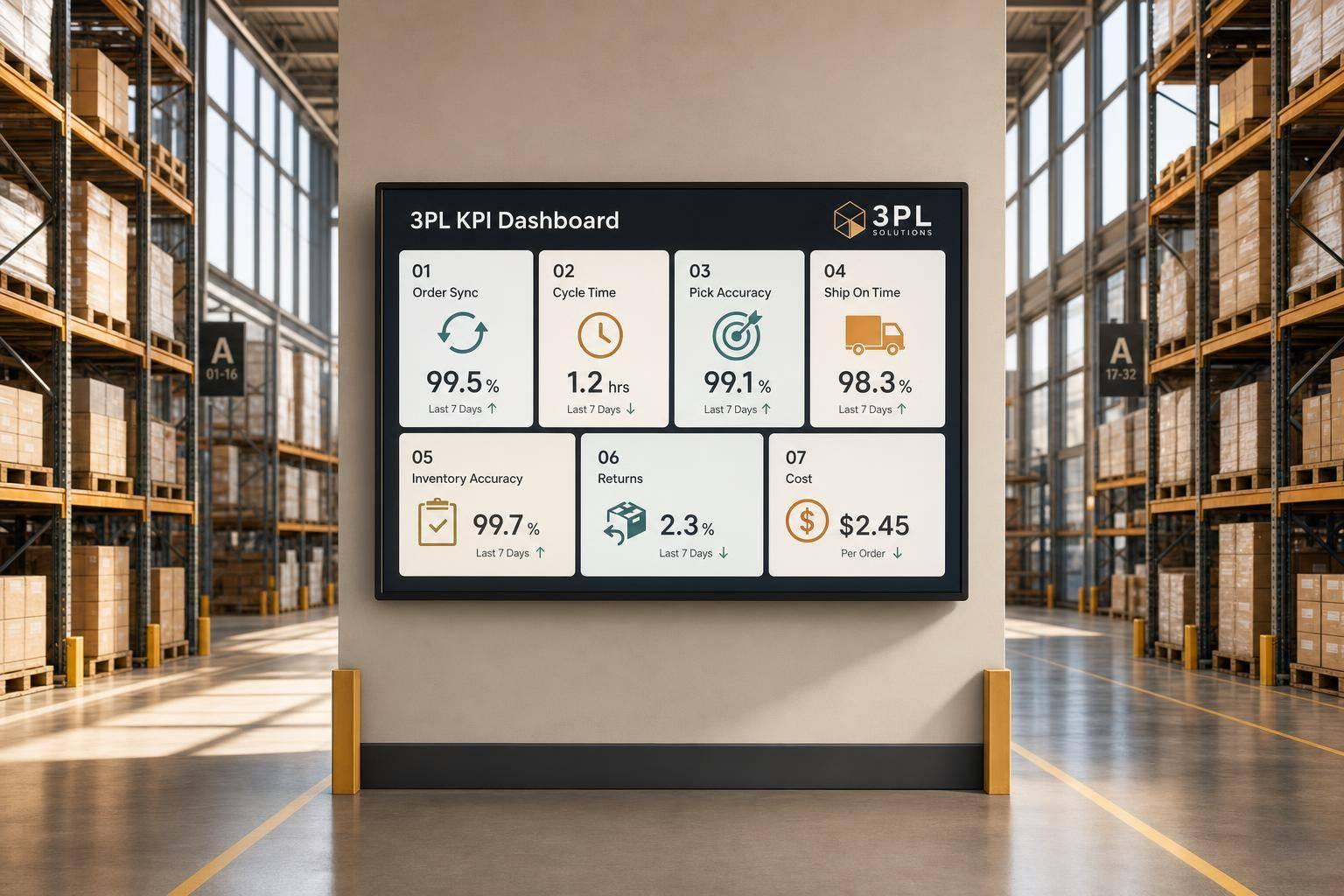
7 WooCommerce 3PL KPIs Teams Track

Centralized vs Decentralized Replenishment
