
The ROI of Port-Adjacent Fulfillment
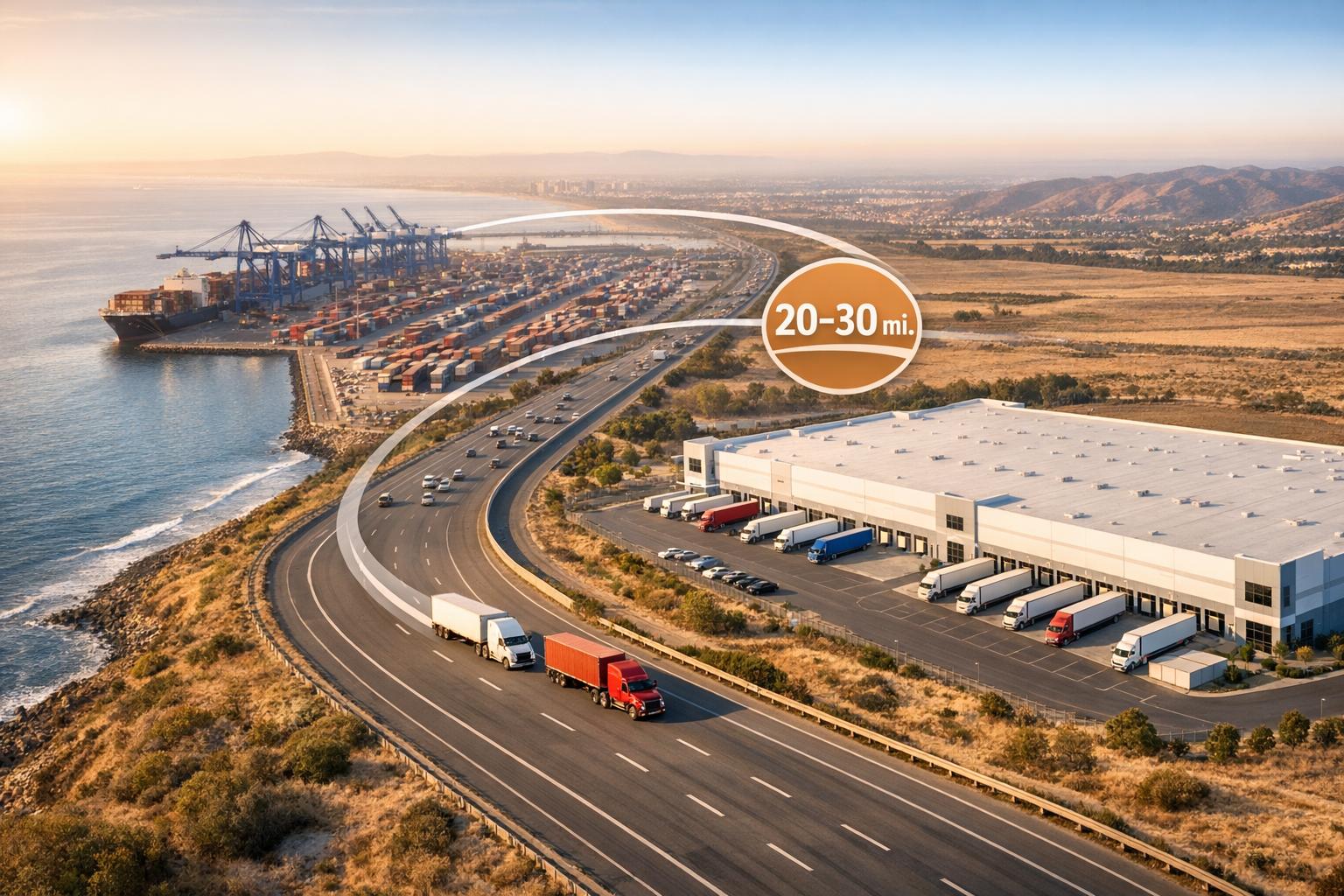
Port-adjacent fulfillment is a logistics strategy where warehouses and order processing centers operate within 20–30 miles of major U.S. ports. This approach minimizes transportation costs and speeds up inventory handling. Here's why it matters:
- Cost Savings: Shorter drayage (container transport) trips cost $350–$450 per container, compared to $1,200–$1,500 for long inland hauls. Businesses moving 50 containers annually can save up to $52,500.
- Faster Processing: Goods move from port to warehouse in 24–48 hours, reducing delays and cutting costs tied to demurrage and detention fees.
- Improved Efficiency: Facilities near ports streamline operations like transloading, reducing transit times and inventory hold-ups.
- Scalability: Port-adjacent 3PL providers offer flexible solutions for peak seasons and high-volume e-commerce brands.
For e-commerce businesses, this model reduces supply chain risks, improves delivery times, and enhances customer satisfaction. It’s particularly effective for fast-moving consumer goods and businesses importing 5–20 containers monthly.
Key Cost Drivers and Savings Opportunities
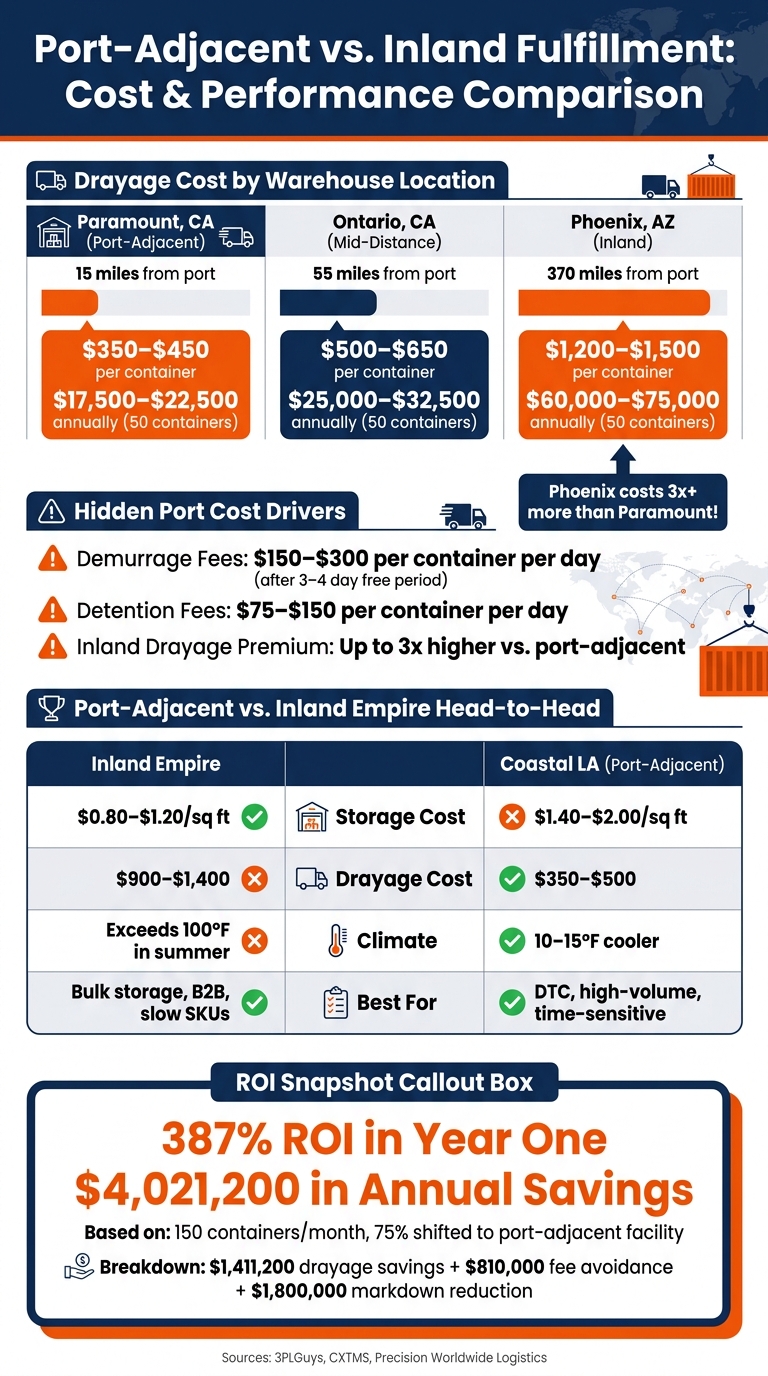
Port-Adjacent vs. Inland Fulfillment: Cost & Performance Comparison
Breaking Down Port-Related Logistics Costs
Port logistics expenses go far beyond just the ocean freight charges. The real financial drain often lies in the processes between the ship's arrival and getting goods to your warehouse. The main cost drivers include drayage, demurrage, detention fees, and transloading inefficiencies.
Demurrage fees kick in when containers sit at the terminal beyond the free period, which is typically 3–4 days. These fees can range from $150–$300 per day per container. Similarly, detention fees are charged when empty containers aren't returned promptly, costing $75–$150 per day. These delays can snowball, leading to significant penalties before your goods even leave the port.
Then there's transloading, the process of transferring goods from ocean containers into domestic trailers or warehouses for quicker inventory readiness. Facilities near the port streamline this operation, cutting down on delays and extra handling costs that arise when transloading is done further inland. As Precision Worldwide Logistics notes:
"The port-to-warehouse journey often represents one of the largest hidden cost centers in your supply chain, consuming 15–30% of total logistics spend."
These costs highlight the importance of reducing drayage distances, which we'll explore further in the next section.
How Port Proximity Lowers Transportation Costs
Keeping your warehouse close to the port doesn't just save time - it can significantly cut transportation costs. The table below illustrates how location impacts costs for 50 containers annually:
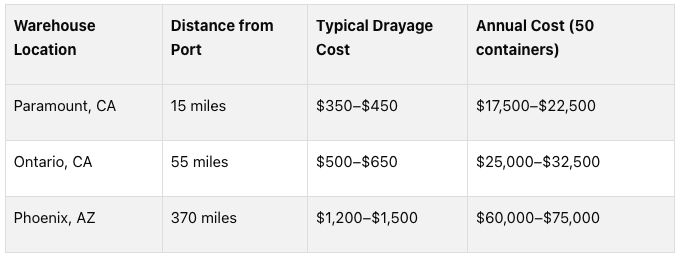 (Source:
 The numbers speak for themselves - moving a warehouse a few hundred miles inland can more than triple annual drayage costs. Port-adjacent facilities not only save on transportation but also help avoid demurrage and detention fees by enabling faster container returns. Additionally, consolidating shipments into full truckloads at the port lowers outbound transportation costs by 20–35%.
Secondary Financial Benefits
The benefits of port proximity extend beyond transportation. Faster processing times can transform operational efficiency and financial performance. Moving inventory from port to warehouse in 24–48 hours - instead of the typical 14+ days - allows businesses to maintain leaner safety stock. For example, increasing inventory turns from 4 to 12 times per year can free up millions in working capital while safeguarding margins on time-sensitive goods.
For industries like electronics, apparel, and seasonal products, speed directly impacts profitability. A national clothing brand that shifted 75% of its 150-container monthly volume to a near-port facility in 2025 saw markdowns drop by 12%, delivering $1.8 million in annual value on top of savings from drayage and per diem fees. Faster delivery also helps avoid costly retailer chargebacks for late shipments, ensuring smoother operations and better customer relationships.
sbb-itb-eafa320
Operational and Customer Experience Benefits
Faster Delivery and Better Customer Satisfaction
Using port-adjacent fulfillment centers can dramatically cut delivery times. These facilities process inventory within 24–48 hours after customs clearance, a sharp improvement over the 3–5 days typically needed for inland warehouses. With fewer handoffs, there’s less chance of transit damage or coordination errors, which translates to better order accuracy. In fact, port-adjacent third-party logistics providers (3PLs) often achieve 99.9% order accuracy, thanks to real-time inventory tracking.
For e-commerce brands, speed is everything. Many port-adjacent facilities offer same-day order processing for orders placed before a specific cut-off time, like 2:00 PM PT. This quick turnaround significantly shortens the delivery window, improving the overall customer experience. As Flex Logistics explains:
"Competitive advantage is increasingly determined by how efficiently inventory moves from the port to the warehouse shelf and ultimately to the customer."
This speed not only enhances customer satisfaction but also sets the stage for handling higher order volumes during peak seasons.
Handling Peak Season Volume
Peak seasons bring challenges, but staging inventory near ports can help brands manage demand surges while keeping costs in check. Shorter drayage legs - typically just 10–30 miles - reduce reliance on long-haul trucking, which is especially useful during times of tight trucking capacity and rising rates. This is becoming even more critical as U.S. warehouse utilization is projected to reach 85.5% by 2026, with e-commerce expected to account for nearly 25% of new warehouse leases.
For mid-sized brands that can’t commit to long-term warehouse leases, shared-space 3PL models offer a practical solution. Facilities at major hubs like Long Beach, Savannah, and Newark provide surge capacity when it’s needed most, allowing businesses to scale up during busy periods and scale back down afterward - without the burden of fixed overhead costs.
This ability to flex during peak times also helps brands navigate common supply chain challenges more effectively.
Reducing Risk and Building Supply Chain Resilience
Operating closer to ports reduces exposure to risks like rail congestion, driver shortages, and fluctuating fuel costs. It also allows for quicker retrieval and return of containers, helping avoid costly demurrage and detention fees that add up once free time expires. Additionally, many port-adjacent warehouses operate independently of port labor agreements, meaning fulfillment can continue even during labor slowdowns at the terminals.
For brands importing through multiple gateways, such as Long Beach and Savannah, a multi-port network offers even greater flexibility. This setup allows companies to shift volume between regions if one area faces disruptions. As Coastal Logistics Group highlights:
"A multi-port strategy creates a supply chain that is resilient, responsive, and cost-efficient."
Designing a Port-Adjacent Fulfillment Strategy
Assessing Whether Port-Adjacent Fulfillment Fits Your Business
Creating an effective port-adjacent fulfillment strategy can be a game-changer for businesses importing goods regularly and operating at high volumes. This model is particularly beneficial for brands importing 5–20 containers per month, as the savings on drayage costs alone often outweigh the higher facility rent. For direct-to-consumer (DTC) brands offering fast West Coast delivery or same-day processing, port-adjacent facilities provide a competitive edge. Why? These locations typically allow later carrier pickups - 6–8 PM for UPS in coastal Los Angeles, compared to the earlier 4–5 PM cutoff in the Inland Empire.
On the other hand, businesses dealing in bulk storage or slower inventory turnover, like many B2B companies, might find inland hubs more cost-efficient. But for high-velocity DTC operations, the advantages of being near the port become more noticeable as the scale of operations grows.
"The cheap warehouse can be the expensive fulfillment partner." - 3PLGuys
Another key benefit of port-adjacent facilities is their ability to maintain better conditions for temperature-sensitive products, making them ideal for perishable or premium goods. If your business aligns with these criteria, the next step is choosing a location that maximizes efficiency and reach.
Choosing the Right Location
When evaluating potential locations, don’t just focus on rent per square foot. A facility closer to the port may have higher rent but can offer lower overall fulfillment costs when you factor in reduced drayage expenses, faster shipping, and less need for buffer inventory .
Here’s a comparison of inland and port-adjacent options for e-commerce operations:
- Storage Cost: Inland Empire warehouse space is generally more affordable at approximately $0.80–$1.20 per square foot, while port-adjacent Coastal LA facilities typically range from $1.40–$2.00 per square foot
- Drayage Cost: Coastal LA locations benefit from significantly lower drayage costs, averaging $350–$500, compared to Inland Empire rates of roughly $900–$1,400
- Labor Pool: The Inland Empire offers a larger and more readily available labor pool, whereas Coastal LA labor markets are becoming increasingly constrained
- Climate: Inland Empire facilities often experience summer temperatures exceeding 100°F, while Coastal LA locations remain approximately 10–15°F cooler
- Best Fit: Inland Empire locations are ideal for bulk storage, B2B distribution, and slower-moving SKUs, while Coastal LA facilities are better suited for direct-to-consumer fulfillment, high-volume imports, and time-sensitive goods
For brands using multiple ports - like Long Beach, Savannah, or Newark - a multi-port network offers flexibility to adjust volumes across regions when disruptions occur.
Process Design and Technology Integration
Selecting the right facility is just the beginning. To fully capitalize on a port-adjacent strategy, your processes and technology need to work in harmony. The first priority? Connecting your Warehouse Management System (WMS) directly to ocean carrier milestones. This ensures your team can align drayage pickups with terminal gate schedules, keeping containers moving within 24–48 hours of port discharge and avoiding costly demurrage fees, which can range from $150–$300 per day after the free period ends .
Additional tools like a Transportation Management System (TMS) streamline drayage scheduling and outbound shipments, while ERP integration ensures inventory data stays up-to-date across your entire operation. Providers like JIT Transportation include ERP integration in their 3PL services, helping businesses maintain visibility across both port-adjacent and inland facilities.
For many e-commerce brands, a hybrid model works best. Use port-adjacent locations for tasks like deconsolidation, kitting, quality checks, and regional dispatch. Meanwhile, inland facilities can handle long-term storage for slower-moving products. This approach keeps your fastest-turning inventory close to the port while reducing the need for excess stock.
"The combination of physical proximity and digital visibility transforms port-adjacent facilities from passive storage into active, responsive distribution nodes." - CXTMS
Calculating and Tracking ROI
Building a ROI Framework
Creating a reliable ROI framework for port-adjacent fulfillment involves more than just comparing warehouse rental costs. It takes into account a variety of cost-saving factors, such as drayage savings, avoidance of demurrage and detention fees, lower inventory carrying costs, and improved outbound freight efficiency. The goal is to measure the total landed cost per unit.
The formula is simple: Total Savings − Total Incremental Costs = Net ROI. The complexity comes in accurately defining each saving. Additionally, faster inventory turnover can free up working capital, providing further financial benefits.
"Proximity changes the entire rhythm of the supply chain. Products spend less time sitting in containers, less time waiting in staging yards, and less time occupying expensive storage space." - FLEX Logistics
For businesses importing 3–5 containers each month, port-adjacent transloading often pays for itself in less than two months.
Key Metrics and Data Requirements
To manage ROI effectively, you need accurate data across three critical areas: financial, operational, and customer value metrics.
- Financial Metrics: Track drayage spend, demurrage and detention fees, inventory carrying costs, and outbound freight cost per unit to measure overall transportation and storage efficiency
- Operational Metrics: Monitor container dwell time at the port, container-to-warehouse cycle time, inventory turnover rate, and pick-to-ship time to evaluate supply chain speed and operational performance
- Customer Value Metrics: Measure port-to-customer delivery speed, order accuracy, customer retention rate, and cart abandonment rate to understand customer satisfaction and fulfillment effectiveness
Tracking these metrics can reveal significant savings. For instance, a national apparel brand importing 150 containers monthly shifted 75% of its volume to a near-port facility. With a 48-hour turnaround and no per diem charges, the company saved $1,411,200 in drayage and $810,000 in fees annually. Faster inventory turnover also reduced markdowns by 12%, adding another $1.8 million in savings. Altogether, this resulted in $4,021,200 in annual savings and a 387% ROI in year one.
"Shipping savings is a measurement problem before it is a negotiation problem. If you cannot see cost drivers clearly, you cannot control them." - Jason Nesbitt, Nautical Manufacturing & Fulfillment
These metrics form the foundation of scenario modeling, enabling precise ROI calculations and tracking.
Scenario Modeling and Ongoing Review
Once you’ve calculated your baseline ROI, scenario modeling helps refine cost predictions. This approach allows you to test various conditions before implementing changes. For example, compare your current total landed cost per container with a proposed port-adjacent model. Drayage costs for a 15-mile move typically range between $350–$450, while a 370-mile haul can cost $1,200–$1,500. Running the numbers at different import volumes - such as 20, 50, or 100 containers per month - can reveal the point where the port-adjacent model becomes most cost-effective.
Regular reviews are essential to account for changes in freight rates and carrier performance. For instance, UPS has announced a 5.9% General Rate Increase for 2026, and trucking capacity constraints are likely to drive rates higher. Conducting quarterly audits of drayage spend, detention fees, and outbound distribution zones can help identify inefficiencies before they escalate. A practical way to approach this is through a 30-60-90 day plan:
- Days 1–30: Establish a baseline for your true cost per order, including all surcharges.
- Days 31–60: Optimize your carrier mix to reduce costs.
- Days 61–90: Assess network-wide adjustments, such as reducing zones.
Conclusion: The Case for Port-Adjacent Fulfillment
Choosing port-adjacent fulfillment offers clear financial and operational benefits. By reducing drayage distances, avoiding demurrage and detention fees, improving inventory turnover, and minimizing the need for excess stock, this approach creates a strong cost advantage compared to inland distribution. As warehouse demand and freight rate pressures increase, this cost gap will only grow.
But it’s not just about savings. For e-commerce brands looking to scale, port-adjacent fulfillment provides a critical edge in speed and supply chain reliability. Products get to customers faster, stockouts are less likely, and proximity to the port helps avoid many of the risks that can disrupt inland supply chains. These factors form the foundation of the infrastructure and operational strength demonstrated by JIT Transportation.
JIT Transportation has embraced this model fully. With 14 strategically located warehouses near major ports like Los Angeles, San Francisco, and Houston, and a total of over 2.5 million square feet of space, JIT enables brands to implement port-adjacent strategies without committing to long-term leases. Their services - ranging from cross-docking and transloading to kitting and white-glove handling - ensure goods are processed and shipped efficiently. Add to that a 98.5% on-time performance rate for regional LTL solutions, and you have a reliable partner that can seamlessly integrate port-adjacent strategies into your operations.
For fast-growing e-commerce brands, the message is clear: moving your supply chain closer to the port isn’t just an option - it’s a strategic imperative. The question now is how quickly you can make the shift and how effectively your 3PL partner can deliver on this approach.
FAQs
How do I know if port-adjacent fulfillment is worth it for my import volume?
Businesses looking to decide if port-adjacent fulfillment makes sense should weigh the potential cost savings and operational benefits. For companies importing over 50 containers annually, this approach can significantly cut transportation expenses - such as drayage fees, which typically range between $150 and $400 per container. It also helps sidestep delays like demurrage charges and boosts inventory turnover rates. If these savings can balance out the higher warehousing costs and operational efficiency is a top concern, port-adjacent fulfillment could be a smart move.
What data do I need to calculate ROI for a port-adjacent 3PL setup?
To figure out the ROI for a port-adjacent 3PL setup, you'll need to collect data on a few key areas:
- Port-to-warehouse transportation costs: This includes expenses like drayage, demurrage, and detention fees.
- Warehouse fees: The costs associated with operating or leasing the warehouse near the port.
- Inventory carrying costs: The expenses tied to storing and managing your inventory.
- Shipment volume: The total amount of goods moving through the facility.
By analyzing these metrics, you can get a clearer picture of the potential cost savings and efficiency benefits that come with using port-adjacent facilities.
Should I use a port-adjacent-only network or a hybrid with inland storage?
Choosing between a port-adjacent network and a hybrid model with inland storage comes down to your specific operational goals and cost considerations.
A port-adjacent network is perfect for frequent, high-volume shipments. It helps lower drayage costs, speeds up inventory turnover, and reduces additional fees, making it a smart choice for businesses focused on efficiency and quick delivery near ports.
On the other hand, a hybrid approach offers more flexibility. By incorporating inland storage, it supports regional distribution and helps manage risks like port congestion. This makes it a better fit for businesses with a wider customer base or those dealing with seasonal demand changes.
Related Blog Posts
Related Articles
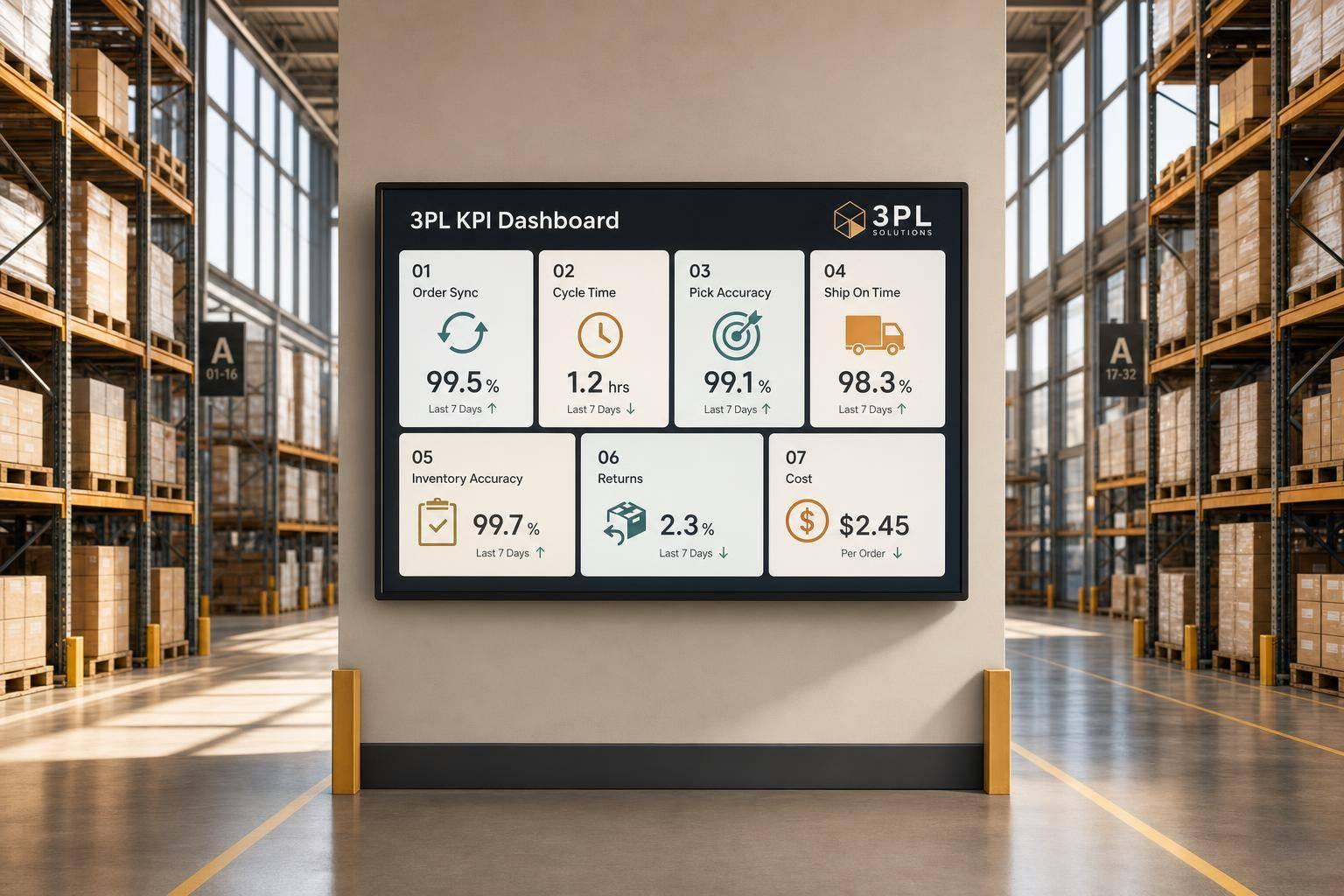
7 WooCommerce 3PL KPIs Teams Track

Centralized vs Decentralized Replenishment
