
Real-Time Tracking in 3PL: Key Features to Look For
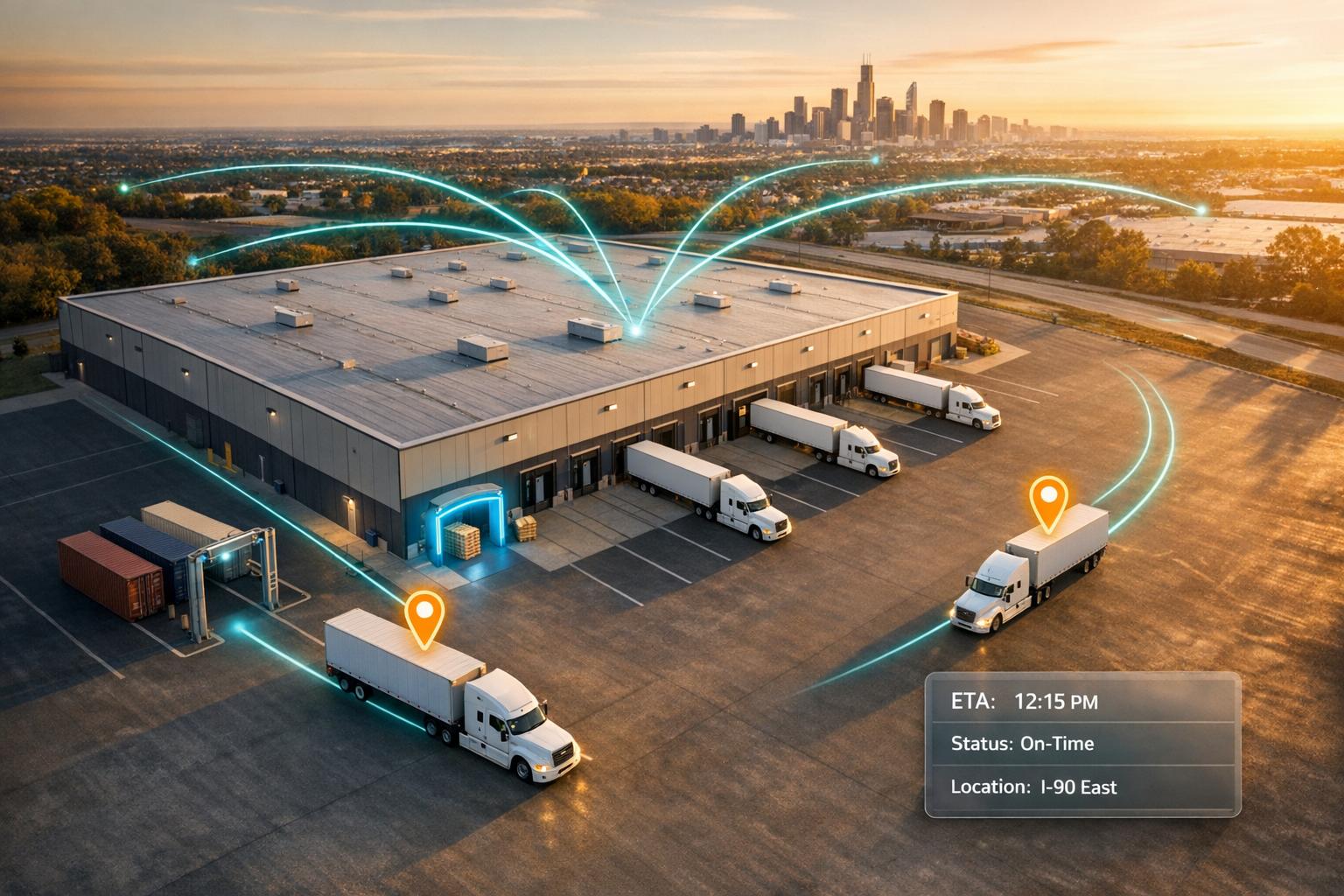
Real-time tracking in third-party logistics (3PL) is no longer optional - it’s a necessity. With tools like GPS, automated scanning, and analytics dashboards, these systems provide instant updates on inventory, shipments, and warehouse operations. This ensures better accuracy, faster problem-solving, and fewer customer complaints.
Key Takeaways:
- GPS Tracking: Real-time shipment location with automated alerts for delays.
- Automated Scanning: Instant updates on inventory and order status to prevent errors.
- Analytics Dashboards: Insights into performance metrics and trends for better decision-making.
- Customer Portals: Self-service tools that reduce inquiries and build trust.
By 2026, real-time tracking will be a standard expectation for effective logistics. These systems reduce errors, improve transparency, and help businesses save on logistics costs while meeting customer demands for visibility and reliability.
Using Power BI to track real-time deliveries of a 3rd-Party logistics business

sbb-itb-eafa320
Core Features of Real-Time Tracking Systems
Today's 3PL tracking systems are built on three essential layers: GPS tracking for shipments, automated scanning for warehouse operations, and analytics dashboards for data insights. Together, these components address key gaps in the supply chain. For instance, GPS provides accurate, real-time location data, bypassing the delays and errors common in manual carrier updates. Similarly, automated scanning captures every warehouse movement, ensuring that physical inventory matches digital records. Finally, analytics dashboards transform raw data into actionable insights, enabling businesses to assess carrier performance and predict demand. These elements work together to create a seamless and efficient logistics process.
GPS Integration for Live Shipment Location
GPS technology offers a real-time view of shipments from the moment they leave the warehouse to their final destination. By combining data from GPS devices, telematics, and even ocean tracking systems, it calculates dynamic ETAs and sends automated alerts when shipments are delayed or idle for too long. This allows businesses to take immediate action - rerouting shipments, adjusting schedules, or notifying customers - before small delays become costly problems.
"The goal isn't just tracking a dot on a map; it's spotting exceptions early enough to reroute, reschedule, notify customers, and prevent small issues from turning into big costs." – Mitch Belsley, GPX
The importance of this capability is clear: 42% of transportation professionals consider real-time visibility the most critical feature for effective logistics management. For sensitive or high-value cargo, disposable GPS trackers can be added to provide unfiltered, real-time data, further enhancing reliability.
Automated Updates and Notifications
To complement GPS tracking, automated updates ensure every movement is logged as it happens. Barcode scanning, RFID, and API integrations record order status changes instantly, creating a fully digital workflow that tracks every action - from receiving to picking. This eliminates the need for manual checks and reduces the risk of errors.
"You want everything to be scanned in the warehouse, nothing done on paper. You can lose a lot of money in this industry by having people ship stuff wrong, or store it wrong, and now it's lost somewhere." – Connor Perkins, G10 Fulfillment
These systems also integrate with sales channels via APIs, keeping inventory counts accurate and preventing overselling. Automated SMS and email notifications enhance customer satisfaction by providing timely updates on shipment progress.
Live Inventory Tracking and Analytics Dashboards
Building on the data captured by GPS and scanning, advanced dashboards turn raw information into meaningful insights. Live inventory tracking maps each item to its specific bin or zone, ensuring precise stock counts. This level of detail supports better SKU management, demand planning, and performance monitoring across multiple clients. High-performing 3PLs using these systems can achieve inventory accuracy rates as high as 99.7%.
Analytics dashboards also highlight key performance metrics and historical trends, helping businesses quickly identify bottlenecks like delays in receiving or slow picking processes. Cloud-based systems, now used in nearly 50% of Warehouse Management System deployments, allow for instant data synchronization across devices and locations. Multi-client portals provide customers with direct access to their stock levels, order statuses, and performance metrics, reducing manual inquiries and fostering trust by eliminating unnecessary uncertainty.
Customer Portals and Multi-Client Support
Customer portals are transforming logistics by giving clients direct, self-service access to shipment data in real time. These platforms eliminate the need for phone calls or email inquiries by offering a full view of the warehouse lifecycle. From inbound tracking and receiving to picking, packing, labeling, and final shipment, every update is reflected instantly with each scan. Integrated carrier systems provide immediate tracking updates and delivery confirmations, while exception tracking flags issues like scan gaps or failed picks - allowing 3PLs to address problems before they disrupt delivery schedules.
"What these real-time portals provide our customers is 100% visibility. That is the benchmark." – Maureen Milligan, G10 Fulfillment
For 3PLs managing multiple clients, keeping data separated by client is essential. Each client can view only their own inventory, SKUs, and billing information, while the 3PL retains centralized control. This approach allows providers to create tailored operational rules for individual clients, such as specific picking strategies (FIFO vs. FEFO), storage setups, or shipping preferences. These personalized rules work in harmony with real-time data, strengthening the logistics management process. Integration with client ERPs and platforms like Shopify or Amazon ensures inventory levels sync across all sales channels, reducing the risk of overselling or delays in fulfillment.
Portals go beyond basic inventory counts by categorizing stock into detailed states - such as available, allocated, picked, packed, damaged, or quarantined. This granular view helps clients understand what inventory is immediately sellable. Custom reporting tools offer both high-level summaries and detailed transaction insights, with export options to Excel for team analysis. Automated invoicing based on tracked fulfillment activities further simplifies billing and reduces disputes. Additionally, white-labeling options allow 3PLs to brand the portal as their own, enhancing client trust and loyalty.
These cloud-based systems synchronize data instantly across devices and locations, cutting down on customer inquiries about inventory status and freeing up time for fulfillment teams. By offering verifiable proof of accurate inventory and on-time order fulfillment, portals build trust while ensuring transparency. Clients no longer need to rely on tickets, calls, or spreadsheets to stay informed, making the entire fulfillment process smoother and more efficient. This seamless separation of client data and robust tracking capabilities lays the foundation for streamlined 3PL operations.
How to Implement Real-Time Tracking in 3PL Operations
Steps to Evaluate and Deploy Tracking Systems
Start by reviewing your current scanning practices to confirm that every movement within the operation is being digitally recorded. Transition to a fully digital, scan-based system where each action - whether it involves the dock, a pallet, a forklift, or a storage location - creates a data point.
Ensure the platform you choose supports all transportation modes, including ocean, air, road, and rail. It should offer frequent updates with dynamic ETAs and exception tracking for delays or route deviations. Real-time operations demand updates every few minutes to enable quick, informed decisions.
Integrate tracking into your WMS (Warehouse Management System) as part of daily workflows rather than treating it as an add-on. Opt for platforms that connect seamlessly with your ERP, CRM, and e-commerce systems using Electronic Data Interchange (EDI) and pre-built integrations. Test the system’s ability to monitor the entire warehouse lifecycle - from receiving and picking to packing, labeling, and shipping - to ensure comprehensive visibility. Pay special attention to areas where data is often lost, like ports, terminals, or cross-docks, and confirm the platform addresses these problem areas.
Finally, involve your team from the start. Train staff on how the tracking system interacts with other platforms, and make scanning a mandatory part of all warehouse tasks. This alignment between the digital platform and physical workflows is critical for accuracy. Advanced tracking systems can deliver impressive results, such as maintaining inventory accuracy levels of up to 99.7%.
Once your tracking systems are operational, the focus should shift to ensuring scalability and securing strong vendor support to handle future growth.
Scalability and Vendor Support Requirements
Select a platform that can grow with your business. It should handle rising shipment volumes, new carrier integrations, and increasing order frequencies without slowing down. As demand grows, the system must also accommodate more SKUs and additional clients seamlessly. With 42% of transportation professionals identifying real-time visibility as the top priority for transport management, your system must scale effectively to meet this expectation.
Vendor support is crucial to success. Choose a provider that offers extensive help with data migration, initial integration, and staff training. The vendor should assist with transitioning from legacy systems and provide ongoing technical support as your needs evolve. A proven track record of successful deployments and responsive customer service is essential - especially for resolving integration challenges or onboarding new team members. Reliable support can be the difference between a smooth implementation and a frustrating experience.
Feature Comparison Table
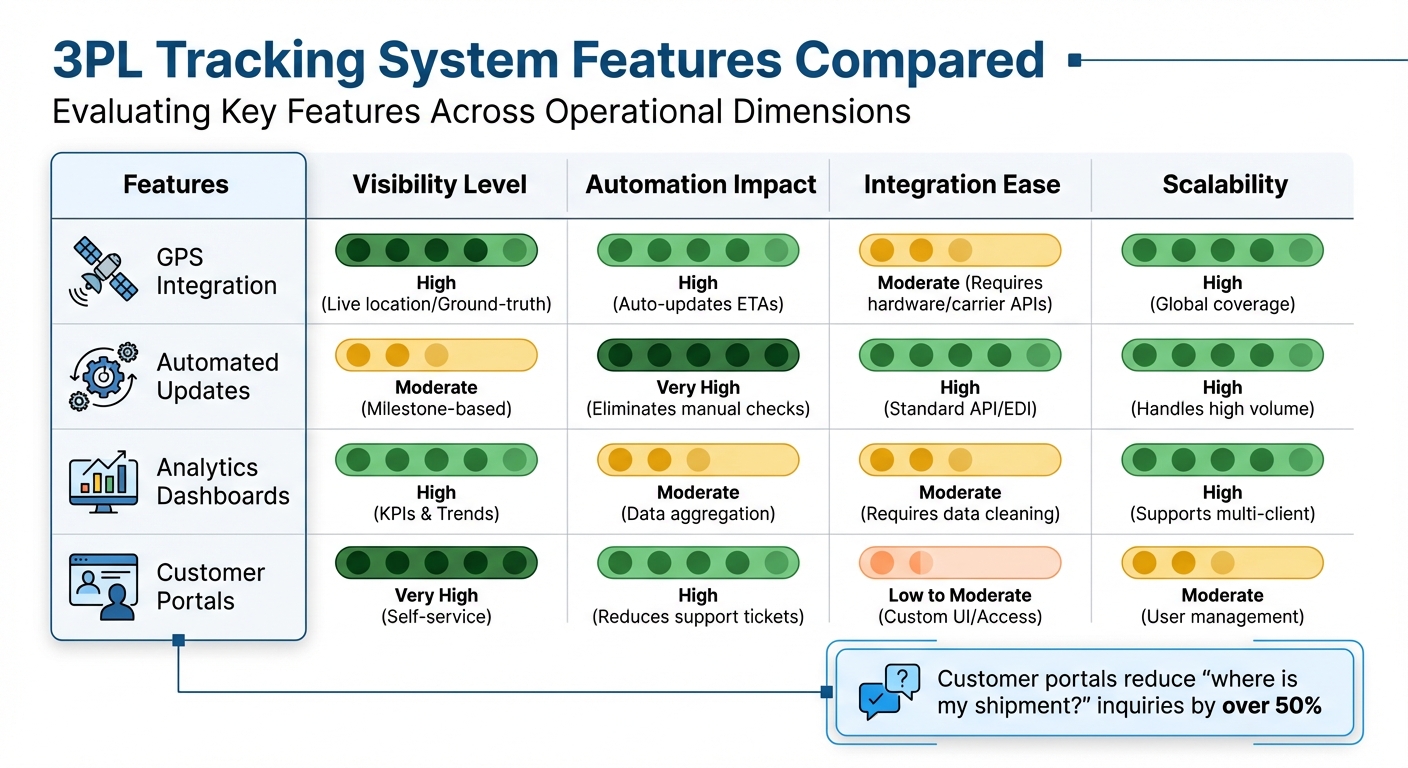
3PL Real-Time Tracking System Features Comparison Chart
3PL Tracking System Features Compared
Here’s a breakdown of key tracking system features, evaluated across critical operational dimensions like visibility, automation, integration, and scalability. This table serves as a practical guide to help you identify the platform that aligns with your needs.
| Feature | Visibility Level | Automation Impact | Integration Ease | Scalability |
|---|---|---|---|---|
| GPS Integration | High (Live location/Ground-truth) | High (Auto-updates ETAs) | Moderate (Requires hardware/carrier APIs) | High (Global coverage) |
| Automated Updates | Moderate (Milestone-based) | Very High (Eliminates manual checks) | High (Standard API/EDI) | High (Handles high volume) |
| Analytics Dashboards | High (KPIs & Trends) | Moderate (Data aggregation) | Moderate (Requires data cleaning) | High (Supports multi-client) |
| Customer Portals | Very High (Self-service) | High (Reduces support tickets) | Low to Moderate (Custom UI/Access) | Moderate (User management) |
- GPS Integration: Offers top-tier visibility with live location tracking, but it requires additional hardware or dependable carrier APIs. Its global scalability makes it ideal for businesses with widespread operations.
- Automated Updates: Streamlines processes by removing the need for manual status checks. Its milestone-based system handles high volumes effortlessly, though it doesn’t provide continuous tracking.
- Analytics Dashboards: Delivers valuable insights into KPIs and trends. However, its effectiveness depends on consistent data input - without it, the dashboards risk showing outdated information.
- Customer Portals: A game-changer for self-service, cutting "where is my shipment?" inquiries by over 50%. While they enhance customer experience, they require careful user access management as your client base expands.
When deciding on features, consider your priorities. For instance, if reducing support inquiries is your focus, customer portals are a strong choice. On the other hand, if operational insights are key, invest in reliable analytics dashboards. Use this comparison to align your tracking system with your specific operational goals.
Conclusion
Real-time tracking has become a cornerstone of modern 3PL operations. With features like GPS integration, automated updates, and analytics dashboards, these systems provide the transparency needed to build trust. And trust matters - a lot. In fact, 73% of customers say they spend less with companies they don't trust. Unlike periodic updates that react to problems after they happen, real-time tracking helps prevent issues from escalating in the first place.
"Real-time tracking is the difference between prevention and apology." - G10 Fulfillment
Considering that inventory distortion costs businesses $1.73 trillion annually, capturing every warehouse event as time-stamped data is no longer optional - it's essential. JIT Transportation leverages advanced tracking tools and a nationwide network to ensure complete visibility at every stage, from receiving inventory to final delivery.
For 3PL providers juggling multiple clients, real-time systems offer a clear advantage. They allow for logical inventory separation while providing centralized oversight, streamlining operations and paving the way for better performance.
The benefits are clear: these tracking tools help reduce logistics costs and minimize processing delays. For example, the right system can lower logistics expenses by 20% and cut order processing time by 30%. When choosing a 3PL partner, look for one that enforces scanning at every touchpoint, integrates smoothly with your existing systems, and provides the detailed insights needed to resolve fulfillment challenges at their source.
FAQs
How often should tracking updates refresh?
Tracking updates should refresh as often as the system permits to ensure near real-time visibility. Depending on the technology in use, this might happen every few seconds or minutes. Frequent updates are key to maintaining accurate and current tracking details.
What integrations should a 3PL tracking system support?
A 3PL tracking system needs to work hand-in-hand with GPS tracking software, APIs for real-time data sharing, and warehouse management systems (WMS). These connections allow for precise, up-to-the-minute updates on shipment locations, inventory levels, and order statuses, helping maintain smooth supply chain operations and clear visibility.
How do customer portals keep each client’s data separate?
Customer portals provide a secure, self-service platform where each client can access their own inventory, shipment details, and performance metrics. By keeping data organized and separate for each user, these portals not only protect privacy but also cut down on the volume of support inquiries.
Related Blog Posts
Related Articles
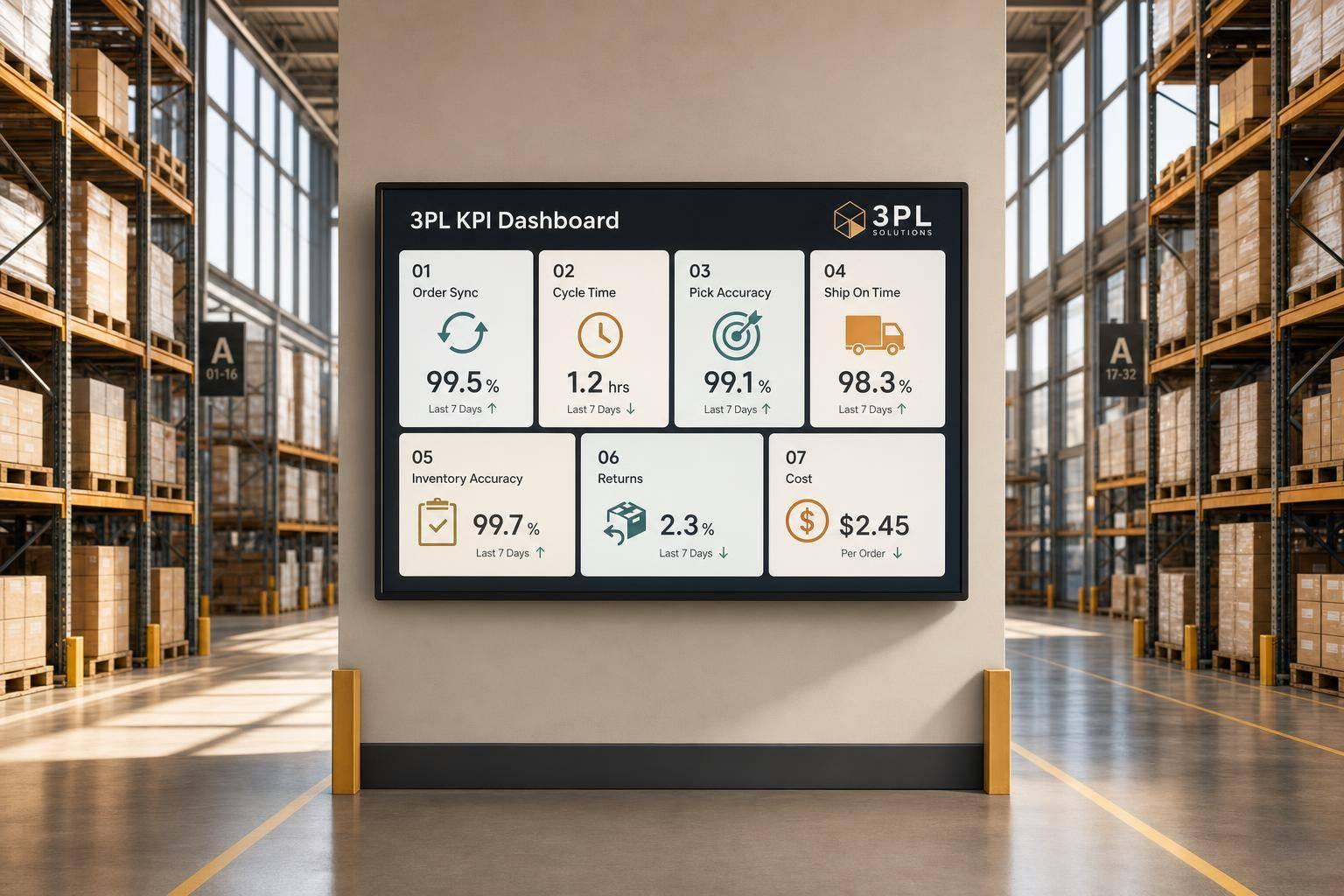
7 WooCommerce 3PL KPIs Teams Track

Centralized vs Decentralized Replenishment
