How Real-Time Tracking Improves E-Commerce Fulfillment

Real-time tracking solves common e-commerce fulfillment problems like inventory mismatches, order errors, and delivery delays. Here's how it helps:
- Eliminates outdated inventory data: Prevents "phantom inventory" and ensures stock levels are accurate across platforms.
- Reduces picking and packing mistakes: Scan-based workflows verify every step, achieving over 99% accuracy rates.
- Speeds up deliveries: Live updates address issues like route delays within seconds.
- Cuts costs: Automation reduces support costs per order from $0.62 to $0.11.
- Improves customer experience: Automated updates reduce "Where Is My Order?" inquiries by up to 75%.
Real-time tracking ensures visibility at every step - from warehouse operations to last-mile delivery - helping e-commerce businesses stay efficient and meet customer expectations.
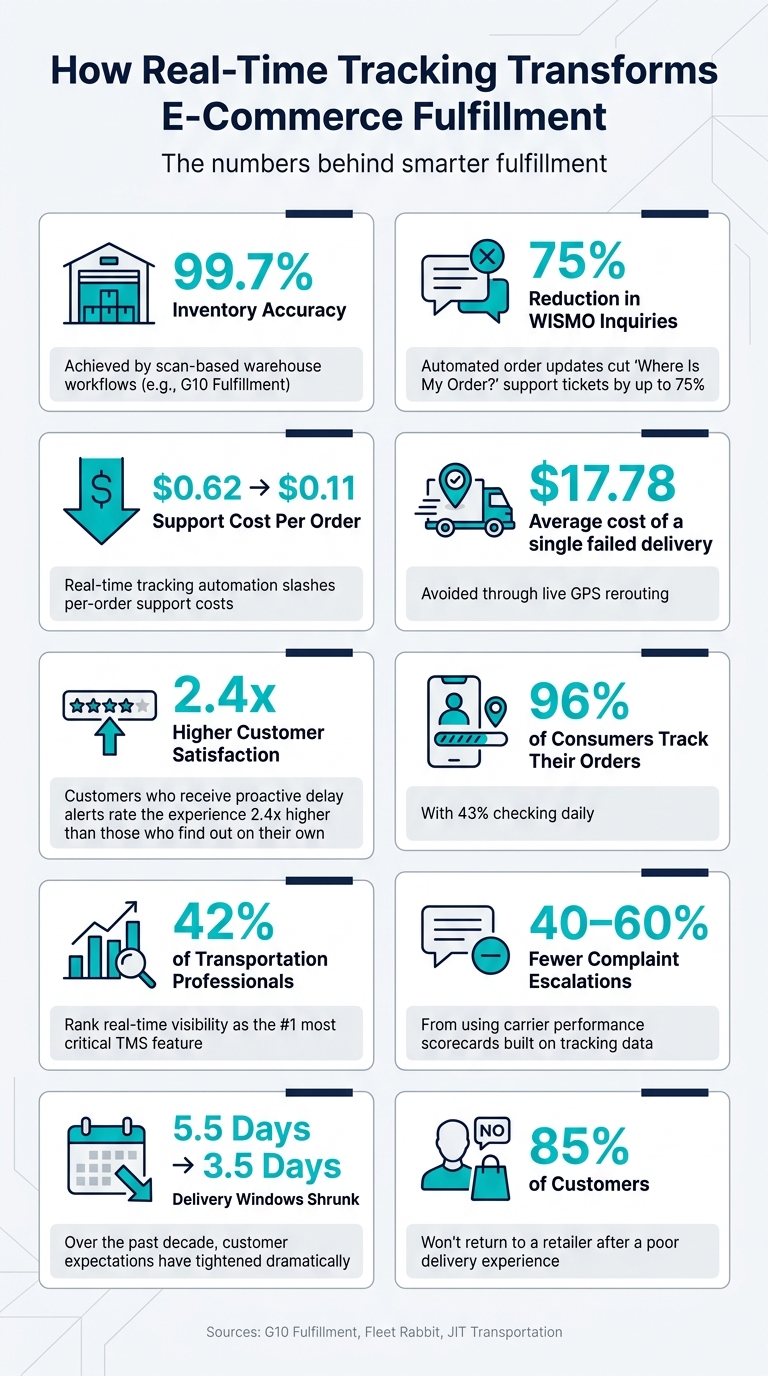
Real-Time Tracking: Key Stats That Transform E-Commerce Fulfillment
Real-Time Order Status Tracking for eCommerce Logistics #n8n #ai #automation #aiagents
sbb-itb-eafa320
How Real-Time Tracking Improves Order Accuracy
Real-time tracking plays a crucial role in ensuring order accuracy and streamlining the fulfillment process. At its core, order accuracy hinges on keeping physical inventory aligned with digital records. When these records fall out of sync, it leads to picking errors, unreliable stock levels, and dissatisfied customers.
Preventing Inventory Errors with Live Data
Traditional inventory systems often update stock in batches, which creates "inventory drift" - a mismatch between recorded and actual stock levels. Real-time tracking eliminates this issue by updating inventory instantly whenever an item is moved. Whether it’s being received, placed in a bin, or picked for shipment, the system ensures stock levels are accurate at all times.
This instant synchronization is especially helpful for businesses operating across multiple sales channels. For instance, when an item is picked for one channel, it’s immediately deducted from the inventory shown on all platforms. This prevents overselling, order cancellations, and the headaches of managing misplaced stock. By tracking the exact location of items, real-time systems also reduce the likelihood of short-ships and other errors. These updates pave the way for smoother picking and packing processes.
Reducing Picking and Packing Mistakes
A scan-based workflow is key to minimizing errors during picking and packing. Workers scan items at every stage - receiving, storing, picking, and packing - and the system validates that the scanned product matches the order. If the wrong SKU is scanned, the system blocks the action immediately.
"You want everything to be scanned in the warehouse, nothing done on paper. You can lose a lot of money in this industry by... having people ship stuff wrong, or store it wrong, and now it's lost somewhere." - Connor Perkins, G10 Fulfillment
This method ensures a seamless chain of custody from the receiving dock to the outbound truck. For example, G10 Fulfillment has achieved an impressive 99.7% inventory accuracy rate using this system. Even when errors occur, they’re often caught at the packing station, where corrections are faster and less costly.
Handling Exceptions and Quality Control in Real Time
Real-time systems don’t just prevent errors - they also manage exceptions efficiently. Even in the most organized warehouses, issues like damaged items, short-picks, or weight mismatches can arise. At the packing station, for instance, a weight check compares the actual weight of a package to the expected weight. If there’s a mismatch, the system flags it for immediate inspection before the carton is sealed.
Similarly, if a damaged item is found during picking, it can be scanned into a "damage" status. This action triggers an automated replacement workflow without disrupting the fulfillment process. For businesses handling perishable goods, lot and expiration tracking ensures that expired items never make it to the customer.
"Real-time isn't faster data entry. It's fewer surprises because the system reacts while you can still fix the issue." - Leanafy
The result? Fewer reships, happier customers, and a well-documented audit trail for every order leaving the warehouse. These benefits highlight the real impact of real-time tracking on operational efficiency and customer satisfaction.
How Real-Time Tracking Speeds Up Delivery
Getting orders right in the warehouse is just the beginning. Once the package is on its way, the clock keeps ticking - and customers are paying attention. Real-time tracking helps close the gap between "order placed" and "order delivered" by cutting out delays at every step of the process.
Faster Internal Order Processing
When your systems - like sales channels, enterprise resource planning, and warehouse management - are connected, orders sync instantly. This seamless integration triggers picking, packing, and labeling without manual handoffs, paving the way for same-day or next-day shipping. Real-time tracking doesn’t just speed up processing; it also ensures smoother operations across the board.
With live data, warehouse managers can monitor every batch in progress. If something goes wrong, like a delay in picking or a malfunctioning label printer, the system flags it immediately, allowing managers to fix the issue on the spot. Bryan Wright from G10 Fulfillment explains the power of this visibility:
"We have history that shows you all of that tracking. It shows the product landed on the dock at 8 o'clock. At 8:10, John picked it up... and at 11 o'clock, we packed it... all the way through the process onto the truck."
This kind of chain-of-custody tracking ensures nothing gets lost between receiving and shipping. And when the internal process runs smoothly, it sets the stage for a better delivery experience.
Better Last-Mile Visibility
The last mile is where delivery promises are either kept or broken. Real-time GPS tracking takes the guesswork out of this critical phase, offering clear visibility and control.
Live location data can alert dispatchers to issues like a driver going off-route within 45 seconds. It also enables dynamic route optimization, which adjusts for real-time traffic and conditions. This means tighter arrival windows and fewer failed deliveries. Considering that one failed delivery costs a retailer an average of $17.78, these adjustments can lead to significant savings.
Keeping Customers Informed with Automated Updates
While faster delivery is important, keeping customers informed is just as crucial. With 96% of consumers tracking their orders and 43% checking daily, automated updates are key to reducing frustration and avoiding negative reviews.
Real-time tracking systems can send automated updates via SMS or email at critical points - like when an order is dispatched, leaves the facility, or is about to arrive. These updates not only keep customers in the loop but also reduce WISMO ("Where Is My Order?") inquiries by 60–75%. This has a direct impact on support costs, which drop from $0.38–$0.62 per order to under $0.11.
For example, a subscription box company in San Francisco saw a 19% boost in its 60-day customer retention rate after switching from standard carrier emails to proactive delivery notifications. One industry expert summed it up perfectly:
"Customers who receive a delay alert with a revised ETA rate the experience 2.4x higher than those who discover delays independently." - Fleet Rabbit
How Real-Time Tracking Boosts Operational Efficiency
Speeding up deliveries and ensuring order accuracy are just the beginning. Real-time tracking goes beyond these benefits, enhancing efficiency across the entire fulfillment network. It equips teams with the insights they need to make quicker, smarter decisions.
Full Visibility Across the Fulfillment Network
Integrating your TMS, WMS, and e-commerce platforms eliminates blind spots, replacing them with real-time visibility. Instead of relying on end-of-day reports, managers can monitor order statuses, throughput rates, and carrier performance - all in real time, from one centralized dashboard.
This setup functions as a control tower for your supply chain. Teams can quickly identify risks - whether it's a weather delay, port congestion, or a lagging batch - and take action before small problems escalate into costly disruptions. As Mitch Belsley from GPX Team explains:
"The goal isn't just tracking a dot on a map; it's spotting exceptions early enough to reroute, reschedule, notify customers, and prevent small issues from turning into big costs."
In fact, 42% of transportation professionals consider real-time transportation visibility the most critical feature in a transport management system, outranking tools for order management and routing. This level of visibility not only reduces blind spots but also provides actionable data for assessing carrier performance.
Using Tracking Data to Improve Carrier Performance
Real-time tracking offers something many businesses lack: hard data on carrier performance. Instead of relying on assumptions or sporadic complaints, you can use verified metrics - pickup times, transit durations, ETA accuracy, and exception rates by lane and route - to build performance scorecards.
This approach is crucial because underperformance isn’t always obvious. A carrier might perform well overall but struggle on specific routes or during peak times. By analyzing tracking data by lane, you can pinpoint where delays occur and make informed changes to your carrier mix. Businesses using this method have reduced complaint escalations by 40% to 60% by addressing delays before customers even notice them. With such insights, you can also pave the way for automating manual tasks in the warehouse.
Reducing Manual Work Through Automation
Manual processes like paper pick lists, verbal handoffs, and manual status updates are prone to errors. Real-time tracking transforms these actions into scan-based events, capturing picks, packs, and staging instantly. This reduces labor demands and tightens inventory control without duplicating existing verification steps.
Automation doesn’t stop in the warehouse. Self-service portals allow customers to track their orders at every stage, cutting down on support inquiries without increasing staff. Maureen Milligan of JIT Transportation highlights the impact:
"What these real-time portals provide our customers is 100% visibility... They can then make sure that their orders are fulfilled and out the door without having to wait till we send them back a notification."
The result? A leaner operation with fewer manual touchpoints, less labor waste, and inventory accuracy rates as high as 99.7%.
How to Add Real-Time Tracking to Your Fulfillment Operations
Identifying Gaps in Your Current Fulfillment Visibility
Improving visibility in your fulfillment operations is essential for ensuring accurate orders and faster deliveries - two key pillars of efficient e-commerce. Start by mapping out the entire order process, from when a customer places an order to the moment it’s delivered. At each step, evaluate how frequently data is updated and how timely that information is.
Some common blind spots include inventory systems that only update during nightly batch runs or shipment tracking that goes dark once a package leaves the warehouse.
"Freight feels unpredictable when communication disappears between pickup and delivery, but the right checkpoints can keep everyone aligned the entire way." - JIT Transportation
To make your assessment actionable, track metrics like order accuracy, on-time delivery rates, discrepancies between inventory records and physical counts, and the number of "where is my order?" inquiries your customer service team handles. Monitor these over a 30–90 day period. This data will help you determine whether your focus should be on improving in-transit visibility or synchronizing inventory updates across sales channels and fulfillment centers.
Building a Technology Integration Plan
After identifying the gaps, the next step is creating a plan to address them with the right technology. A robust system typically integrates tools like an Order Management System (OMS), Warehouse Management System (WMS), inventory management software, and a Transportation Management System (TMS) through APIs.
"Modern fulfillment requires seamless data flow between sales channels, ERPs, carriers, and warehouses." - JIT Transportation
Roll out new technology in phases. Start with the areas that cause the most friction and run the new system alongside your current one during a pilot phase. Track the key metrics you identified earlier to measure improvements. Once the data stabilizes, expand the implementation to other locations and channels. Schedule major system updates during slower periods - avoiding peak times like Black Friday - and have a backup plan ready in case you need to revert to the old system. This phased approach not only reduces disruptions but also ensures smoother collaboration with experienced third-party logistics providers (3PLs).
Working with a Technology-Enabled 3PL Like JIT Transportation
If building and integrating these systems in-house feels overwhelming, partnering with a tech-enabled 3PL can simplify the process. These providers come with pre-built integrations and a unified infrastructure that’s ready to use, saving you time and resources.
JIT Transportation, for example, connects its TMS, WMS, and fulfillment platforms into one system that clients can plug into directly. They offer pre-built integrations for platforms like Shopify, Magento, WooCommerce, BigCommerce, and Amazon FBA/SFP, ensuring that orders flow seamlessly from your online store to the warehouse floor without manual input. Their in-house IT team also handles custom API connections and ERP integrations, reducing the technical workload on your end. This setup gives you a single dashboard to track inventory, order statuses, and carrier performance across JIT's 14 warehouses and 2.5 million square feet of storage space in the U.S..
JIT’s extensive network also speeds up delivery. With over 500 carrier partners and a fleet of 200+ trucks, they provide 1–2 day delivery to most U.S. ZIP codes while offering unified tracking data for all shipments. Plus, their scalable infrastructure adjusts to seasonal spikes or rapid growth, so you don’t have to worry about renegotiating contracts or expanding warehouse capacity on your own.
Conclusion: Why Real-Time Tracking Matters for E-Commerce Fulfillment
Real-time tracking plays a critical role in every step of e-commerce fulfillment. With delivery windows shrinking from 5.5 days a decade ago to just 3.5 days today, and 85% of customers saying they won’t return to a retailer after a poor delivery experience, visibility has become a must-have for staying competitive.
This technology doesn’t just improve the customer experience - it also helps businesses cut costs. Real-time tracking reduces stockouts, trims emergency shipping expenses, and lowers overall logistics costs. Automated updates also ease the burden on customer support teams by reducing inquiries.
"Shipment tracking is now a requirement, not an enhancement. It protects customer experience, tightens operations, and prevents preventable misses." - Connor Perkins, G10 Fulfillment
The benefits of tracking go beyond immediate gains. Over time, it improves order accuracy, speeds up deliveries, and streamlines operations. The data collected - like carrier performance, exception patterns, and inventory trends - empowers smarter decisions about routing, stocking, and fulfillment. This constant flow of real-time information becomes the backbone of a strong and adaptable fulfillment strategy.
"In modern logistics, just-in-time isn't just a method - it's a mindset. And it's powered by technology built for speed, accuracy, and reliability." - JIT Transportation
Whether you’re developing solutions in-house or collaborating with a tech-savvy third-party logistics provider, treating visibility as a core part of your infrastructure is no longer optional - it's essential.
FAQs
What systems should real-time tracking connect to?
For real-time tracking to work seamlessly, your fulfillment setup needs to bring together essential systems into one cohesive network. Warehouse Management Systems (WMS) play a crucial role by monitoring inventory and activities at the SKU level. These systems sync with e-commerce platforms like Shopify or Amazon using APIs or EDI connections. On top of that, APIs link to shipping carriers to provide live updates, while GPS platforms and IoT sensors give you real-time insights into transit status and parcel conditions.
How do scan workflows prevent pick-and-pack errors?
Scan workflows help cut down on pick-and-pack mistakes by using real-time validation at every step. Workers scan barcodes for locations, products, and orders, which lets the system instantly catch errors like picking the wrong SKU or incorrect quantities. This means mistakes get fixed on the spot, stopping them from causing bigger issues later. Plus, scan-based systems eliminate the need for manual data entry and paper tickets, ensuring inventory records stay accurate throughout the fulfillment process.
Which metrics prove real-time tracking ROI?
Real-time tracking has a direct impact on improving performance and delivering measurable returns. For instance, businesses have seen order status inquiries drop by as much as 70%, significantly enhancing customer service efficiency.
On the fulfillment side, metrics show impressive results: order accuracy rates reaching 99.5% or higher and on-time deliveries increasing from 84% to 99.2%. These improvements not only streamline operations but also enhance customer satisfaction.
Cost savings are another major highlight. Companies report route costs decreasing by 31%, while warehouse operations benefit from better productivity, with more orders processed per hour and fewer inventory discrepancies. Together, these gains showcase how real-time tracking can transform operational efficiency.
Related Blog Posts
Related Articles

Demand-Driven Replenishment for Multi-Node 3PL

3PL Models Compared for Reverse Logistics Carbon