
FAQs About Returnable Packaging for E-commerce Brands
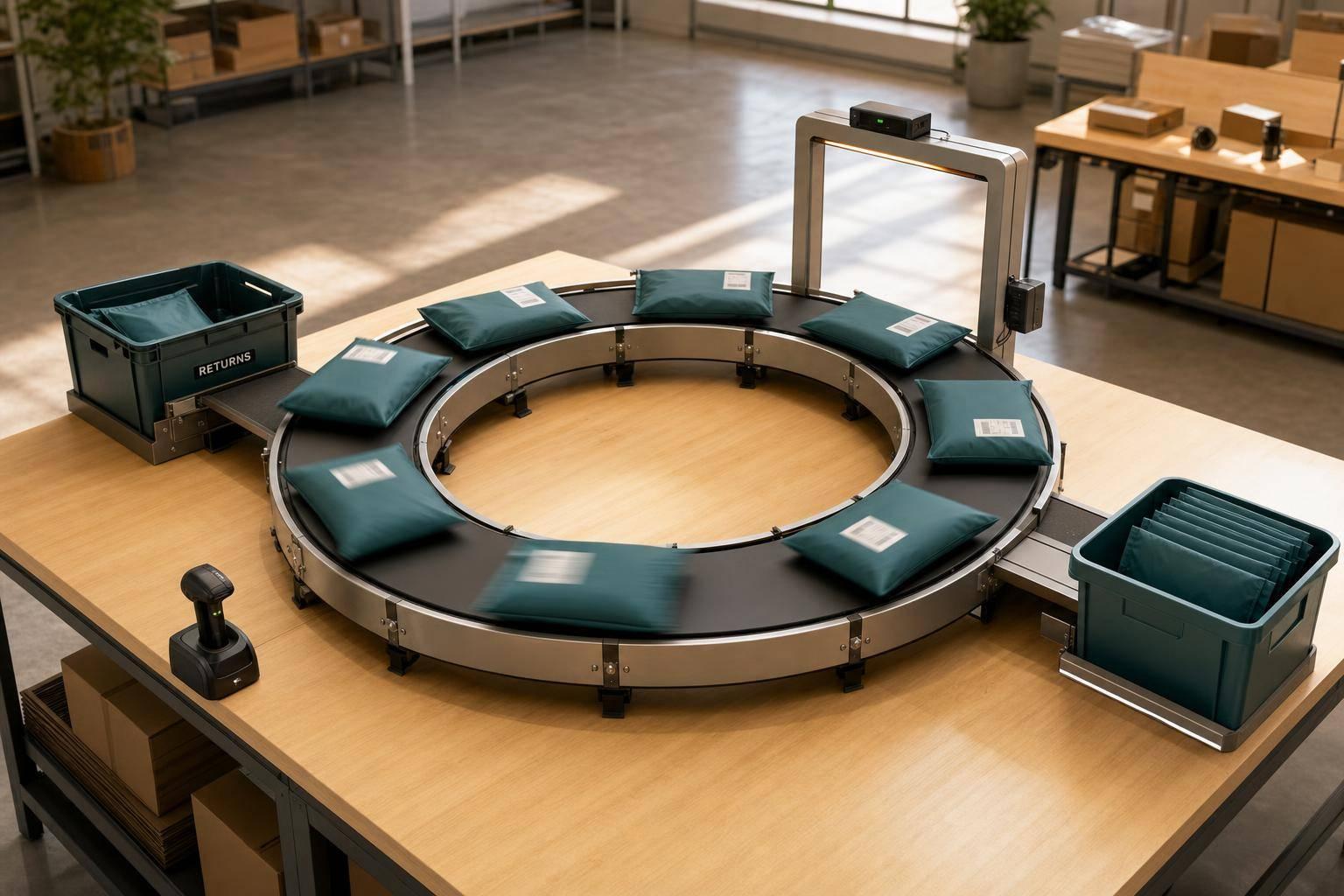
Yes - returnable packaging can cut shipping-packaging cost over time, but only if your return loop is tight. If a reusable shipper costs $13 to $19 and a one-use box costs about $1.90, the math only works when containers come back fast, loss stays low, and your team can inspect, clean, and reuse units without slowing fulfillment.
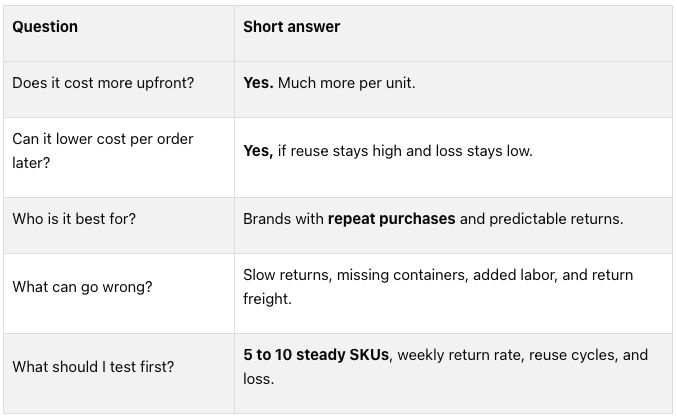
Here’s the short version:
- I’d look at returnable packaging if you ship repeat orders in categories like apparel, beauty, vitamins, pet care, or subscriptions.
- I’d be cautious if your buyers are mostly one-time customers or your return flow is hard to predict.
- Your break-even depends on reuse cycles, loss rate, return freight, cleaning, and labor.
- A 4-week loop can reach ROI in about 6 months, with savings of 48.7% in Year 1 and 82.9% by Year 3 in the model cited.
- Tracking matters a lot: loss can run 8% to 15% without tracking, vs. 2% to 4% with RFID.
- You’ll also need a larger packaging pool - about 1.2x to 1.5x demand - to avoid stockouts.
- Customer returns make or break the model, so the return step has to feel easy.
If I had to sum it up in one line: returnable packaging is less about the package and more about whether your warehouse, returns flow, and customers can keep the loop moving.
 Below, I’ll walk through the main questions in plain English so you can judge if this model fits your brand.
Packaging Strategies for E-Commerce Returns
Cost, ROI, and Financial Planning
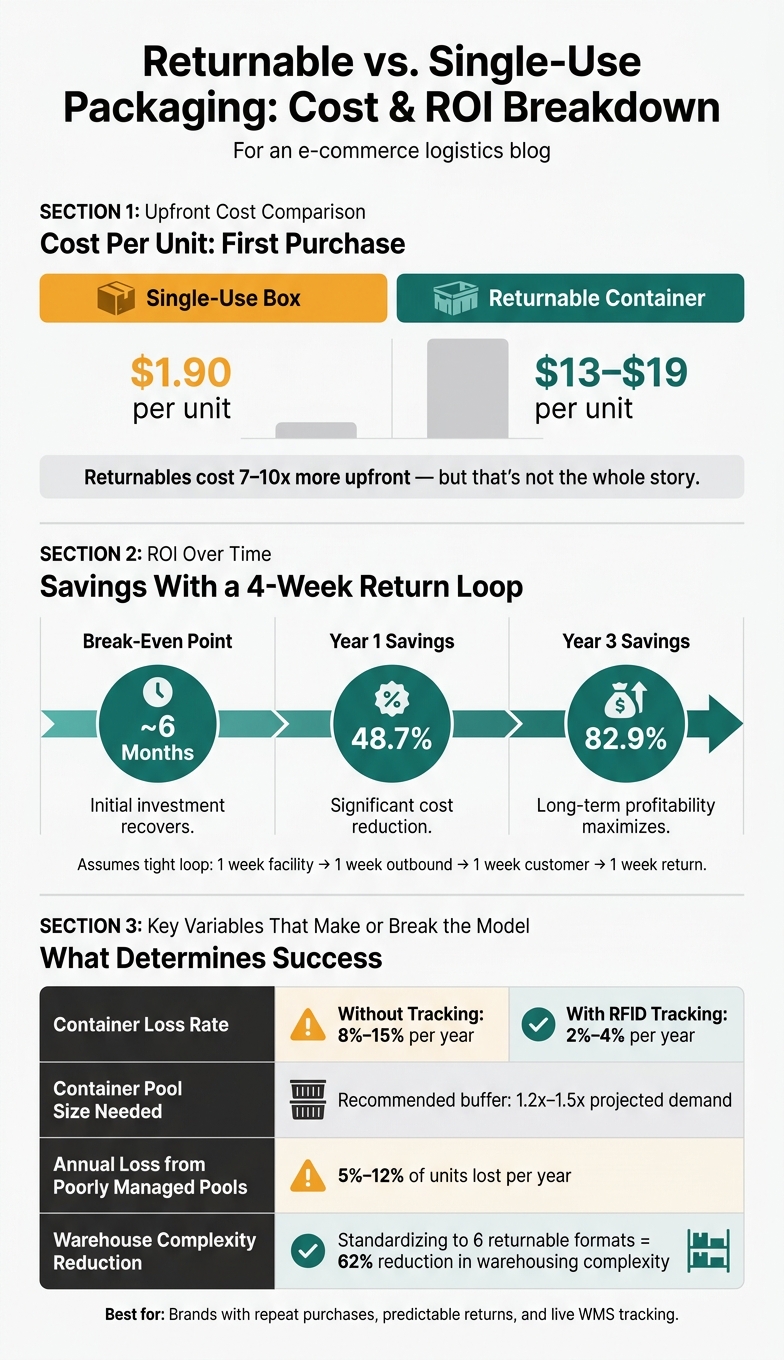
Returnable vs. Single-Use Packaging: Cost & ROI Breakdown
Why Upfront Costs Are Higher but Per-Order Costs Can Drop Over Time
After you lock in the packaging format, the next issue is simple: does reuse save money over time? That’s where many teams pause.
Returnable packaging changes where the money goes. Instead of buying consumables again and again, you invest in reusable assets. A standard corrugated box costs about $1.90 per unit, while a durable returnable container usually runs $13 to $19 per unit, depending on volume and design. That price gap is real, and finance teams usually spot it right away.
But the upfront price doesn’t tell the whole story. What matters is the cost per shipment over time. If containers move back fast and stay in the loop, the math can shift in your favor. If they sit too long or disappear, it falls apart.
Loss rate plays a big part here. Untracked pools can lose 8% to 15% of units each year. With RFID tracking, that loss can drop to 2% to 4%. That difference hits the bottom line fast, because every missing container pushes your per-order cost back up.
How to Estimate Break-Even for a Returnable Packaging Program
Break-even comes down to a few core inputs:
- container cost
- reuse rate
- loss rate
- return freight
Start with what you already spend each year on single-use packaging. That’s your baseline. Then build the returnable model around the full picture: purchase cost per container, expected reuse cycles, return rate, cleaning costs, inspection labor, and return freight.
Loop speed matters a lot. In a standard 4-week cycle - one week at your facility, one week in outbound transit, one week at the customer, and one week coming back - businesses can see ROI in about six months. In that setup, cost savings can reach 48.7% by the end of Year 1 and up to 82.9% by Year 3.
It’s also smart to account for the stuff that’s easy to miss. Sorting and inspecting returned units takes labor. Some containers will leave the system and need to be replaced. The return leg adds freight cost. Those line items may not look huge at first, but together they shape your actual per-order number.
To avoid stockouts or fulfillment slowdowns, plan your container pool at 1.2x to 1.5x projected demand. That buffer gives you room for delays, returns in transit, and units that are temporarily out of service.
sbb-itb-eafa320
How Returnable Packaging Affects Fulfillment and Reverse Logistics
Once the financial model checks out, the next issue is day-to-day execution: what changes inside the warehouse and across the transportation network? Quite a bit. Returnable packaging changes both warehouse routines and transportation flow.
What Changes in Pick, Pack, and Packaging Inventory Control
The big shift is simple: each container becomes a tracked asset. That changes how you store it, scan it, and account for it.
With single-use boxes, you buy them, use them, and move on. Returnables work differently. Each container has a reuse cycle, a current location, and a service history. So your team needs a clear view of how many units are in the warehouse, how many are in transit, and how many are still sitting with customers.
Standardizing packaging formats can make this much easier. In one audit, cutting packaging variety down to a family of six returnable formats reduced warehousing complexity by 62%. Less variety means simpler inbound sorting, easier labeling, and less confusion on the pick line. RFID tags help with bulk scanning at loading, while DataMatrix codes give you a backup way to track containers through each step of the cycle.
Returned containers also need a checkpoint before they go back into the pick-and-pack line. Each one should be inspected for structural damage, cleanliness, and dimensional integrity. Reverse logistics programs also need space set aside for:
- consolidation, sorting, and staging of empty returns
- washing or cleaning before redeployment
- routing usable units back into inventory
That tracking and handling is what keeps the loop from breaking down.
How Reverse Logistics Works from Customer Return to Reuse
The reverse flow needs the same discipline as outbound fulfillment. It usually starts with local pickup or customer drop-off, then moves through regional return transportation. After that, units are consolidated at a receiving facility and logged through an RMA workflow.
Once inspection is done, containers are cleaned, relabeled if needed, and moved back into usable inventory. Cross-docking can help cut time here by moving returned units straight from inbound receiving to outbound staging. The faster that loop runs, the easier it is to keep the packaging pool in motion.
How JIT Transportation Can Support Multi-Use Packaging Workflows
Running a closed-loop packaging system adds extra moving parts to the supply chain. JIT Transportation can support closed-loop packaging with WMS-integrated tracking, returns processing, and warehouse space for inspection and redeployment.
Customer Participation and Program Design
Customer participation is what closes the loop. If returns feel like a hassle, packaging drops out of circulation. And every package that doesn't come back adds replacement cost and puts pressure on the business case. That's why convenience and clear instructions matter so much.
What Gets Customers to Return Packaging
Even the best reverse-logistics setup can fall short if customers don't send the container back. The biggest factor is simple: convenience. If the return process feels confusing or takes too much time, participation slips.
A few design choices can help:
- Use embedded RFID or laser-etched DataMatrix codes so drop-off points can scan packages without extra labels.
- Use durable containers that cut down on latch and seal failures, which can annoy customers and stop repeat returns.
- Include clear in-box instructions and make the drop-off process easy to follow.
- Set up regional hubs to shorten the return loop before sorting, washing, and inspection.
This isn't complicated in theory. But in practice, small annoyances add up fast. A package that won't close right or a return flow that needs extra steps can be enough to make people give up.
How to Use Incentives Without Adding Friction
The next piece is removing friction from the return itself. Deposit refunds can increase returns and make collection easier. But the process has to stay simple. One step is best.
If people have to dig through emails, print something, or wait through a clunky refund flow, the incentive loses its punch. The goal is to make the return feel almost automatic.
That matters even more because poorly managed packaging pools can lose 5% to 12% of units each year.
Those choices show whether the model is ready for a pilot.
How to Launch and Manage a Returnable Packaging Program
How to Run a Pilot Without Overcommitting
Once your reverse-logistics loop is mapped out, start small. Test the program with 5 to 10 high-volume, stable SKUs - best if they ship to repeat customers - and use that pilot to build your internal case before rolling it out more broadly.
A leased container program, priced per trip or by the month, keeps upfront costs low. It also gives you room to test the process without locking yourself into a long contract.
Before launch, train warehouse and logistics teams on handling rules. Most early damage comes from forklift hits and rough handling. Set clear rules from day one for damaged or missing packaging. And if the packaging needs cleaning, wash it every 3 to 5 cycles.
During the pilot, track a small set of numbers every week:
- Return rate
- Reuse cycles
- Container loss
Use RFID or DataMatrix codes to track handoffs, cycle counts, and loss during the pilot. Those numbers should guide the go/no-go call.
When Returnable Packaging Makes Sense for Your Brand
Use the pilot data to decide whether returnable packaging belongs in your core fulfillment setup. It only makes sense when the loop is stable at an operations level.
This model tends to work best for brands with repeat orders, returns-ready operations, and live WMS tracking. Without those pieces in place, the program can add extra strain to day-to-day work. When they are in place, returnable packaging can cut per-order costs and waste over time - especially when customer participation, returns handling, and fulfillment are planned as one system from the start.
Related Blog Posts
Related Articles
7 WooCommerce 3PL KPIs Teams Track

Centralized vs Decentralized Replenishment
