Temperature-Controlled Fleet Guide for 3PL Networks
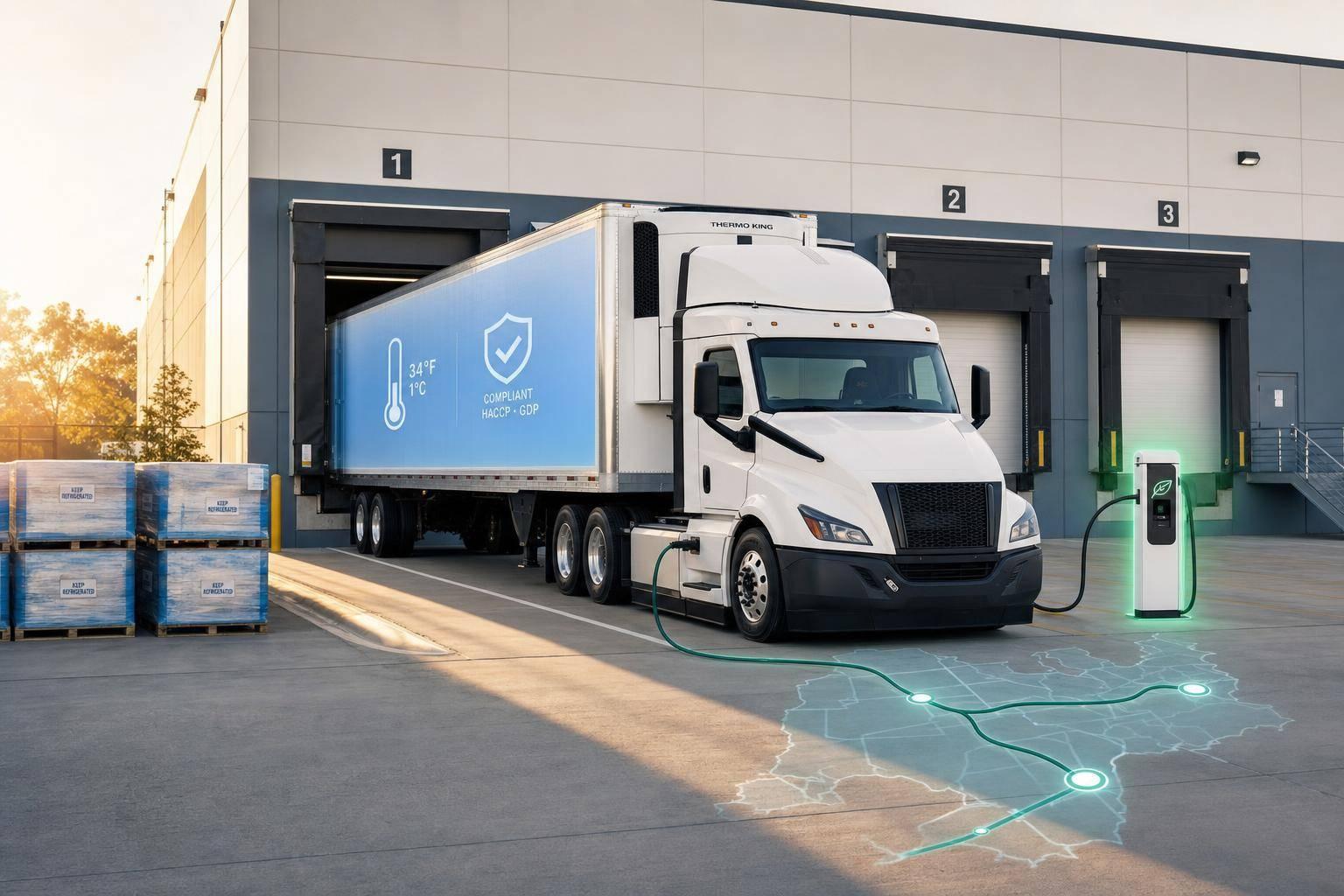
Most cold-chain failures happen close to the customer, not on the highway. If I were building a temperature-controlled fleet for a 3PL network, I’d start with four things: the temperature band, the delivery window, the route shape, and the facility setup.
Here’s the short version:
- Chilled food must stay at or below 41°F
- 63% of temperature excursions happen in last-mile delivery
- Vehicle choice should follow route density, stop count, and node location
- Pre-cooling, cold staging, and dock control matter as much as the truck
- EV reefers can lose 20% to 40% of battery capacity to refrigeration load
- FSMA recordkeeping must cover temperature, cleaning, and corrective actions
If I had to sum up the whole guide in one line, it would be this: a cold fleet works when vehicles, docks, charging, sensors, SOPs, and routing rules all match the product risk.
What that means in practice:
- Use small reefer vans or e-vans for dense city routes
- Use 12–16 ft refrigerated trucks for many suburban runs
- Use straight trucks or reefer trailers for longer regional lanes
- Use modular cold inserts when cold orders are lower volume
- Set up cold staging near storage and pre-cool before loading
- Use routing tools that block trips that break dwell-time or temperature rules
I’d treat this as a network design job, not just a vehicle purchase. That shift is the whole point of the article.
Last-mile logistics: the cold chain challenge
sbb-itb-eafa320
Temperature-Controlled Fleet Requirements for High-Growth E-Commerce
U.S. online grocery delivery keeps growing, so fleet specs need to match the route, the product, and the service promise before you buy vehicles.
Match Product Risk, Delivery Promise, and Temperature Band
The temperature band sets the floor for both vehicle specs and packaging. If you get that part wrong, everything else gets harder.
Frozen products usually need active refrigeration plus strong insulation to stay around -10°F to 0°F. The cost for proper packaging and equipment usually runs $15 to $25 per order. Refrigerated fresh food falls in the 34°F to 41°F range, with gel packs and phase-change panels adding about $8 to $15 per order. Ambient-controlled products, such as some cosmetics, supplements, or room-temperature pharmaceuticals, still need protection from heat swings, but they allow more flexibility. Packaging support there usually costs $2 to $5 per order.
After the temperature band is set, dwell time becomes the next limit. Excursion limits and dwell times change by product category. A chilled food item, for example, may handle a short spike to 45°F for no more than two hours before safety is at risk. Some pharmaceuticals have very tight excursion windows, which means route time has to stay inside tested dwell limits. In plain terms, this turns into a routing rule: total time from pack-out to final delivery can't go past the allowed dwell time, even when traffic gets ugly or a delivery has to be tried again.
Regional weather matters too. Summer heat cuts dwell time in the South and Southwest. Winter cold can freeze sensitive goods in the Midwest and Northeast. A plan that works in Atlanta in April may fall apart in Phoenix in July.
Map Route Length, Stop Density, and Node Location Before Buying Vehicles
Route density is the strongest cost lever in last-mile fleet operations. That’s why it makes sense to map order volume by ZIP code and model daily stops and route length before choosing vehicles. The route profile should drive the fleet mix, not the other way around.
In dense urban areas, high stop counts tend to favor smaller refrigerated vans. They’re easier to move through traffic, easier to park, and better suited for making lots of deliveries per hour. But there’s a catch: frequent door openings add thermal load. Vehicles handling 20 or more stops need insulation and refrigeration systems that can deal with repeated door cycles.
Suburban routes usually look different. With moderate density and longer gaps between stops, medium-sized trucks with larger payloads and multi-temperature compartments often make more sense. Regional routes that cover lower-density areas or connect multiple nodes usually call for larger straight trucks with strong multi-zone refrigeration and enough range to finish the route without putting temperature control at risk.
Node placement matters just as much as vehicle specs. Run route simulations with actual order data, drive times, and loading windows to size the fleet. Then use those inputs to match vehicle types to urban, suburban, and regional lanes.
Fleet Mix Design for Alternative Temperature-Controlled Vehicles
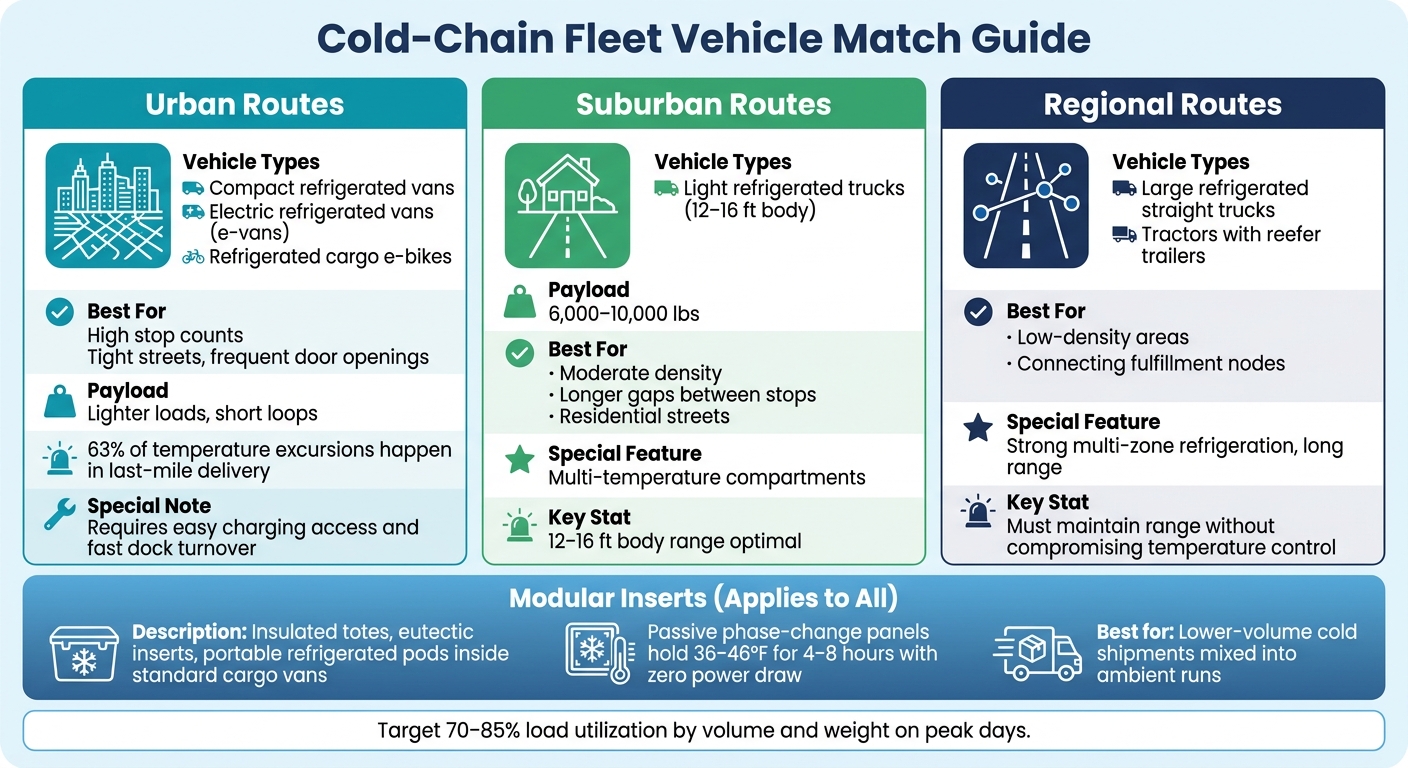
Cold-Chain Fleet Vehicle Match Guide: Urban vs. Suburban vs. Regional Routes
Once your lane profiles are mapped out, the next step is simple: match each route type to the right vehicle. The goal isn't to force one vehicle across the whole network. It's to give each node the vehicle class that fits its mix of lanes.
Choose the Right Vehicle Type for Urban, Suburban, and Regional Delivery
Urban routes usually work best with compact refrigerated vans and electric refrigerated vans. In the densest city areas, refrigerated cargo e-bikes are starting to make sense too. Modern refrigerated cargo e-bikes can carry frozen and chilled products in dual zones. That said, these short city routes only work well when charging is easy to access and dock turnover is fast.
Suburban routes often need light refrigerated trucks in the 12–16 ft body range. That size gives you about 6,000–10,000 lbs of payload, while still being easy enough to handle on residential streets and frequent stop runs. For regional lanes that connect fulfillment nodes to outlying areas, the better fit is usually larger refrigerated straight trucks or tractors with reefer trailers.
There’s also a useful middle option: modular inserts. These can include insulated totes, eutectic inserts, or portable refrigerated pods. Put them inside a standard cargo van, and you get on-demand temperature control without paying for a full reefer body. Passive setups that use phase-change panels can hold 36–46°F for 4–8 hours with no power draw at all. That can be a smart fit for lower-volume cold shipments mixed into larger ambient runs.
Balance Payload, Refrigeration Load, and Vehicle Range
Refrigeration takes a bite out of both payload and range. For electric refrigerated vans, the refrigeration unit can consume 20% to 40% of battery capacity on a tough route, which cuts into how far the van can go before it needs charging. And summer makes the problem worse. A route that looks fine in mild weather can come up short when the reefer is working hard all day.
Door openings make things harder. Every time a driver opens the door, warm air rushes in and the system has to pull temperature back down. If the vehicle also has multi-temperature compartments, energy use goes up again, along with mechanical complexity. Mixed loads sound efficient on paper, but they can be rough on the equipment.
A mixed fleet is usually the cleanest answer:
- E-vans for short urban loops
- Cargo bikes for dense urban cores
- Diesel trucks for longer suburban and regional lanes
- Modular inserts for occasional cold loads
Aim for 70% to 85% load utilization by both volume and weight on peak days. That target helps shape the dock setup, charging plan, and pre-cooling schedule.
Warehouse, Charging, and Infrastructure Support for Cold Vehicles
Set Up Cold Staging, Pre-Cooling, and Fast Turnaround at the Dock
Getting the vehicle mix right is only half the job. The facility behind the fleet is what decides whether temperature control holds from storage to delivery.
The dock is the main excursion risk. Open dock staging leaves product exposed to ambient temperature swings, and that exposure adds up fast. The Global Cold Chain Alliance calls out dock staging as a weak point because dock temperatures are not steady enough to protect chilled or frozen goods. So dock design needs to be an early decision, not something handled at the end.
Cold staging zones should sit right next to temperature-controlled storage. For refrigerated products, keep the staging area between 35°F and 46°F. For frozen goods, keep it between 0°F and 10°F. Enclosed bays, insulated dock vestibules, and high-speed doors help cut down warm air moving in during loading.
FDA guidance and the FSMA Sanitary Transportation rule require you to verify that a mechanically refrigerated compartment is properly prepared before any product is loaded, including pre-cooling when needed. In plain terms: pre-cool to set point before loading. Run the refrigeration unit long enough to reach set point, then confirm that temperature before loading starts. If the compartment has not reached set point, the SOP should block loading until it does, and any exception should be documented.
After the compartment reaches set point, the next control point is verification. Put sensors at multiple spots - front, middle, rear, and near the doors - so you can spot temperature gradients and hot spots. Automated alerts that trigger when temperatures drift more than 2–3°F from target for longer than 10–15 minutes can catch excursions in minutes instead of hours.
Plan Charging and Power Around Route Cycles and Refrigeration Demand
The same facility that protects product temperature also needs to support vehicle power. Charging design and refrigeration design have to be planned together. A common and expensive mistake is sizing electrical service for EV charging first, then trying to add shore power for reefer units later.
Use Level 2 AC charging for overnight depot dwell. It can bring most vehicles from a low state of charge to full during a standard overnight window. Save DC fast charging for short turnarounds and midday top-offs. Put it on routes that actually need it.
For electric refrigerated vehicles, shore power at the warehouse keeps the compartment cold during dwell without pulling from the traction battery. That helps preserve range and cut operating costs. Use shore power when dwell time is long enough to justify the cost.
Load management software can balance charging rates against total site demand, including HVAC and refrigeration load. That lets you fit more chargers into existing electrical capacity without triggering expensive demand spikes or forcing a full service upgrade. Vehicles with the earliest departure times should get priority. Vehicles with longer dwell windows can charge at lower rates. Feed charging and temperature logs into routing and compliance systems. Those records then support both routing decisions and compliance tracking.
Compliance, Routing Software, and Service Models for Multi-Node Fulfillment
Build SOPs Around FSMA, FDA Expectations, and Temperature Data Logging
Once your dock setup and charging equipment are ready, documentation becomes the next layer of control. Under the FSMA Sanitary Transportation rule, shippers, loaders, carriers, and receivers all share responsibility when they handle food that needs temperature control. So your SOPs can't stop at the driver. They need to cover the full handoff chain from start to finish.
At a minimum, your SOPs should spell out three things:
- Written temperature specs for each lane or SKU
- In-transit monitoring
- Recordkeeping for temperature, cleaning, and corrective actions
FSMA also requires carriers to keep temperature and other related records for at least 12 months. In plain terms, your logging system can't rely on one average trip temperature and call it done. It should record vehicle ID, route ID, timestamps, stop events, and the actual temperature readings throughout the trip.
Healthcare and pharma freight come with a higher bar. WHO GDP guidance says temperature monitoring records must be kept for the product's shelf life plus one year. It also says sensors need to be accurate to ±0.5°C and calibrated at least once a year against a traceable standard. If your network handles both food and pharma, it's smart to build around the stricter rule. That makes audits simpler and helps avoid trouble when freight types overlap.
Exception handling should be part of every SOP, not something people figure out on the fly. If there's a temperature excursion, the document should state what happens next: quarantine, reroute, return, or disposal. It should also name who gets notified and how fast that notice needs to happen. And once the SOP sets the temperature rule, routing software should block any route that can't meet it.
Use Routing Software and Visibility Tools to Run a Multi-Node Cold Network
Cold-chain routing software has to do more than cut miles. It should enforce temperature rules at the planning stage by applying constraints such as maximum transit time by lane, delivery windows, vehicle refrigeration capacity, and timing between node transfers. If a refrigerated SKU would miss its transit-time limit, the system should catch that before dispatch, not after the truck is already rolling.
Real-time visibility tools should bring live temperature telemetry, GPS location, and exception alerts into one dashboard across the network. The goal isn't just to react after a breach. You want alerts before the temperature band is crossed, because that's what gives the team time to step in before product is lost.
Your service model should shape route design, transfer timing, and vehicle mix. Hub-and-spoke can work well when inventory is consolidated at a central cold node and final-mile routes stay short. But that model depends on tight hub transfer timing and tends to fit networks where node placement already supports lower-density regional lanes. Micro-fulfillment is a better match for dense, time-sensitive demand because inventory sits closer to the customer. The tradeoff is more small replenishment moves, which means more moving parts to track, especially on high stop-count urban routes. Pool distribution can cut partially loaded refrigerated miles when several shippers share capacity, but it only works if carton-level traceability is in place and service-level rules are clear enough to prevent compliance issues across mixed freight.
For a 3PL running several facilities, the routing platform should connect every stop and every trip to temperature proof: sensor readings, driver confirmations, and delivery timestamps. That gives planners a clean way to show that routes stayed within policy.
Conclusion: Connect Vehicles, Facilities, and Software for a Reliable Cold Fleet
A cold fleet works only when vehicles, facilities, software, and compliance function as one system. Build the fleet mix around node type and lane profile. Back it with the right dock setup and charging plan. Write SOPs that meet FSMA and, when needed, WHO GDP standards. Then use routing and visibility tools to keep service levels in line as volume grows.
When temperature control, data logging, and route execution are designed together, handoffs are much less likely to break down. When each piece is managed on its own, those gaps are where audits fail and product gets lost.
FAQs
How do I choose the right reefer vehicle for each route?
Match each vehicle to the job. Battery electric vehicles make sense for local or last-mile routes. Hybrids are a good fit for regional runs. And for long-haul trips, biofuel options or newer hydrogen fuel cell vehicles tend to line up better.
It also helps to review transportation data on fuel use and vehicle performance. Check that the reefer unit can handle the usual 10% to 25% fuel penalty. Then use routing software to cut miles and improve fleet efficiency.
When do modular cold inserts make more sense than full reefer trucks?
Modular cold inserts often make more sense when you need temperature control for smaller shipments, or when you're using standard delivery vehicles for last-mile or urban routes.
They fit especially well in mixed-load setups, where a dedicated reefer unit can be overkill. Instead of cooling the whole vehicle, inserts help keep each shipment at the right temperature inside the equipment you already use. That means better use of vehicle space and fewer fuel costs than old-school refrigeration units.
What temperature records do I need to keep for compliance?
Keep complete, tamper-evident electronic records that show the cold chain stayed intact and support FDA 21 CFR Part 11, FSMA 204, and ALCOA+ requirements.
Your records should include continuous temperature readings every 15 to 30 minutes, NIST-traceable sensor calibration certificates, lot codes, and key event records. The system should also log any changes with unique electronic signatures.
If there are unexplained data gaps, auditors may see that as a sign that monitoring wasn’t done the way it should have been.
Related Blog Posts
Related Articles
Demand-Driven Replenishment for Multi-Node 3PL

3PL Models Compared for Reverse Logistics Carbon