Ultimate Guide to On-Time Delivery Metrics
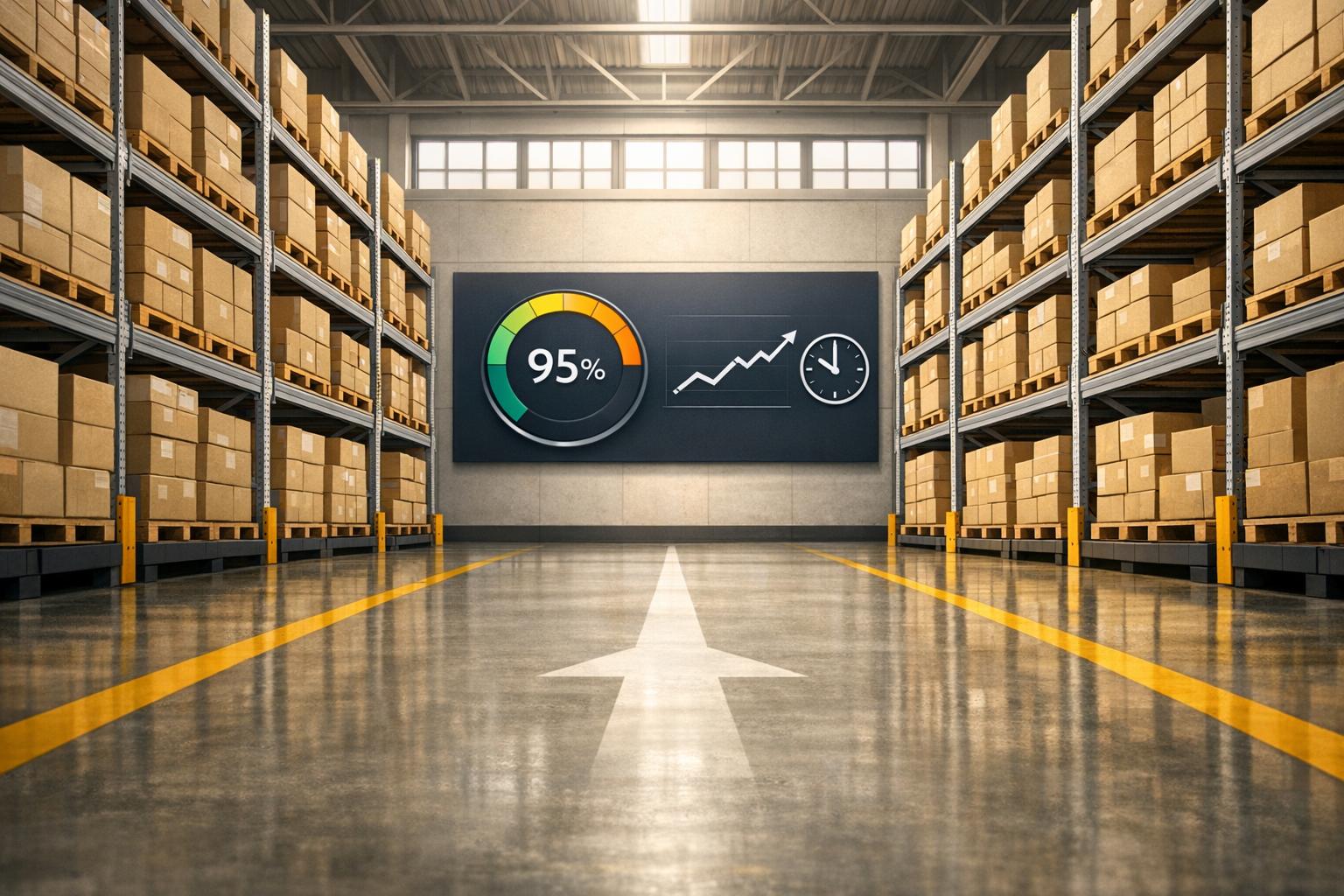
On-time delivery (OTD) measures the percentage of orders delivered within the promised timeframe. It’s critical for customer satisfaction and business success. Late deliveries can lead to lost customers, higher costs, and damaged reputations. Companies with OTD rates below 90% risk losing 15% of their customers annually.
To improve OTD, focus on:
- Tracking key metrics: OTD, OTIF (On-Time In-Full), and Perfect Order Rate.
- Understanding root causes: Internal delays, external disruptions, and customer-side issues.
- Enhancing processes: Improve demand forecasting, speed up order processing, and use real-time tracking.
Reliable logistics partners like JIT Transportation can help businesses meet delivery commitments and reduce delays.
OTD isn’t just a metric - it reflects how well a company fulfills its promises to customers. Prioritizing it leads to better performance, stronger relationships, and long-term growth.
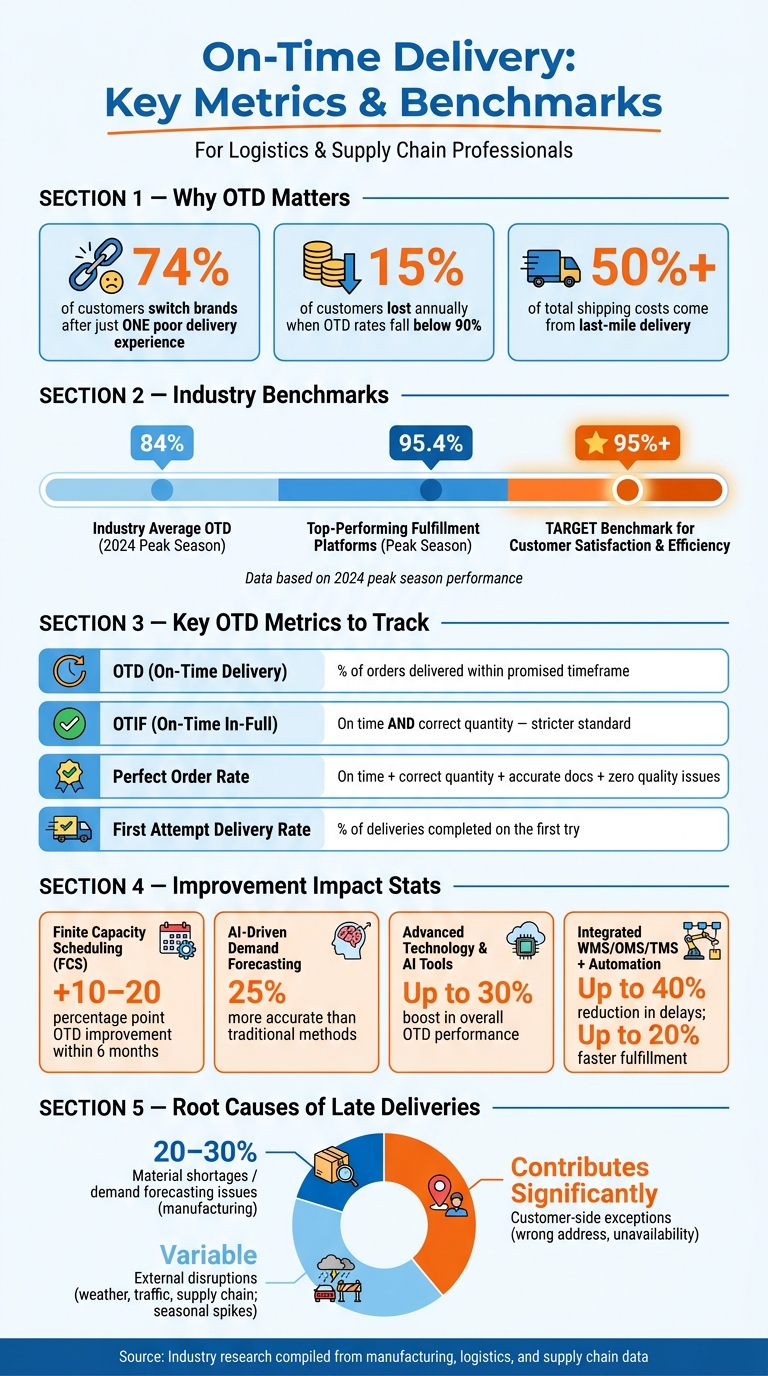
On-Time Delivery Metrics: Key Stats & Benchmarks
Key On-Time Delivery Metrics and How to Calculate Them
Core Metrics to Track
While On-Time Delivery (OTD) is the cornerstone metric, tracking additional data points provides a more complete picture of performance. The specific metrics you focus on will depend on your industry and what your customers expect.
One widely used metric is On-Time In-Full (OTIF), especially in retail and consumer goods. OTIF demands that deliveries not only arrive on time but also meet the exact quantity ordered. This makes it more rigorous than OTD. For industries like pharmaceuticals or aerospace, the bar is set even higher with the Perfect Order Rate. This metric requires flawless execution: on-time delivery, correct quantities, accurate documentation, and zero quality issues.
Other valuable metrics include:
- Average Days Late: This measures the severity of delays rather than just their occurrence.
- First Attempt Delivery Rate: Tracks the percentage of deliveries successfully completed on the first try. This is particularly important for last-mile logistics, where failed attempts can quietly inflate costs.
"OTD is the single most important external performance metric a manufacturing plant has, because it is the one the customer actually experiences. Everything else - OEE, schedule adherence, first-pass yield, labor productivity - is internal plumbing." - Christian Fieg, MES Expert
Standard Calculation Methods
Once you’ve identified the key metrics, it’s critical to calculate them correctly.
The basic formula for OTD is:
OTD (%) = (Number of On-Time Deliveries ÷ Total Deliveries) × 100
For instance, if you successfully delivered 950 orders on time out of 1,000, your OTD rate would be 95%. However, the accuracy of this calculation hinges on two factors: the definition of the agreed date and the delivered timestamp.
When setting the agreed date, you have three options: the customer's original requested date, your confirmed promise date, or the most recently revised date. Measuring against the original requested date often reveals the most about your actual performance. As the User Solutions Team points out: "Measuring against revised dates masks the real problem - if you push a delivery date out twice and then ship on the third date, that is not on-time delivery, that is on-time to a renegotiated commitment."
For the delivery timestamp, the ideal reference is the customer's goods receipt - the moment their system confirms the order has arrived. Using your internal "goods issue" date (when it leaves your warehouse) can inflate your performance by ignoring transit time.
Finally, it’s important to account for situations that can skew these calculations.
How to Handle Edge Cases
Certain scenarios can complicate OTD tracking if clear guidelines aren’t established.
Under OTIF, partial shipments automatically fail the "in-full" requirement. For standard OTD, you’ll need to decide whether to measure based on the first partial delivery or wait until the entire order is fulfilled.
Early deliveries are another tricky area. While early arrivals might seem like a win in most consumer-facing industries, they can cause significant disruptions in Just-In-Time systems, such as those in automotive supply chains. In these cases, early deliveries are often penalized as harshly as late ones. For example, Johnson Controls faced this issue when supplying headliners to a German premium OEM. Their internal OTD score, based on revised dates, was 99.6%, but the OEM’s stricter scorecard - tied to original requested dates and a tight ±15-minute delivery window - showed only 98.4%. Aligning their metrics with the OEM’s criteria significantly improved their results.
Finally, customer-canceled or customer-held orders should be excluded from your calculations entirely. Including them unfairly penalizes your team for delays that were beyond their control, distorting your overall performance rate.
sbb-itb-eafa320
On-Time Delivery and Fulfillment Rates_training
Common Causes of Late Deliveries
Understanding the reasons behind late deliveries is just as important as tracking them. Most delays can be grouped into three main categories: issues within your own operations, external disruptions beyond your control, and exceptions caused by customers. Let’s break down each source of delay to see how they contribute to late shipments.
Internal Operational Issues
Delays that happen before shipments even leave your facility are often preventable. One of the biggest culprits is inaccurate demand forecasting. When inventory levels don’t match actual stock, orders are placed for items that aren’t available, creating unavoidable delays. In fact, material shortages alone account for 20–30% of late deliveries in manufacturing.
Another common but less obvious issue is the "acceptance gap." Joel Malmquist, VP of Customer Experience at G10 Fulfillment, explains it this way:
"The reason I don't say ship is because sometimes it will be marked as completed, but the carrier doesn't actually pick it up right away... you will blame the carrier for delays that started on your dock."
Without tracking both when the warehouse completes an order and when the carrier picks it up, pinpointing the real cause of delays becomes nearly impossible.
External Disruptions
Weather, traffic, and supply chain instability are challenges that no logistics team can completely avoid. What sets top-performing operations apart is their ability to anticipate and adapt to these disruptions. For example, during the 2024 peak season, the industry-wide on-time delivery rate dropped to 84%, largely due to seasonal demand and external pressures piling up.
"Static ETAs create false confidence." - BTX Global Logistics
Relying on fixed delivery estimates can backfire when conditions change. Instead, using predictive ETA models and maintaining a diverse carrier network allows teams to reroute shipments or make adjustments before delays escalate. These external challenges highlight the importance of flexible tracking systems and real-time updates.
Customer-Side Exceptions
Some problems start with the customer. Incorrect addresses, recipients not being available, gated communities, or unclear delivery instructions can all lead to failed delivery attempts. These issues don’t just waste time - they also drive up costs, especially during the last mile, which makes up more than 50% of total shipping expenses.
What makes these exceptions particularly tricky is how customers perceive them. Most people don’t separate the carrier’s performance from the brand’s reputation. Kimberley Hughes, Content Marketing Lead at Starshipit, explains:
"Broken promises tend to frustrate customers more than a small difference in speed. An order promised in two days that arrives in three usually feels worse than one promised in three days that arrives on time."
Simple steps like validating addresses during checkout and sending proactive notifications via SMS or email can significantly reduce these issues before they even reach the delivery driver. These examples show why customer-side challenges require thoughtful strategies to minimize their impact.
How to Improve On-Time Delivery Performance
Understanding the root causes of delays is just the start. The real challenge lies in creating systems that prevent them. Focusing on these three areas can make a significant difference in boosting your on-time delivery rates.
Improving Demand Forecasting
Delivery delays often stem from poor inventory planning. The solution involves ditching outdated assumptions and relying on real-time data instead.
Finite capacity scheduling (FCS) is a game-changer. By considering actual machine availability, labor constraints, and material timing, FCS can improve on-time delivery rates by 10–20 percentage points within six months. Pair this with AI-driven demand forecasting, which predicts shortages 25% more accurately than traditional methods, and you’ll have a stronger foundation for meeting delivery commitments.
A critical shift in approach: your sales team should base delivery quotes on the actual workload of your shop floor, not theoretical lead times. Integrating live scheduling data into the quoting process ensures that promises align with what’s realistically achievable.
Speeding Up Order Processing
Delays in fulfillment often result from inefficient workflows rather than limited capacity. Surprisingly, actual processing time makes up just 10–15% of total lead time - the rest is lost to waiting, queuing, and unnecessary steps. This is where the biggest opportunities for improvement lie.
Connecting your Warehouse Management System (WMS), Order Management System (OMS), and Transport Management System (TMS) into a unified data flow eliminates manual handoffs that slow things down. Techniques like zone picking, wave planning, and sort-to-light automation can cut fulfillment time by up to 20%. Standardized processes and better technology can reduce delays by as much as 40%.
One often-overlooked strategy: reserve inventory as soon as a purchase order is acknowledged. Without this step, stock intended for one order could be used elsewhere before it’s shipped.
Once your operations are streamlined, real-time tracking can further enhance efficiency by keeping everything on schedule during transit.
Using Real-Time Tracking
Real-time tracking complements faster order processing by providing instant visibility to address delays before they escalate. GPS telematics can generate ETAs accurate to within 15 minutes, making proactive exception management possible.
With exception-based monitoring, alerts are triggered only when shipments deviate from their planned route. This allows your team to focus on resolving real issues. Automated notifications via SMS or email also keep customers informed, reducing the volume of “where’s my order?” inquiries.
"On-time delivery is a supply chain's most visible - and most consequential - output." - Kris Gösser, CMO, Shipium
When implemented fully, advanced technology and AI tools can boost overall on-time delivery performance by up to 30%. This is especially critical for manufacturers with on-time delivery rates below 90%, as they risk losing an average of 15% of their customer base annually.
How JIT Transportation Supports On-Time Delivery

Having strong internal processes is great, but if your logistics partner isn't reliable, on-time shipments can become a headache. That's where JIT Transportation steps in. This US-based third-party logistics (3PL) provider has built its operations around the idea that on-time delivery isn't just luck - it's the result of smart planning, advanced technology, and the right infrastructure.
Custom Logistics Solutions
JIT Transportation offers custom solutions designed to tackle common internal delays head-on. Their 3PL services are tailored to fit the specific transportation, distribution, and fulfillment needs of each business. One major cause of missed delivery windows is outdated, rigid routing systems. Instead of relying on fixed routes, JIT employs dynamic routing frameworks that adjust in real time to factors like carrier backlogs, regional transit delays, and capacity issues. This flexibility ensures shipments stay on track, even when disruptions occur.
To further minimize delays, JIT keeps a close eye on two critical points: when warehouses complete orders and when carriers accept them. By managing this "acceptance gap", they reduce downtime during the handoff process.
Value-Added Services
JIT goes beyond basic logistics with value-added services like pick & pack, kitting & assembly, testing, and white glove handling. These services ensure that orders meet the OTIF (On-Time, In-Full) standard, which is crucial for avoiding penalties. For instance, Walmart charges a 3% penalty on the cost of goods sold for every OTIF failure. JIT prevents these costly mistakes by verifying orders before they leave the warehouse, ensuring shipments are complete and accurate.
For high-value or sensitive items like medical equipment, electronics, or fragile goods, JIT offers white glove handling. This service provides meticulous scheduling and careful handling to meet the tight delivery windows and specific requirements of demanding customers or retailers.
Nationwide Network and Scalability
JIT's nationwide carrier network is designed for consistency, not just broad coverage. Instead of relying on a single carrier, JIT diversifies its carrier mix, allowing them to shift shipment volumes when localized slowdowns or capacity issues arise. This flexibility is particularly valuable during peak seasons. For example, in 2024, the average industry on-time delivery rate dropped to 84%, but businesses using advanced fulfillment platforms, like JIT, maintained rates as high as 95.4%.
JIT's scalable infrastructure grows alongside your business without compromising reliability. Features like ERP integration, real-time tracking, and exception-based monitoring help identify potential delays early, giving teams a chance to address issues before they impact customers.
Conclusion
On-time delivery is more than just a number on a dashboard - it’s a testament to how much your business prioritizes its customers. The statistics are hard to ignore: 74% of customers will switch brands after just one poor delivery experience, and companies with OTD rates below 90% see an average loss of 15% of their customer base annually. These figures aren’t just abstract data points; they represent real customers and real revenue slipping away.
"On-time delivery is not a metric you hope improves - it is a metric you engineer." - User Solutions Team, Manufacturing Software Experts
To stay ahead, tracking the right metrics is key. Whether it’s standard OTD, OTIF, or a composite delivery performance score, these tools give you the insight needed to identify and resolve issues before they affect your customers. The goal isn’t instant perfection - it’s about creating systems, routines, and partnerships that steadily push your performance toward that 95%+ benchmark, where both customer satisfaction and operational efficiency thrive.
This is where a logistics partner like JIT Transportation makes a difference. From dynamic routing and carrier diversification to OTIF-focused fulfillment and white-glove services, JIT helps bridge the gap between what you promise and what your customers receive - ensuring deliveries are on time, every time.
Companies that prioritize on-time delivery as a core part of their operations, rather than an afterthought, are the ones that earn customer loyalty and achieve sustainable growth. Start measuring, start improving, and ensure your supply chain partners share your commitment to excellence.
FAQs
What delivery date should I use to calculate OTD?
To figure out On-Time Delivery (OTD), base it on the date the customer actually receives the goods at their location - not the date the items leave your warehouse. Usually, this means the timestamp when the delivery reaches the customer's receiving dock. Make sure to clarify whether you're comparing the delivery date to the customer's original request date or your confirmed promise date. Also, consider any agreed-upon tolerance windows for early or late deliveries when calculating.
Should early deliveries count as on-time?
Whether an early delivery is considered "on-time" depends entirely on your service agreements and how your operations are structured. For some businesses, any delivery that arrives before the deadline is acceptable and counts as on-time. However, in industries relying on just-in-time systems, early deliveries can actually cause problems, disrupting workflows or creating storage issues.
To prevent misunderstandings, clearly define your acceptable delivery window in your contracts. This way, both parties know what to expect, and disputes can be minimized. It’s also a smart move to track early deliveries separately. Doing so gives you a clearer picture of your overall delivery performance and helps identify patterns or areas for improvement.
How can I improve OTD fast without adding more staff?
Boosting on-time delivery starts with improving efficiency and automating key processes. For example, route optimization can help reduce travel times, while techniques like batch picking or zone picking streamline warehouse operations. Setting realistic delivery windows based on accurate data also ensures smoother scheduling.
Automation plays a big role too. Automated customer notifications can minimize missed deliveries by keeping recipients informed, and AI-driven demand forecasting helps avoid bottlenecks by predicting supply needs more accurately.
If you're looking for scalable support, JIT Transportation offers 3PL solutions designed to handle advanced logistics and fulfillment. This lets businesses grow without the need to expand their workforce.
Related Blog Posts
Related Articles

Demand-Driven Replenishment for Multi-Node 3PL

3PL Models Compared for Reverse Logistics Carbon