
Understanding Rules of Origin in Trade Agreements
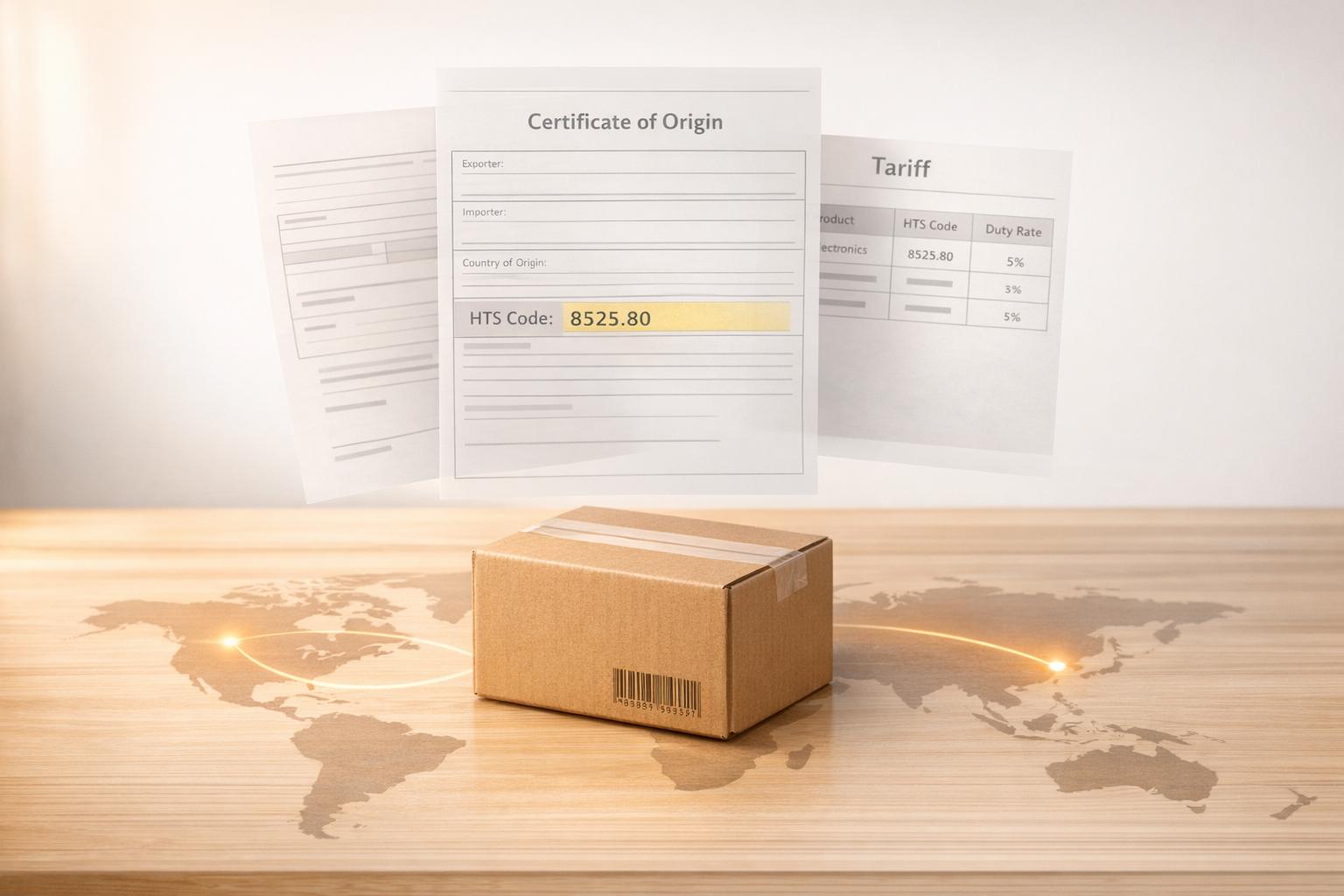
Rules of Origin (ROO) determine the country where a product is considered to originate. This affects tariffs, trade preferences, and compliance with trade agreements like the USMCA. Here's what you need to know:
-
Two Types of ROO:
- Preferential ROO: Linked to trade agreements offering reduced tariffs.
- Non-preferential ROO: Apply universally for customs, anti-dumping, and labeling.
-
Key Origin Methods:
- Wholly Obtained: Products entirely made in one country.
- Tariff Shift: Materials undergo transformation changing their classification.
- Regional Value Content (RVC): A set percentage of the product's value must come from within an agreement region.
-
For E-commerce Brands:
Accurate origin claims reduce costs and avoid penalties. Importers must verify product origins using HTS codes, supplier declarations, and bills of materials. -
Documentation Tips:
- Use self-certifications for trade agreements like USMCA.
- Retain records for at least 5 years.
- Monitor supply chain changes to maintain compliance.
Mistakes in classification, origin claims, or documentation can lead to penalties of up to four times unpaid duties. Staying informed and organized is key to avoiding costly errors.
How Trade Agreements Determine Origin
Key Origin Qualification Methods
Trade agreements rely on a variety of tests to determine the origin of goods, with the specific method depending on the product and its manufacturing process.
The most straightforward approach applies to goods that are entirely grown, harvested, or extracted within the territory of a Free Trade Agreement (FTA) or are made exclusively from qualifying materials.
For products made using materials from multiple countries, the tariff shift method comes into play. This method requires that non-originating materials undergo a substantial transformation, changing their Harmonized System (HS) classification. For instance, raw wood classified under one chapter might be processed into furniture classified under another chapter, thereby meeting the tariff shift requirement.
In cases where a tariff shift alone isn’t enough, the Regional Value Content (RVC) test is used. This test ensures a minimum percentage of the product's value originates within the FTA region. A notable example is the USMCA, which requires passenger vehicles to meet a 75% RVC threshold. The RVC can be calculated using methods like transaction value or net cost.
Some agreements also impose technical rules, specifying that certain manufacturing or chemical processes must occur within the FTA region to qualify the product as originating.
How HS/HTS Classifications Tie Into Origin Rules
After applying origin tests, accurate HS/HTS classification becomes critical to determine the correct rule of origin. As noted by the International Trade Administration:
"Rules of origin (ROOs) are listed in FTA agreements by HS product classification numbers."
Each FTA includes an annex that pairs specific origin rules with individual HS or HTS codes. This means the applicable rule depends entirely on the product's classification. Even products that seem similar may face different origin requirements if they fall under separate HS/HTS headings. Misclassification can lead to missed tariff benefits or invalid claims for preferential treatment. For complex cases, U.S. Customs and Border Protection offers the option to request a binding advance ruling, providing a definitive classification before importation.
Origin Rules in Practice: A Working Example
Let’s put these rules into action with an example. Imagine a U.S. e-commerce brand importing assembled laptop bags from Mexico. While the bags are sewn in Mexico, the zippers come from China, and the fabric is sourced from Vietnam - both outside the FTA region. To qualify for USMCA preferential treatment, the brand must confirm that these non-originating materials undergo a qualifying tariff shift during production. If the transformation changes the bag’s tariff classification from its components, it qualifies. If not, the de minimis rule might apply, allowing non-originating materials to be disregarded if they account for less than 10% of the total value.
sbb-itb-eafa320
How to Identify and Apply Free Trade Agreement (FTA) Rules of Origin
How E-Commerce Brands Can Verify Product Origin
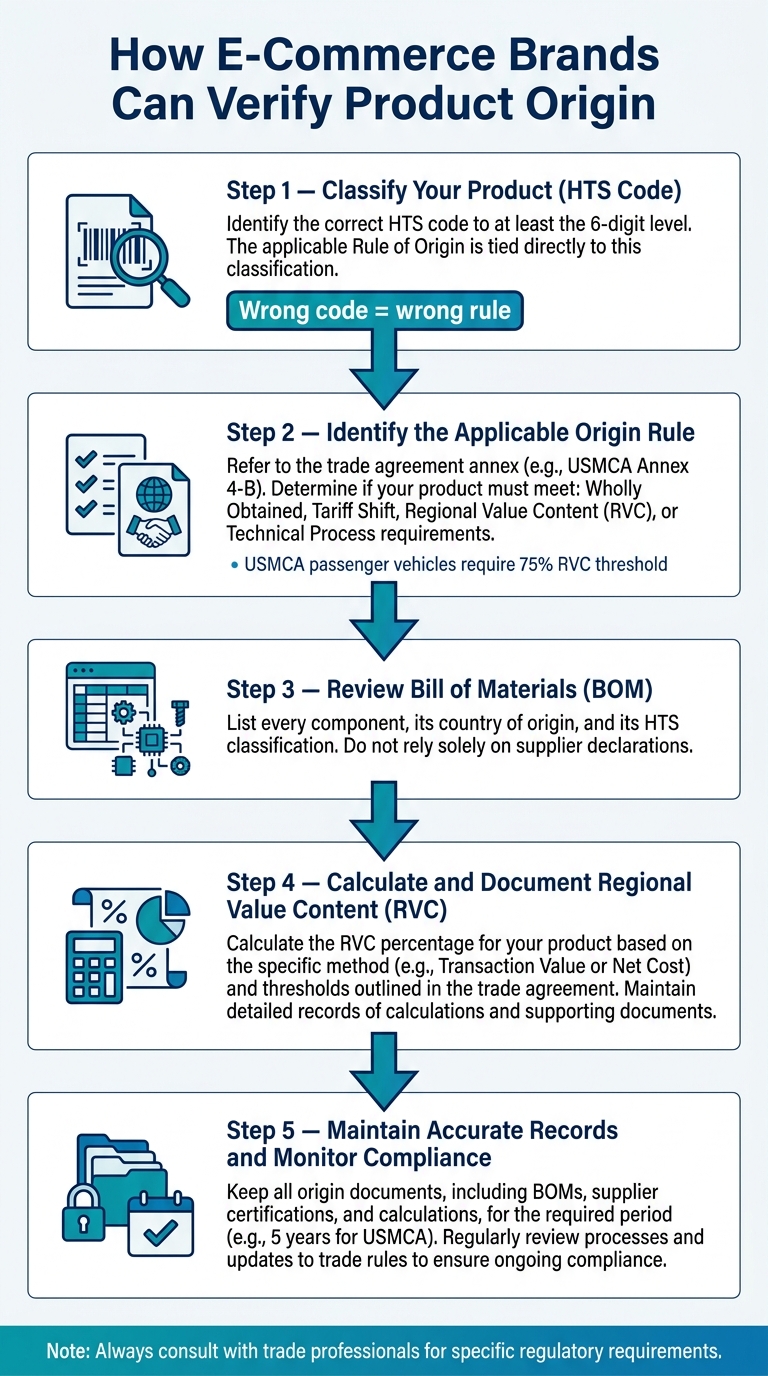
Rules of Origin Compliance: Step-by-Step Guide for E-Commerce Brands
For e-commerce businesses aiming to secure tariff advantages, verifying the origin of products is a critical step.
Confirming the Right Tariff Classification
Once you’ve determined the correct Harmonized Tariff Schedule (HTS) code for your product, the next step is confirming tariff details. The rules of origin are directly tied to the HTS classification, so using the wrong code means you’re working with the wrong rule.
Classify your product down to at least the six-digit level. Then, refer to the specific rule of origin outlined in the relevant trade agreement annex (like USMCA Annex 4-B). This rule will explain the requirements for your product to qualify, whether it’s a tariff shift, a Regional Value Content (RVC) threshold, or another condition. If your product includes components from multiple countries and classification seems unclear, you can request a binding advance ruling from U.S. Customs and Border Protection (CBP). This ensures your classification is locked in before goods arrive.
Tracking Bill of Materials and Supplier Declarations
Once you’ve identified the applicable rule, the next step is verifying that your product meets it. This involves reviewing your Bill of Materials (BOM), which lists every component, its country of origin, and its HTS classification. Relying solely on a supplier’s "Made in" claim isn’t sufficient.
"Importers are expected to exercise reasonable care, which may include understanding how the product is actually manufactured." - David Noah, President, Shipping Solutions
To back your claim, secure formal supplier certifications confirming the originating status of each material. These certifications are essential, especially if CBP audits your claim. For products shipped repeatedly, a blanket certification can cover up to 365 days, streamlining the process without compromising compliance. Keep in mind, negligence in origin declarations can result in penalties as high as four times the unpaid duties, making thorough documentation a worthwhile investment.
Reverifying Origin After Supply Chain Changes
Even after verifying and documenting origin, you need to monitor supply chain changes. A new supplier, a shift in production facilities, or a change in materials can disqualify a product that previously met origin rules.
If you’re using a blanket certification and a sourcing change occurs mid-period, the certification may no longer apply. In such cases, re-evaluation is crucial to avoid unexpected duty assessments. As Peacock Tariff Consulting explains:
"Blanket certifications must be reviewed and updated whenever material changes occur. Failing to do so can result in retroactive duty assessments on all shipments covered by the blanket period."
To stay compliant, implement a standard operating procedure (SOP) that flags any changes in suppliers, components, or production locations. Update your supply chain map, reanalyze the BOM, and recheck the tariff shift or RVC calculations. If there’s uncertainty with the new configuration, apply for a binding ruling before shipping begins. This proactive approach helps safeguard against compliance issues and potential penalties.
How to Document and Claim Tariff Benefits
Once you've verified the origin of your product, the next step is to ensure proper documentation and claim tariff benefits effectively. This is essential for avoiding delays or issues during the border clearance process.
Certificates of Origin and Supporting Records
For many free trade agreements (FTAs), including the USMCA, a government-issued certificate or a stamp from a Chamber of Commerce isn't mandatory. Instead, you can self-certify. This means the exporter, producer, or importer can prepare the declaration directly, provided they have enough knowledge about the product's origin.
Although no specific form is required, the declaration must include certain key details:
- Certifier identity and contact information: Specify whether the certifier is the importer, exporter, or producer.
- 6-digit HTS classification and product description: Include the Harmonized Tariff Schedule code and a clear description of the product.
- Origin criterion: Indicate how the product qualifies (e.g., Wholly Obtained, Tariff Shift, or RVC).
- Blanket period: If applicable, include a date range of up to 12 months.
- Authorized signature and date: Ensure the certification is signed and dated by an authorized individual.
For shipments valued under $2,500, a simple statement on the commercial invoice can suffice to qualify for FTA benefits. For larger shipments, you can simplify the process by using a blanket certification, which covers up to 365 days for identical goods, reducing repetitive paperwork.
"Certificates should not be provided just because someone asks. You should only provide a certificate if the product meets the FTA requirements." - Trade.gov
Recordkeeping Requirements
Submitting the right documents at the time of import is only part of the process. It's equally important to retain these records. Under USMCA guidelines, importers are required to keep all supporting documentation for at least 5 years from the date of importation. This includes:
- Certificates of origin
- Commercial invoices
- Bills of materials
- Sourcing records
- Any worksheets related to RVC calculations
Customs and Border Protection (CBP) typically allows just 30 days to respond to a verification audit request. To avoid last-minute scrambling, maintain a well-organized digital system for storing these records. It's important to note that the importer of record is legally responsible for the accuracy of all submitted documentation, even if a supplier provided the original declaration.
"The importer is responsible for exercising reasonable care concerning the accuracy of all documentation submitted to CBP." - Trade.gov
Next, confirm that your shipment's transit and routing comply with the trade agreement's requirements.
Additional Conditions for Claiming Tariff Benefits
Even with proper documentation and recordkeeping, there's another critical factor to consider: the direct shipment rule. To qualify for preferential tariff treatment, goods must typically move directly between FTA partner countries without entering the commerce of a non-party country.
If your shipment passes through a third country - for example, a consolidation hub outside the FTA zone - you'll need proof that the goods remained under customs control and weren't processed during transit. Acceptable documentation might include:
- Storage receipts
- Customs transit documents
- Official records confirming the goods didn't enter free circulation
It's also important to note that USMCA benefits don't override Section 232 tariffs on steel and aluminum. These tariffs apply regardless of origin certification. Being aware of such exceptions can help you avoid unexpected costs at the border.
Common Rules of Origin Mistakes and How to Avoid Them
Even the most diligent brands can lose out on tariff benefits due to avoidable mistakes. These errors typically fall into three categories: classification issues, documentation gaps, and supply chain missteps. Let’s break down these common pitfalls and how to steer clear of them.
Wrong HS Codes and Misinterpreted Product Rules
Using the wrong HTS code can lead to major losses in tariff benefits. Since many product-specific rules depend on a tariff shift, starting with an incorrect code makes it impossible to validate that shift. A review of 300,000 import declarations revealed that over 18% contained HS code errors, resulting in an estimated $7.2 billion annually in overpaid duties, penalties, and lost revenue.
Another common error is misunderstanding what qualifies as substantial transformation. Simple tasks like assembly, relabeling, or repackaging do not change a product's country of origin, even if the work is done in a Free Trade Agreement (FTA) partner country. Processing alone doesn’t guarantee compliance with origin rules.
"Misclassifying products with incorrect HS Codes can cost businesses upwards of 30% in unnecessary tariffs or lead to severe penalties and shipment delays." - DutyPilot
If classification errors are a recurring issue, it’s worth seeking a binding ruling to confirm compliance. This not only ensures accuracy but also provides a safeguard if the classification is later questioned. Pairing accurate coding with thorough documentation is essential for securing tariff benefits.
Supply Chain and Documentation Oversights
A certificate of origin isn’t enough if the supporting records are incomplete. Customs and Border Protection (CBP) often takes a forensic approach to verification, requiring importers to provide detailed records like bills of materials, production documents, and Regional Value Content (RVC) calculations - not just a signed certificate.
"Generic supplier certifications affirming 'product origin is Mexico' or similar statements provide insufficient substantiation." - Peacock Tariff Consulting
One frequent misstep is failing to update blanket certifications when supply chains change. For instance, if a supplier changes a component source or alters a manufacturing process, any existing certification may no longer be valid. Overlooking these updates can expose brands to retroactive duties. Under 19 U.S.C. 1592, penalties for negligence in origin claims can be up to four times the unpaid duties. Staying ahead of these issues by proactively addressing gaps is crucial to avoiding costly compliance problems.
How to Fix Compliance Issues
If a compliance error is identified, it’s important to act quickly. Brands have up to one year to claim retroactive refunds on duties. Early detection significantly improves the chances of a successful refund.
To maintain compliance, create a "verification-ready" folder that includes all essential documents - bills of lading, supplier invoices, manufacturing specs, and RVC worksheets. This ensures you can respond promptly to CBP’s typical 30-day audit window. Additionally, conducting annual reviews of top SKUs and blanket certifications can help identify discrepancies between records and actual supply chain practices.
"The difference between successful USMCA claims and denied claims typically lies in documentation completeness, supplier verification, and responsiveness to CBP inquiries rather than in the products' actual compliance with rules of origin." - Peacock Tariff Consulting
Key Takeaways for E-Commerce Brands
For e-commerce brands navigating tariff benefits, staying on top of compliance isn't optional - it’s essential. Missteps in origin compliance can hit hard, with penalties reaching up to four times the unpaid duties. Here’s how you can protect your business and keep costs in check:
Start with Accurate Classification
Every origin determination begins with the correct Harmonized Tariff Schedule (HTS) classification. Mistakes here can completely derail tariff shifts. If there’s any uncertainty, consider obtaining a Customs and Border Protection (CBP) binding ruling to ensure legal clarity.
Leverage Preferential Treatment
The USMCA offers significant cost-saving opportunities. Qualifying goods can avoid the hefty 25% IEEPA tariffs, and the agreement allows for up to 10% non-originating materials under the de minimis rule.
Keep Your Documentation in Order
Audits can be intense, with customs examining the entire production process. To prepare, maintain detailed records like supplier declarations, bills of materials, and Regional Value Content (RVC) worksheets for at least five years.
Stay Vigilant with Your Supply Chain
Supply chains evolve, and even a single new supplier can jeopardize compliance. Regularly review and reverify origin details whenever changes occur. Routine checks are your best bet for staying compliant over time.
FAQs
How do I know which rule of origin applies to my product?
To figure out the rule of origin for your product, start by identifying its Harmonized System (HS) code. Once you have this, look at the relevant chapter or annex of the applicable Free Trade Agreement (FTA) to find the specific requirements. If your product includes components from different countries, ensure it satisfies conditions like substantial transformation, regional value content, or tariff shift. For absolute clarity, you can request a binding advanced ruling from the customs authority in the destination country.
What documents do I need to prove USMCA origin if I’m audited?
To demonstrate USMCA origin during an audit, you'll need a valid certification of origin. This must include the nine required data elements outlined in Annex 5-A. The certification can be presented on a commercial invoice or another document.
In addition, it's essential to retain supporting records for at least five years from the import date. These records should include production documents, bills of material, supplier declarations, and cost files that confirm compliance with the rules of origin. Proper documentation ensures you're prepared if your compliance is ever questioned.
When should I recertify origin after a supplier or material change?
If you change your supplier, materials, or manufacturing process in any way that impacts eligibility, you need to recertify your product's origin right away. Origin qualification is tied to specific rules, such as tariff classification shifts, regional value content, or technical processing requirements. Even a small change could make your certification invalid. Be sure to reassess your product under the applicable trade agreement rules before issuing a new declaration.
Related Blog Posts
Related Articles

8 Ways 3PLs Handle Seasonal Workforce Swings

Marketplace API vs EDI for Fulfillment
